QUESTION IMAGE
Question
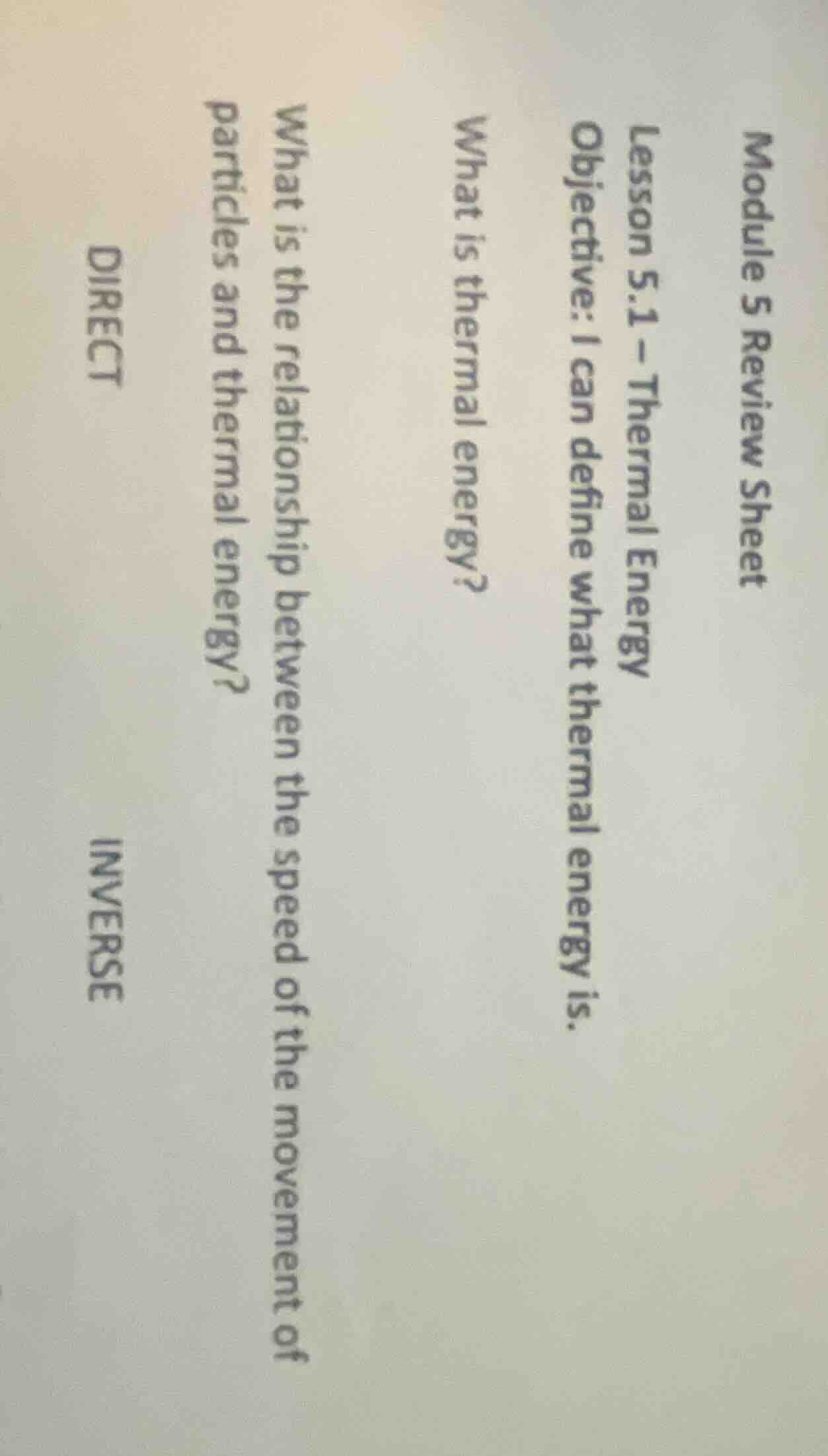
module 5 review sheet
lesson 5.1 – thermal energy
objective: i can define what thermal energy is.
what is thermal energy?
what is the relationship between the speed of the movement of particles and thermal energy?
direct
inverse
For "What is thermal energy?":
Thermal energy is the internal energy present in a system due to the kinetic energy of its particles (atoms, molecules, etc.). It's related to the temperature of the substance, as higher - temperature substances have particles with more kinetic energy (faster motion), and thus more thermal energy. It can be transferred as heat between objects of different temperatures.
The speed of particle movement (kinetic energy of particles) is directly related to thermal energy. Thermal energy is the sum of the kinetic energies of all the particles in a substance. As the average speed of the particles (e.g., atoms or molecules) in a substance increases, the total kinetic energy of the particles (and thus the thermal energy of the substance) increases. Conversely, if the average speed of the particles decreases, the thermal energy of the substance decreases. This relationship is also tied to temperature, as temperature is a measure of the average kinetic energy of the particles.

Snap & solve any problem in the app
Get step-by-step solutions on Sovi AI
Photo-based solutions with guided steps
Explore more problems and detailed explanations
Thermal energy is the internal energy of a system arising from the kinetic energy of its constituent particles (atoms, molecules, etc.). It is related to the temperature of the substance, with higher - temperature substances generally having more thermal energy due to the greater kinetic energy (faster motion) of their particles. It can be transferred as heat.