QUESTION IMAGE
Question
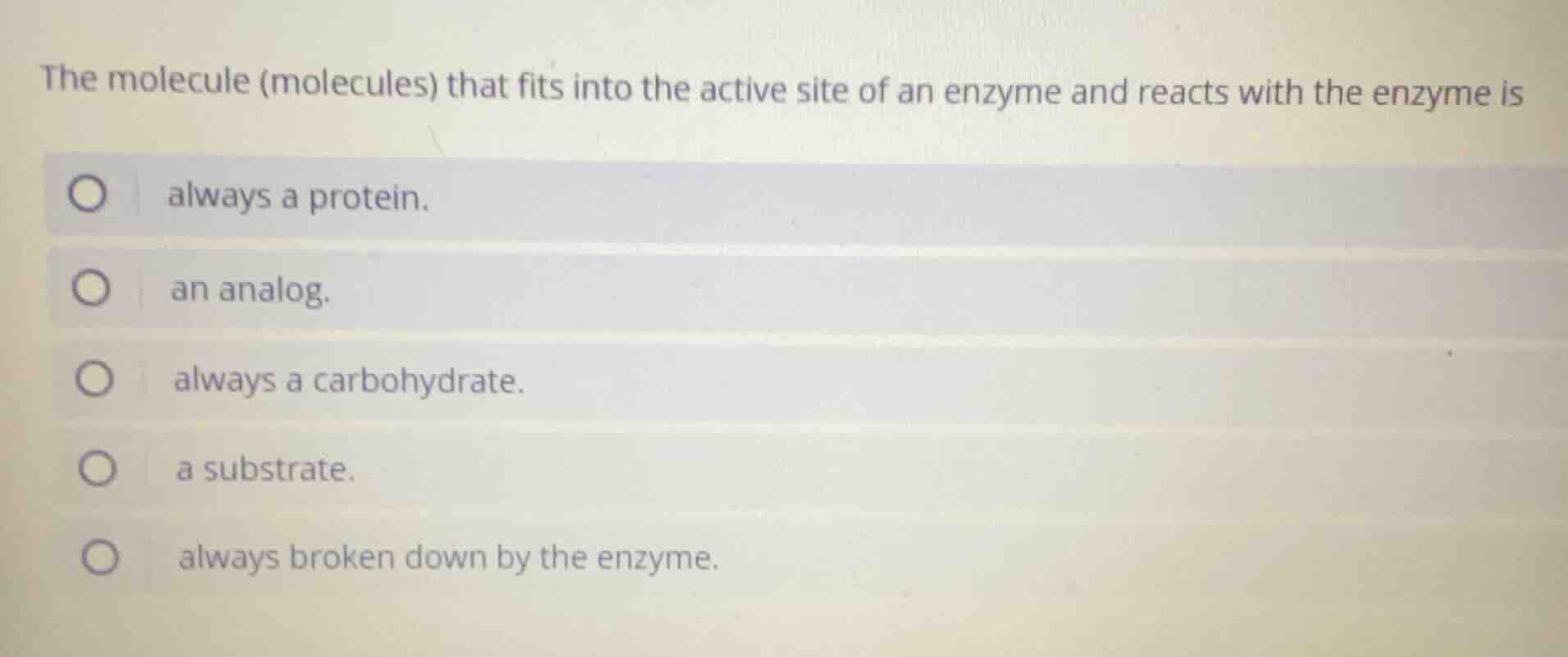
the molecule (molecules) that fits into the active site of an enzyme and reacts with the enzyme is
always a protein.
an analog.
always a carbohydrate.
a substrate.
always broken down by the enzyme.
Brief Explanations
- "always a protein": Enzymes are proteins, but the molecule reacting with them (substrate) isn't always a protein (e.g., lactose is a carbohydrate substrate). Eliminate.
- "an analog": Analogs are molecules similar to substrates that may inhibit enzymes, not the reacting molecule. Eliminate.
- "always a carbohydrate": Substrates can be proteins, lipids, etc. (e.g., protease acts on protein). Eliminate.
- "a substrate": By definition, a substrate is the molecule that binds to an enzyme’s active site and undergoes a reaction (can be broken down or combined, e.g., in synthesis reactions). Correct.
- "always broken down by the enzyme": Enzymes can also catalyze synthesis (e.g., DNA polymerase builds DNA), so substrates aren't always broken down. Eliminate.

Snap & solve any problem in the app
Get step-by-step solutions on Sovi AI
Photo-based solutions with guided steps
Explore more problems and detailed explanations
D. a substrate