QUESTION IMAGE
Question
monday
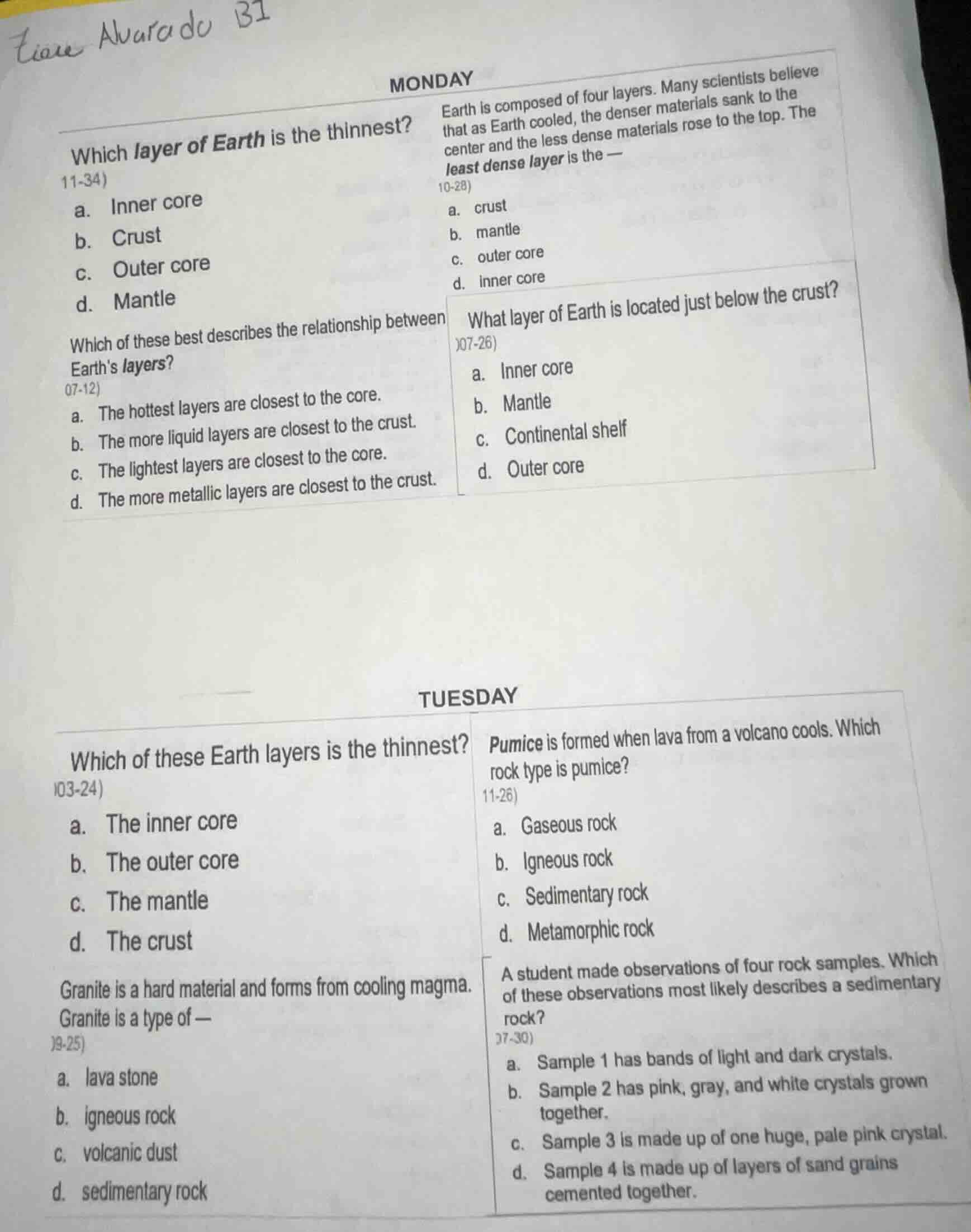
which layer of earth is the thinnest?
(11-34)
a. inner core
b. crust
c. outer core
d. mantle
which of these best describes the relationship between earths layers?
(07-12)
a. the hottest layers are closest to the core.
b. the more liquid layers are closest to the crust.
c. the lightest layers are closest to the core.
d. the more metallic layers are closest to the crust.
earth is composed of four layers. many scientists believe that as earth cooled, the denser materials sank to the center and the less dense materials rose to the top. the least dense layer is the —
(10-28)
a. crust
b. mantle
c. outer core
d. inner core
what layer of earth is located just below the crust?
(07-26)
a. inner core
b. mantle
c. continental shelf
d. outer core
tuesday
which of these earth layers is the thinnest?
(03-24)
a. the inner core
b. the outer core
c. the mantle
d. the crust
granite is a hard material and forms from cooling magma. granite is a type of —
(09-25)
a. lava stone
b. igneous rock
c. volcanic dust
d. sedimentary rock
pumice is formed when lava from a volcano cools. which rock type is pumice?
(11-26)
a. gaseous rock
b. igneous rock
c. sedimentary rock
d. metamorphic rock
a student made observations of four rock samples. which of these observations most likely describes a sedimentary rock?
(27-30)
a. sample 1 has bands of light and dark crystals.
b. sample 2 has pink, gray, and white crystals grown together.
c. sample 3 is made up of one huge, pale pink crystal.
d. sample 4 is made up of layers of sand grains cemented together.
- Pregunta 1 (Monday): La corteza es la capa más delgada de la Tierra, con un espesor que varía entre 5 y 70 km, mucho menor que el manto, el núcleo externo y el interno.
- Pregunta 2 (Monday): Al enfriarse la Tierra, los materiales menos densos ascendieron a la superficie, formando la corteza, que es la capa menos densa.
- Pregunta 3 (Monday): La relación entre las capas terrestres se define por la temperatura: cuanto más cerca del núcleo (zona más caliente de la Tierra), más caliente es la capa. Las otras opciones son incorrectas: las capas más líquidas están cerca del núcleo, las más ligeras cerca de la superficie y las más metálicas en el núcleo.
- Pregunta 4 (Monday): Justo debajo de la corteza se encuentra el manto, la capa más gruesa de la Tierra.
- Pregunta 1 (Tuesday): Al igual que en la pregunta anterior, la corteza es la capa más delgada del planeta.
- Pregunta 2 (Tuesday): La granito se forma por el enfriamiento y solidificación del magma bajo la superficie, por lo que es una roca ígnea intrusiva.
- Pregunta 3 (Tuesday): El pómice se forma por el enfriamiento rápido de la lava volcánica en la superficie, por lo que pertenece al grupo de las rocas ígneas extrusivas.
- Pregunta 4 (Tuesday): Las rocas sedimentarias se forman por la acumulación y cementación de sedimentos, por lo que la muestra con capas de granos de arena cementados corresponde a este tipo. Las otras opciones describen rocas metamórficas (a) e ígneas (b, c).

Snap & solve any problem in the app
Get step-by-step solutions on Sovi AI
Photo-based solutions with guided steps
Explore more problems and detailed explanations
MARTES
- b. Crust
- a. crust
- a. The hottest layers are closest to the core.
- b. Mantle
LUNES
- d. The crust
- b. igneous rock
- b. Igneous rock
- d. Sample 4 is made up of layers of sand grains cemented together.