QUESTION IMAGE
Question
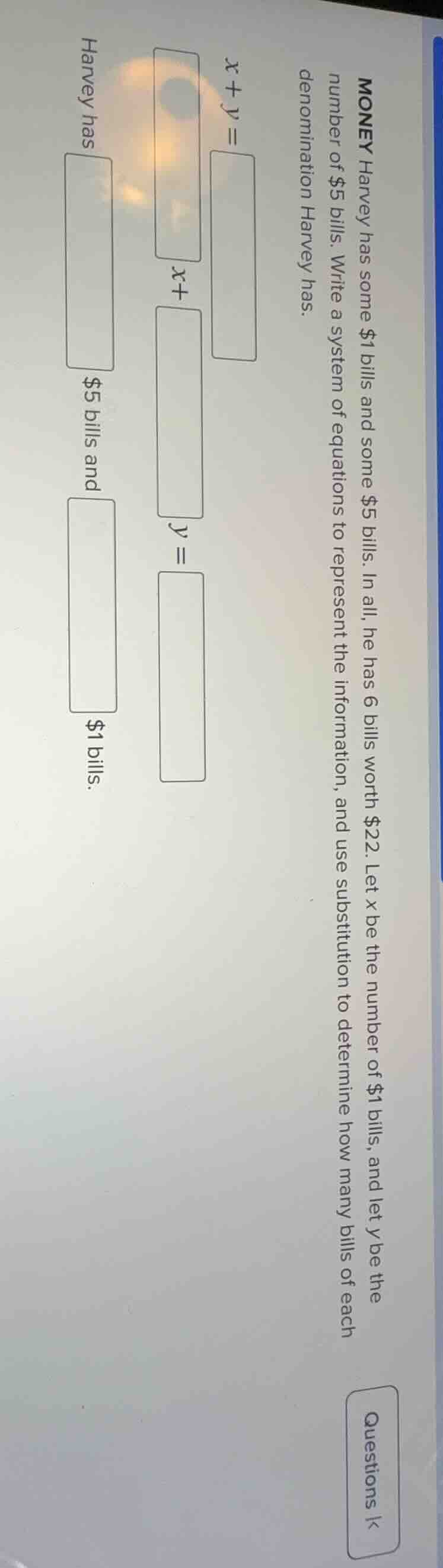
money harvey has some $1 bills and some $5 bills. in all, he has 6 bills worth $22. let x be the number of $1 bills, and let y be the number of $5 bills. write a system of equations to represent the information, and use substitution to determine how many bills of each denomination harvey has.
$x + y = square$
$square x + square y = square$
harvey has $square$ $5 bills and $square$ $1 bills.
Step1: Define variables and first equation
Let \( x \) be the number of \(\$1\) bills and \( y \) be the number of \(\$5\) bills. The total number of bills is 6, so the first equation is \( x + y = 6 \).
Step2: Second equation for total value
The total value of the bills is \(\$22\). Since each \(\$1\) bill is worth 1 and each \(\$5\) bill is worth 5, the second equation is \( x + 5y = 22 \).
Step3: Solve the system using substitution
From the first equation, we can express \( x \) as \( x = 6 - y \). Substitute this into the second equation: \( (6 - y) + 5y = 22 \). Simplify: \( 6 + 4y = 22 \). Subtract 6 from both sides: \( 4y = 16 \). Divide by 4: \( y = 4 \).
Step4: Find \( x \)
Substitute \( y = 4 \) back into \( x = 6 - y \): \( x = 6 - 4 = 2 \).

Snap & solve any problem in the app
Get step-by-step solutions on Sovi AI
Photo-based solutions with guided steps
Explore more problems and detailed explanations
The system of equations is \(
\). Harvey has \( y = 4 \) \(\$5\) bills and \( x = 2 \) \(\$1\) bills. So filling in the blanks: \( x + y = \boldsymbol{6} \), \( x + \boldsymbol{5}y = \boldsymbol{22} \), Harvey has \(\boldsymbol{4}\) \(\$5\) bills and \(\boldsymbol{2}\) \(\$1\) bills.