QUESTION IMAGE
Question
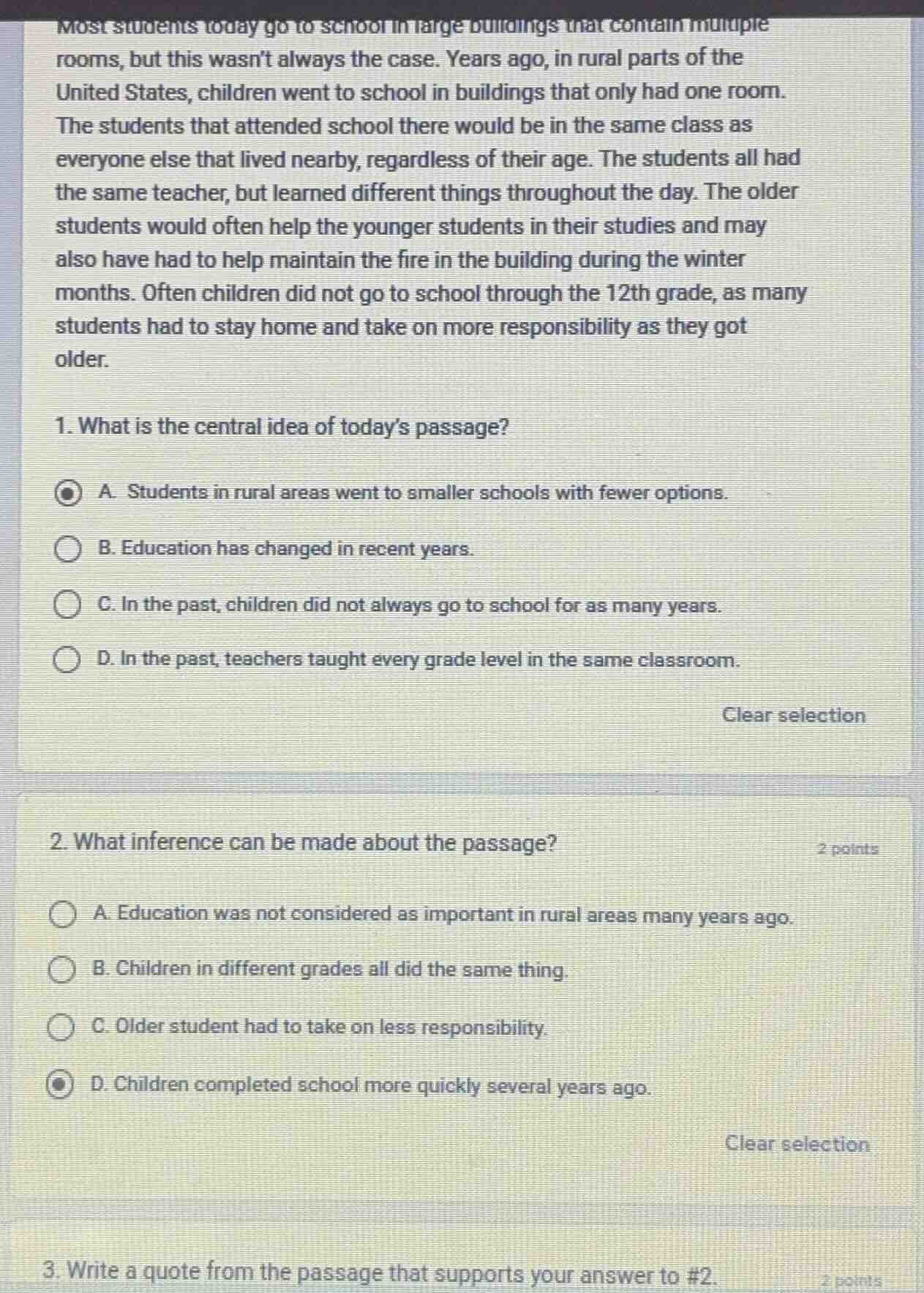
most students today go to school in large buildings that contain multiple rooms, but this wasn’t always the case. years ago, in rural parts of the united states, children went to school in buildings that only had one room. the students that attended school there would be in the same class as everyone else that lived nearby, regardless of their age. the students all had the same teacher, but learned different things throughout the day. the older students would often help the younger students in their studies and may also have had to help maintain the fire in the building during the winter months. often children did not go to school through the 12th grade, as many students had to stay home and take on more responsibility as they got older.
- what is the central idea of today’s passage?
a. students in rural areas went to smaller schools with fewer options.
b. education has changed in recent years.
c. in the past, children did not always go to school for as many years.
d. in the past, teachers taught every grade level in the same classroom.
clear selection
- what inference can be made about the passage?
2 points
a. education was not considered as important in rural areas many years ago.
b. children in different grades all did the same thing.
c. older student had to take on less responsibility.
d. children completed school more quickly several years ago.
clear selection
- write a quote from the passage that supports your answer to #2.
- For question 1: The passage contrasts modern large schools with past rural one-room schools, covering their structure, student dynamics, and limited schooling duration. Option A encapsulates the core of the passage about rural students' smaller schools with fewer options, while other options only cover single details.
- For question 2: The passage states many students left school early to take on responsibilities, so we can infer they completed school more quickly. Other options are incorrect: A is not stated, B contradicts the text (students learned different things), C is wrong (older students had more responsibility).
- For question 3: The quote directly supports the inference that children finished school earlier by stating they often did not complete 12th grade.

Snap & solve any problem in the app
Get step-by-step solutions on Sovi AI
Photo-based solutions with guided steps
Explore more problems and detailed explanations
- A. Students in rural areas went to smaller schools with fewer options.
- D. Children completed school more quickly several years ago.
- "Often children did not go to school through the 12th grade, as many students had to stay home and take on more responsibility as they got older."