QUESTION IMAGE
Question
- mouse experiment
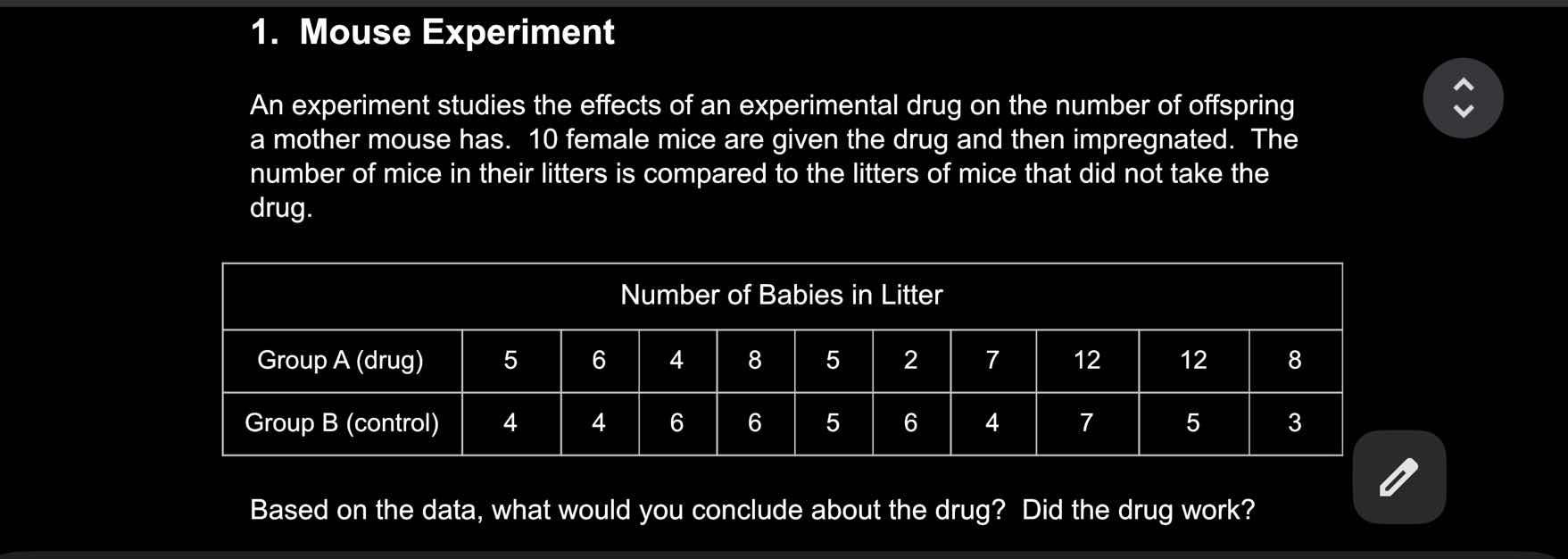
an experiment studies the effects of an experimental drug on the number of offspring a mother mouse has. 10 female mice are given the drug and then impregnated. the number of mice in their litters is compared to the litters of mice that did not take the drug.
| group b (control) | 4 | 4 | 6 | 6 | 5 | 6 | 4 | 7 | 5 | 3 |
based on the data, what would you conclude about the drug? did the drug work?
Step1: Calculate mean of Group A
Add all values, divide by 10.
$\text{Mean}_A = \frac{5+6+4+8+5+2+7+12+12+8}{10} = \frac{69}{10} = 6.9$
Step2: Calculate mean of Group B
Add all values, divide by 10.
$\text{Mean}_B = \frac{4+4+6+6+5+6+4+7+5+3}{10} = \frac{50}{10} = 5.0$
Step3: Compare means and variability
Group A has higher mean, but more outliers (2, 12, 12).

Snap & solve any problem in the app
Get step-by-step solutions on Sovi AI
Photo-based solutions with guided steps
Explore more problems and detailed explanations
The mean number of offspring for the drug group (Group A, 6.9) is higher than the control group (Group B, 5.0). However, Group A has greater variability in litter sizes, with extreme low (2) and high (12, 12) values that skew the average. While the average litter size is larger with the drug, the inconsistent results mean the drug's effect is not uniformly positive; it may increase litter size in some mice but reduce it in others. Overall, the drug appears to increase the average number of offspring, but with inconsistent effects across individual mice.