QUESTION IMAGE
Question
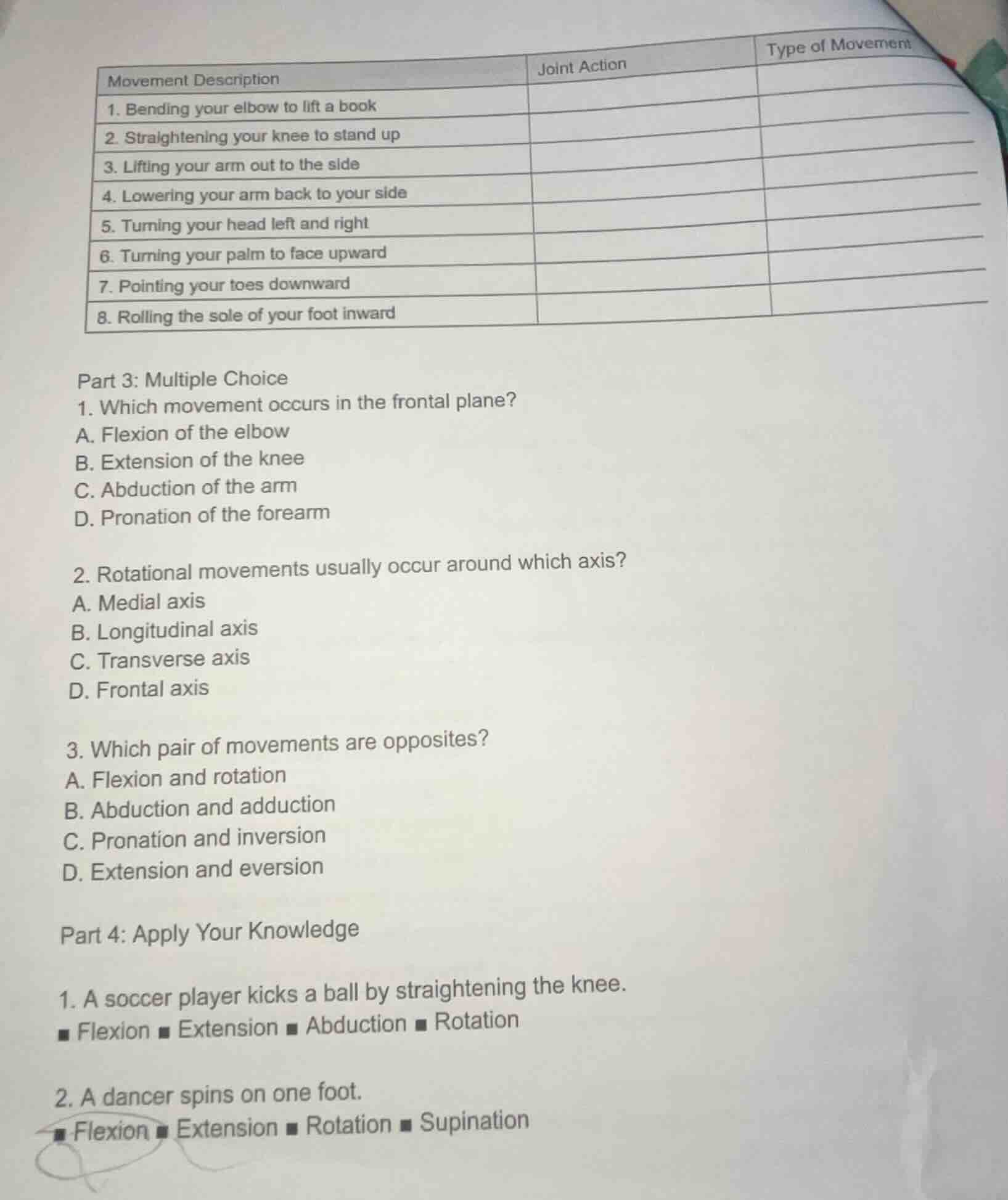
movement description joint action type of movement
- bending your elbow to lift a book
- straightening your knee to stand up
- lifting your arm out to the side
- lowering your arm back to your side
- turning your head left and right
- turning your palm to face upward
- pointing your toes downward
- rolling the sole of your foot inward
part 3: multiple choice
- which movement occurs in the frontal plane?
a. flexion of the elbow
b. extension of the knee
c. abduction of the arm
d. pronation of the forearm
- rotational movements usually occur around which axis?
a. medial axis
b. longitudinal axis
c. transverse axis
d. frontal axis
- which pair of movements are opposites?
a. flexion and rotation
b. abduction and adduction
c. pronation and inversion
d. extension and eversion
part 4: apply your knowledge
- a soccer player kicks a ball by straightening the knee.
■ flexion ■ extension ■ abduction ■ rotation
- a dancer spins on one foot.
■ flexion ■ extension ■ rotation ■ supination
Response
Table Completion
Brief Explanations
Each movement is matched to its standard anatomical joint action and movement type based on human kinesiology definitions.
Brief Explanations
- Frontal plane movements involve side-to-side motion; arm abduction fits this.
- Rotational movements occur around the longitudinal (vertical) axis of a body part.
- Abduction (moving away from midline) and adduction (moving toward midline) are direct opposite movements.
Brief Explanations
- Straightening a joint is defined as extension.
- Spinning around a vertical axis is rotational movement.

Snap & solve any problem in the app
Get step-by-step solutions on Sovi AI
Photo-based solutions with guided steps
Explore more problems and detailed explanations
| Movement Description | Joint Action | Type of Movement |
|---|---|---|
| 2. Straightening your knee to stand up | Knee Extension | Sagittal Plane Movement |
| 3. Lifting your arm out to the side | Shoulder Abduction | Frontal Plane Movement |
| 4. Lowering your arm back to your side | Shoulder Adduction | Frontal Plane Movement |
| 5. Turning your head left and right | Cervical Rotation | Transverse Plane Movement |
| 6. Turning your palm to face upward | Forearm Supination | Transverse Plane Movement |
| 7. Pointing your toes downward | Ankle Plantarflexion | Sagittal Plane Movement |
| 8. Rolling the sole of your foot inward | Foot Inversion | Frontal Plane Movement |
---