QUESTION IMAGE
Question
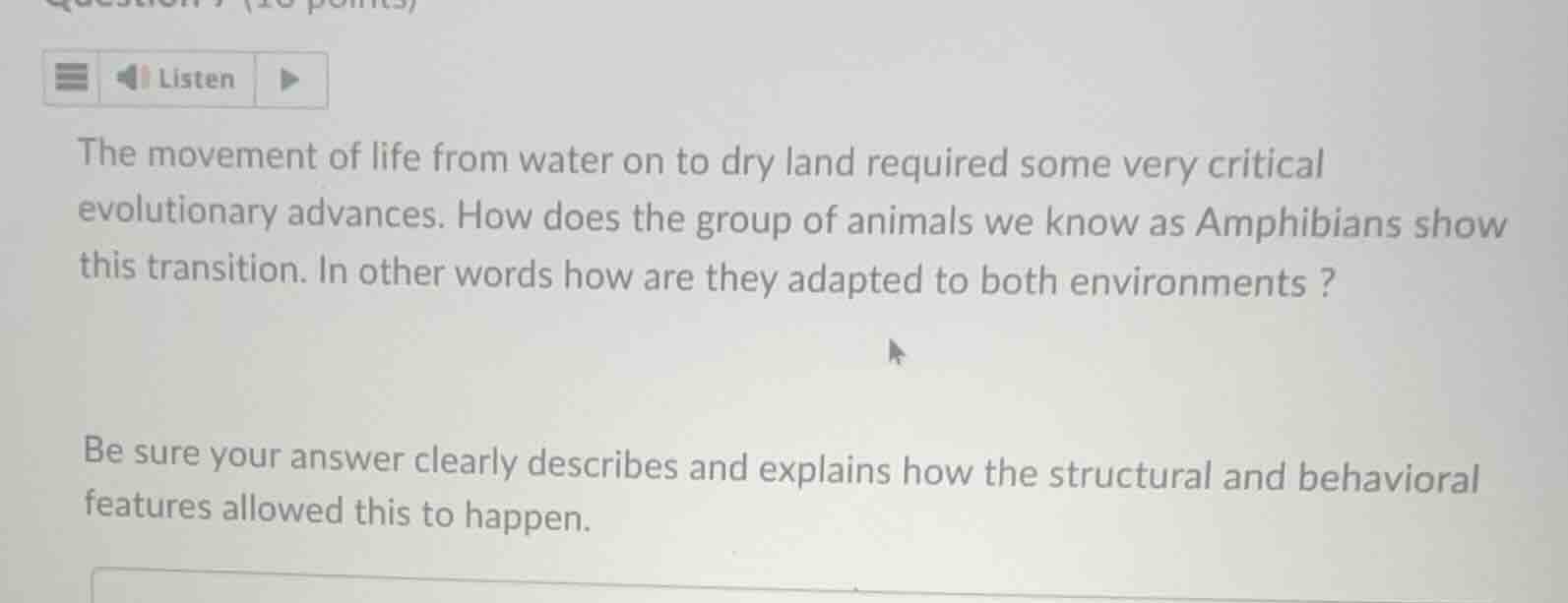
the movement of life from water on to dry land required some very critical evolutionary advances. how does the group of animals we know as amphibians show this transition. in other words how are they adapted to both environments ? be sure your answer clearly describes and explains how the structural and behavioral features allowed this to happen.
Brief Explanations
Amphibians exhibit structural and behavioral adaptations that bridge aquatic and terrestrial environments:
- Aquatic adaptations (larval stage): Most amphibians start as aquatic larvae (e.g., tadpoles) with gills ($\text{Gill structures}$) for extracting oxygen from water, a tail for swimming, and a lateral line system to detect water movements, fully suited to an aquatic lifestyle.
- Structural adaptations for land (adult stage): Adults develop lungs ($\text{Lung structures}$) to breathe atmospheric oxygen, paired limbs with sturdy bones and muscles for locomotion on land, and permeable skin that can absorb oxygen (supplementing lungs) while also retaining moisture with mucus glands.
- Behavioral adaptations: They rely on moist microhabitats (e.g., under logs, near water) to prevent desiccation. Many return to water to lay eggs, as their eggs lack a protective shell and require a moist environment to develop, linking their terrestrial adult life to an aquatic reproductive cycle.

Snap & solve any problem in the app
Get step-by-step solutions on Sovi AI
Photo-based solutions with guided steps
Explore more problems and detailed explanations
Amphibians demonstrate the water-to-land transition through a combination of structural and behavioral traits:
- Larval aquatic adaptations: Tadpoles have gills for underwater respiration, a swimming tail, and lateral lines for aquatic sensory input.
- Adult terrestrial structural adaptations: Developed lungs for air breathing, muscular limbs for land movement, and permeable, mucus-coated skin that aids gas exchange and prevents dehydration.
- Linking behavioral adaptation: They inhabit moist, near-water habitats to avoid drying out, and return to aquatic environments to lay shell-less, moisture-dependent eggs, completing a life cycle that ties both ecosystems together.