QUESTION IMAGE
Question
the movement of the progress bar may be uneven because questions can be worth more or less (including zero) depending on your answer.
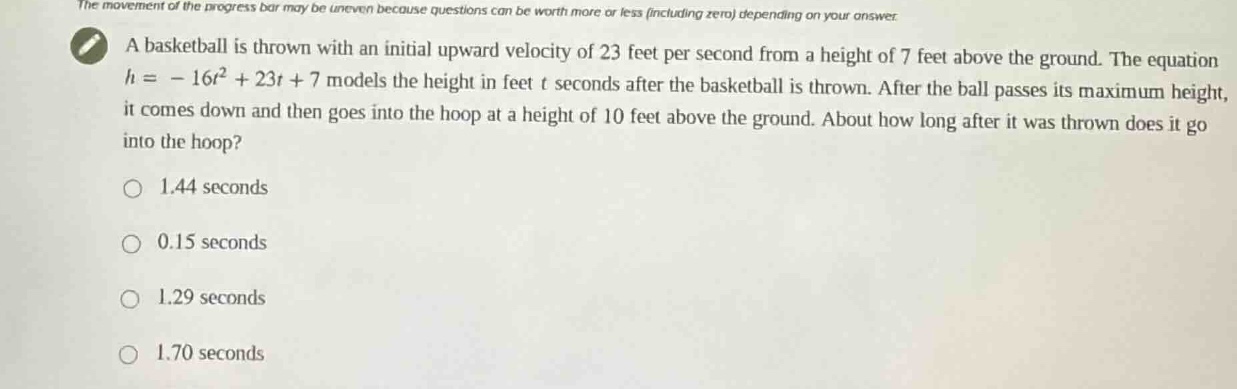
a basketball is thrown with an initial upward velocity of 23 feet per second from a height of 7 feet above the ground. the equation $h = -16t^2 + 23t + 7$ models the height in feet $t$ seconds after the basketball is thrown. after the ball passes its maximum height, it comes down and then goes into the hoop at a height of 10 feet above the ground. about how long after it was thrown does it go into the hoop?
\bigcirc 1.44 seconds
\bigcirc 0.15 seconds
\bigcirc 1.29 seconds
\bigcirc 1.70 seconds
Step1: Set up the equation
We know the height equation is \( h = -16t^2 + 23t + 7 \), and we want to find \( t \) when \( h = 10 \). So we set up the equation:
\( -16t^2 + 23t + 7 = 10 \)
Step2: Simplify the equation
Subtract 10 from both sides to get a quadratic equation in standard form:
\( -16t^2 + 23t - 3 = 0 \)
Multiply both sides by -1 to make the coefficient of \( t^2 \) positive:
\( 16t^2 - 23t + 3 = 0 \)
Step3: Use the quadratic formula
The quadratic formula is \( t = \frac{-b \pm \sqrt{b^2 - 4ac}}{2a} \) for a quadratic equation \( ax^2 + bx + c = 0 \). Here, \( a = 16 \), \( b = -23 \), and \( c = 3 \).
First, calculate the discriminant \( D = b^2 - 4ac \):
\( D = (-23)^2 - 4(16)(3) = 529 - 192 = 337 \)
Then, find the two solutions:
\( t = \frac{23 \pm \sqrt{337}}{32} \)
Calculate the two values:
\( t_1 = \frac{23 + \sqrt{337}}{32} \approx \frac{23 + 18.36}{32} \approx \frac{41.36}{32} \approx 1.29 \)
\( t_2 = \frac{23 - \sqrt{337}}{32} \approx \frac{23 - 18.36}{32} \approx \frac{4.64}{32} \approx 0.145 \)
Since the ball goes into the hoop after reaching maximum height, we take the larger solution, which is approximately 1.29 seconds. But wait, let's check the maximum height time. The time to reach maximum height for a quadratic \( at^2 + bt + c \) is \( t = -\frac{b}{2a} \) for the height equation \( h = -16t^2 + 23t + 7 \), so \( t = -\frac{23}{2(-16)} = \frac{23}{32} \approx 0.71875 \) seconds. So the time after maximum height should be greater than 0.71875. Now let's recalculate the quadratic formula correctly. Wait, in step 2, when we set \( h = 10 \), the equation is \( -16t^2 + 23t + 7 = 10 \), so \( -16t^2 + 23t - 3 = 0 \), so \( a = -16 \), \( b = 23 \), \( c = -3 \). Using quadratic formula:
\( t = \frac{-23 \pm \sqrt{23^2 - 4(-16)(-3)}}{2(-16)} = \frac{-23 \pm \sqrt{529 - 192}}{-32} = \frac{-23 \pm \sqrt{337}}{-32} \)
So \( t = \frac{23 \mp \sqrt{337}}{32} \)
Calculating the two solutions:
\( t_1 = \frac{23 - \sqrt{337}}{32} \approx \frac{23 - 18.36}{32} \approx \frac{4.64}{32} \approx 0.145 \) (this is the time on the way up)
\( t_2 = \frac{23 + \sqrt{337}}{32} \approx \frac{23 + 18.36}{32} \approx \frac{41.36}{32} \approx 1.29 \) (this is the time on the way down, after maximum height)
Wait, but let's check the options. The options are 1.44, 0.15, 1.29, 1.70. Wait, maybe I made a mistake in the quadratic formula. Let's re - calculate the discriminant: \( b^2 - 4ac = 23^2 - 4\times(-16)\times(-3)=529 - 192 = 337\), correct. Then \( \sqrt{337}\approx18.3575 \)
So \( t=\frac{-23\pm18.3575}{-32} \)
For the plus sign: \( t=\frac{-23 + 18.3575}{-32}=\frac{-4.6425}{-32}\approx0.145 \)
For the minus sign: \( t=\frac{-23 - 18.3575}{-32}=\frac{-41.3575}{-32}\approx1.292 \)
So the time when it goes into the hoop (on the way down) is approximately 1.29 seconds. Wait, but the option 1.44? Wait, maybe I made a mistake in the equation. Wait, the initial height is 7 feet, thrown upward with 23 ft/s. Let's check the equation again. The height of a projectile is given by \( h(t)=-16t^2 + v_0t + h_0 \), where \( v_0 \) is initial velocity, \( h_0 \) is initial height. So that's correct: \( h(t)=-16t^2 + 23t + 7 \). When \( h = 10 \), \( -16t^2+23t + 7 = 10 \), so \( -16t^2+23t - 3 = 0 \). Let's solve this quadratic equation using another method, like completing the square.
\( -16t^2+23t=3 \)
\( t^2-\frac{23}{16}t=-\frac{3}{16} \)
Take half of \( \frac{23}{16} \), which is \( \frac{23}{32} \), square it: \( (\frac{23}{32})^2=\frac{529}{1024} \)
Add to both sides:
\( t^2-\frac{23}{16}t+\frac{529}{1024}=-\frac{3}{16}+\frac…

Snap & solve any problem in the app
Get step-by-step solutions on Sovi AI
Photo-based solutions with guided steps
Explore more problems and detailed explanations
1.29 seconds