QUESTION IMAGE
Question
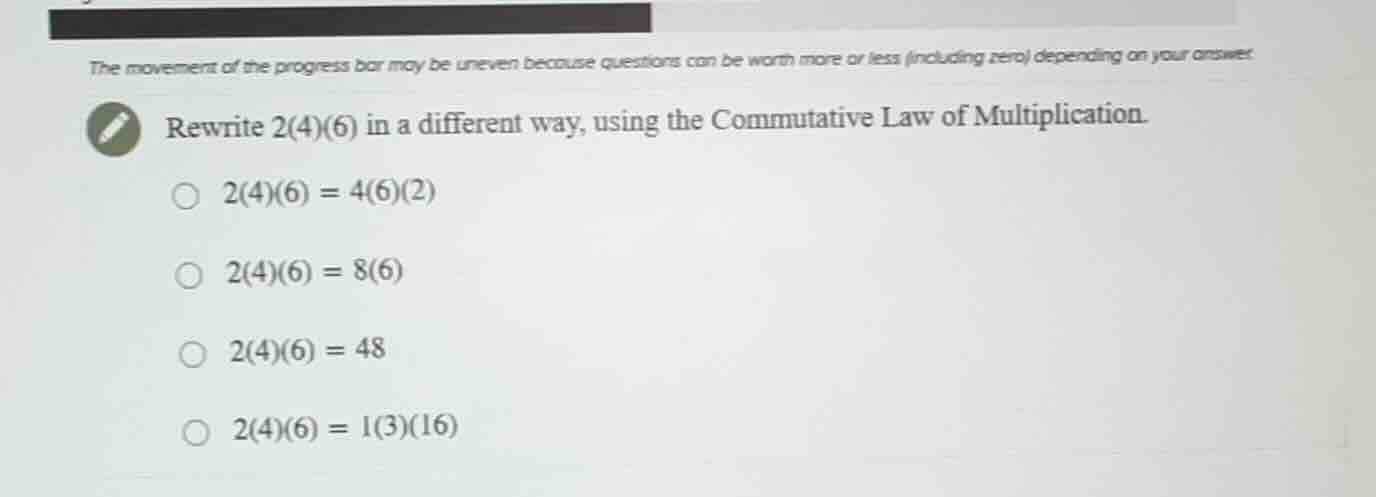
the movement of the progress bar may be uneven because questions can be worth more or less (including zero) depending on your answer. rewrite 2(4)(6) in a different way, using the commutative law of multiplication. 2(4)(6) = 4(6)(2); 2(4)(6) = 8(6); 2(4)(6) = 48; 2(4)(6) = 1(3)(16)
Step1: Recall Commutative Law of Multiplication
The Commutative Law of Multiplication states that for any numbers \(a\), \(b\), and \(c\), \(a\times b\times c = b\times c\times a\) (or any rearrangement of the factors). It means we can change the order of the factors being multiplied.
Step2: Analyze each option
- Option 1: \(2(4)(6)=4(6)(2)\) rearranges the factors \(2\), \(4\), and \(6\) (since \(2\times4\times6 = 4\times6\times2\) by Commutative Law), this follows the Commutative Law.
- Option 2: \(2(4)(6)=8(6)\) is actually performing \(2\times4 = 8\) first, which is using the Associative Law (or just basic multiplication), not the Commutative Law.
- Option 3: \(2(4)(6)=48\) is just calculating the product, not using the Commutative Law to rewrite the expression.
- Option 4: \(2(4)(6)=1(3)(16)\) changes the factors (since \(2\times4\times6=48\) and \(1\times3\times16 = 48\) but it's not a rearrangement of the original factors, so it doesn't use the Commutative Law).

Snap & solve any problem in the app
Get step-by-step solutions on Sovi AI
Photo-based solutions with guided steps
Explore more problems and detailed explanations
A. \(2(4)(6) = 4(6)(2)\)