QUESTION IMAGE
Question
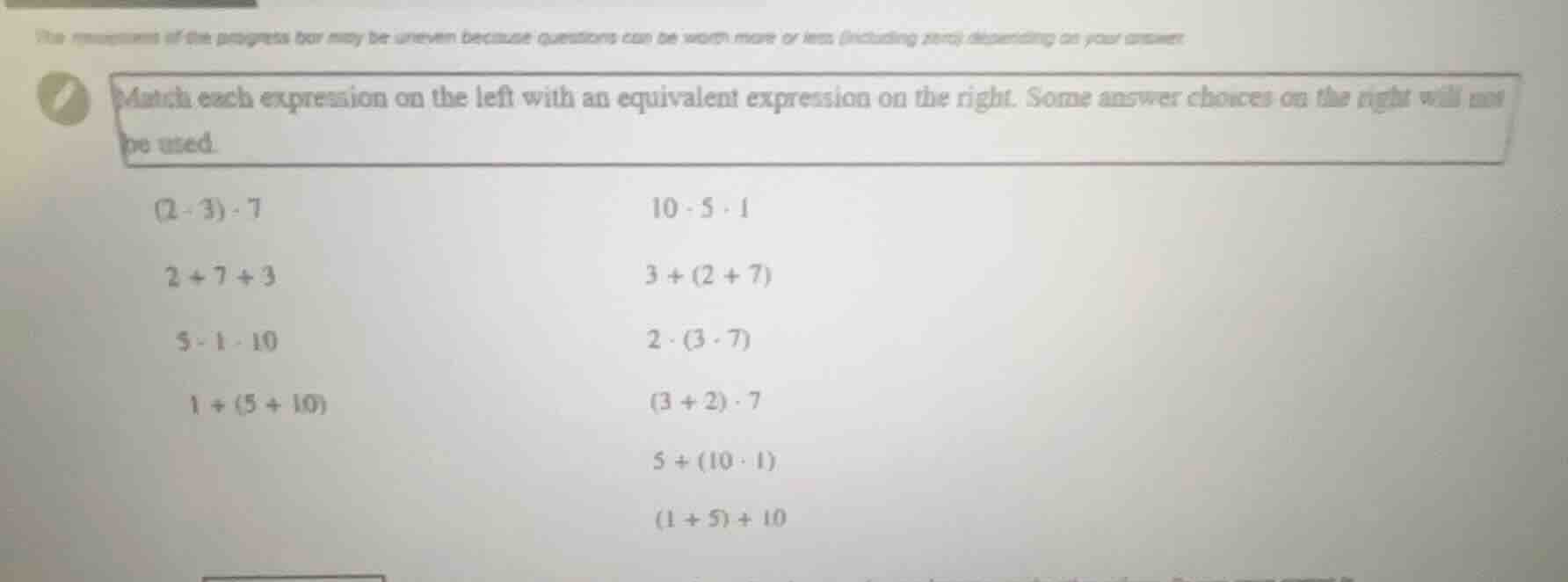
the movements of the progress bar may be uneven because questions can be worth more or less (including zero) depending on your answer. match each expression on the left with an equivalent expression on the right. some answer choices on the right will not be used. (2·3)·7 10·5·1 2+7+3 3+(2+7) 5·1·10 2·(3·7) 1+(5+10) (3+2)·7 5+(10·1) (1+5)+10
Step1: Apply associative property of multiplication
For $(2 \cdot 3) \cdot 7$, the associative property of multiplication states $(a \cdot b) \cdot c = a \cdot (b \cdot c)$. So $(2 \cdot 3) \cdot 7 = 2 \cdot (3 \cdot 7)$
Step2: Apply commutative property of addition
For $2 + 7 + 3$, the commutative property of addition allows rearranging terms: $2 + 7 + 3 = 3 + 2 + 7$. Then using associative property, $3 + (2 + 7)$.
Step3: Apply commutative property of multiplication
For $5 \cdot 1 \cdot 10$, the commutative property of multiplication allows rearranging factors: $5 \cdot 1 \cdot 10 = 10 \cdot 5 \cdot 1$.
Step4: Apply associative property of addition
For $1 + (5 + 10)$, the associative property of addition states $a + (b + c) = (a + b) + c$. So $1 + (5 + 10) = (1 + 5) + 10$.

Snap & solve any problem in the app
Get step-by-step solutions on Sovi AI
Photo-based solutions with guided steps
Explore more problems and detailed explanations
- $(2 \cdot 3) \cdot 7 \longleftrightarrow 2 \cdot (3 \cdot 7)$
- $2 + 7 + 3 \longleftrightarrow 3 + (2 + 7)$
- $5 \cdot 1 \cdot 10 \longleftrightarrow 10 \cdot 5 \cdot 1$
- $1 + (5 + 10) \longleftrightarrow (1 + 5) + 10$
Unused right-side expressions: $(3 + 2) \cdot 7$, $5 + (10 \cdot 1)$