QUESTION IMAGE
Question
mpm2d0
quadratic graphs
name: salma bouaj
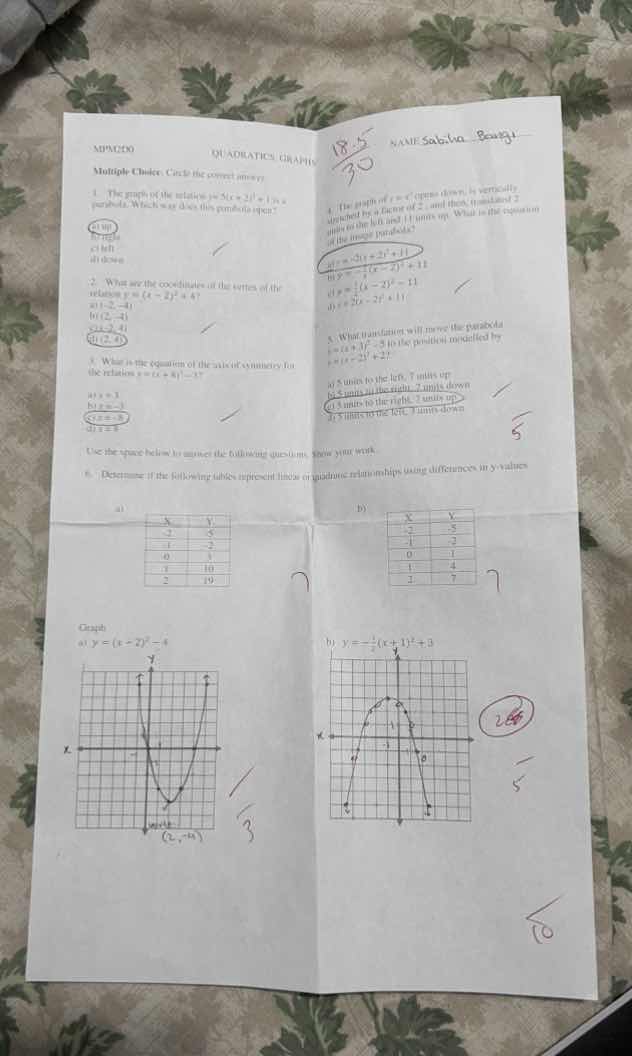
multiple choice: circle the correct answer.
- the graph of the relation ( y = 5(x + 2)^2 ) is a parabola. which way does this parabola open?
a) up
b) right
c) left
d) down
- what are the coordinates of the vertex of the relation ( y = (x - 2)^2 + 4 )?
a) ( (2, 4) )
b) ( (2, -4) )
c) ( (-2, 4) )
d) ( (-2, -4) )
- what is the equation of the axis of symmetry for the relation ( y = (x - 4)^2 - 3 )?
a) ( x = 3 )
b) ( x = -3 )
c) ( x = 4 )
d) ( x = -4 )
- the graph of ( y = x^2 ) opens down, is vertically stretched by a factor of 2, and then translated 2 units to the right and 11 units up. what is the equation of the new parabola?
a) ( y = -2(x - 2)^2 + 11 )
b) ( y = -2(x + 2)^2 + 11 )
c) ( y = -2(x - 2)^2 - 11 )
d) ( y = 2(x - 2)^2 + 11 )
- what transformation will move the parabola ( y = (x + 5)^2 - 3 ) to the position modeled by ( y = (x - 2)^2 + 2 )?
a) 5 units to the left, 3 units up
b) 5 units to the right, 3 units down
c) 7 units to the right, 5 units up
d) 7 units to the left, 5 units down
use the space below to answer the following questions. show your work.
- determine if the following tables represent linear or quadratic relationships using differences in y - values.
a)
| x | y |
|---|---|
| -1 | 2 |
| 0 | 1 |
| 1 | 2 |
| 2 | 5 |
b)
| x | y |
|---|---|
| -1 | 1 |
| 0 | 4 |
| 1 | 7 |
| 2 | 10 |
graph
a) ( y = (x - 2)^2 - 4 )
b) ( y = -\frac{1}{2}(x + 1)^2 + 3 )
Let's tackle problem 6a first (determine if the table represents linear or quadratic using differences in y - values).
Step 1: List the x and y values
For part a), the x - values are \(-2,-1,0,1,2\) and the corresponding y - values are \(5,2,1,2,5\).
Step 2: Find the first differences (differences between consecutive y - values)
- Between \(x=-2\) ( \(y = 5\)) and \(x=-1\) ( \(y = 2\)): \(2 - 5=-3\)
- Between \(x=-1\) ( \(y = 2\)) and \(x = 0\) ( \(y = 1\)): \(1 - 2=-1\)
- Between \(x = 0\) ( \(y = 1\)) and \(x = 1\) ( \(y = 2\)): \(2 - 1 = 1\)
- Between \(x = 1\) ( \(y = 2\)) and \(x = 2\) ( \(y = 5\)): \(5 - 2 = 3\)
Step 3: Find the second differences (differences between consecutive first differences)
- Between \(-3\) and \(-1\): \(-1-(-3)=2\)
- Between \(-1\) and \(1\): \(1 - (-1)=2\)
- Between \(1\) and \(3\): \(3 - 1 = 2\)
Since the second differences are constant (all equal to 2), the relationship is quadratic.
Now for problem 6b:
Step 1: List the x and y values
For part b), the x - values are \(-2,-1,0,1,2\) and the corresponding y - values are \(2,3,4,5,6\).
Step 2: Find the first differences (differences between consecutive y - values)
- Between \(x=-2\) ( \(y = 2\)) and \(x=-1\) ( \(y = 3\)): \(3 - 2 = 1\)
- Between \(x=-1\) ( \(y = 3\)) and \(x = 0\) ( \(y = 4\)): \(4 - 3 = 1\)
- Between \(x = 0\) ( \(y = 4\)) and \(x = 1\) ( \(y = 5\)): \(5 - 4 = 1\)
- Between \(x = 1\) ( \(y = 5\)) and \(x = 2\) ( \(y = 6\)): \(6 - 5 = 1\)
Since the first differences are constant (all equal to 1), the relationship is linear.

Snap & solve any problem in the app
Get step-by-step solutions on Sovi AI
Photo-based solutions with guided steps
Explore more problems and detailed explanations
- For 6a: The relationship is quadratic (because the second differences of the y - values are constant).
- For 6b: The relationship is linear (because the first differences of the y - values are constant).