QUESTION IMAGE
Question
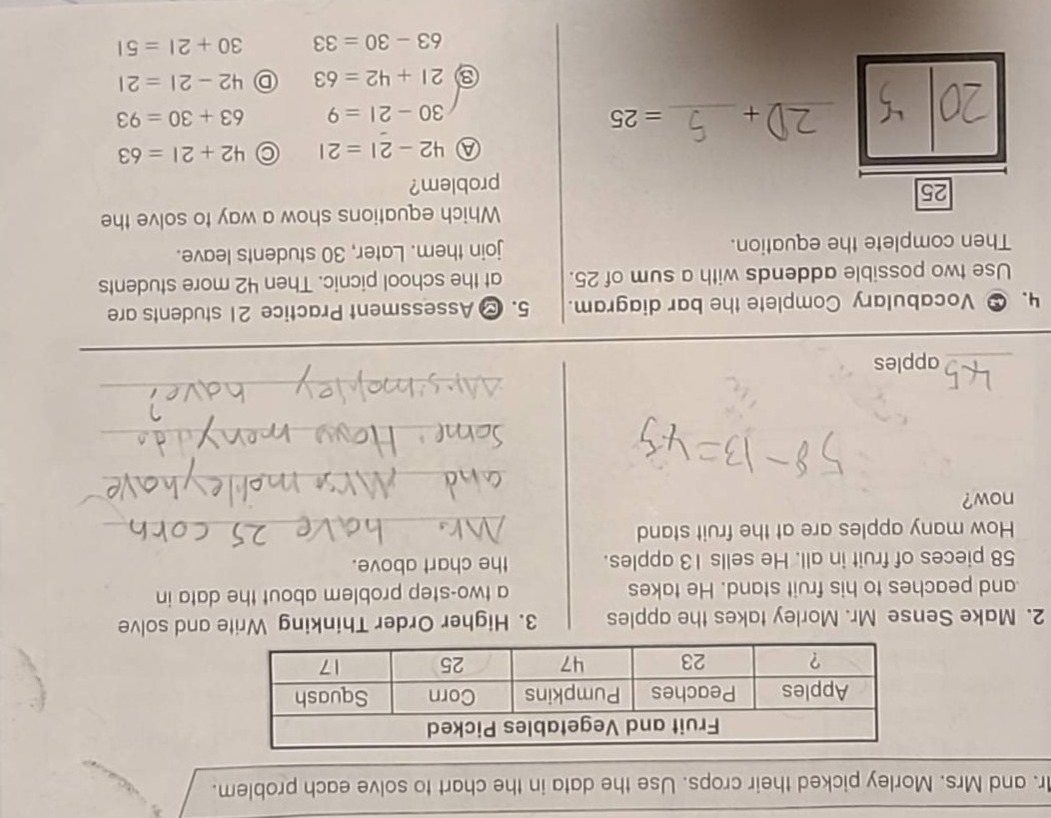
mr. and mrs. motley picked their crops. use the data in the chart to solve each problem.
fruit and vegetables picked
apples?
peaches 23
pumpkins 47
corn 25
squash 17
- make sense mr. motley takes the apples and peaches to his fruit stand. he takes 58 pieces of fruit in all. he sells 13 apples. how many apples are at the fruit stand now?
- higher order thinking write and solve a two - step problem about the data in the chart above.
- vocabulary complete the bar diagram. use two possible addends with a sum of 25. then complete the equation.
- circled{g} assessment practice 21 students are at the school picnic. then 42 more students join them. later, 30 students leave. which equations show a way to solve the problem?
a ( 42 - 21 = 21 )
b ( 30 - 21 = 9 )
c ( 42 + 21 = 63 )
d ( 42 - 21 = 21 )
( 63 + 30 = 93 )
( 63 - 30 = 33 )
( 30 + 21 = 51 )
Problem 2:
To find the number of apples left, we subtract the number of apples sold from the total number of apples. The total number of apples is 58, and 13 are sold. So we use the subtraction operation: \( 58 - 13 \).
Step 1: Perform the subtraction
\( 58 - 13 = 45 \)
We know that the sum of two numbers (addends) should be 25. Let's choose 20 and 5. So the equation is \( 20 + 5 = 25 \).
First, we find the total number of students before 30 left. Initially, there were 21 students, then 42 more joined. So we add 21 and 42 to get the total before students left. Then we subtract 30 to find the final number. But to show the equation for the total before leaving, we use \( 21 + 42 = 63 \) (option C).
Step 1: Identify the operation for total before leaving
We add the initial 21 students and the 42 who joined: \( 21 + 42 \)
Step 2: Calculate the sum
\( 21 + 42 = 63 \)

Snap & solve any problem in the app
Get step-by-step solutions on Sovi AI
Photo-based solutions with guided steps
Explore more problems and detailed explanations
45 apples
Problem 4:
We need to find two addends that sum to 25. One possible pair is 20 and 5 since \( 20 + 5 = 25 \). (Other pairs like 10 and 15, 15 and 10, 25 and 0, etc., are also possible, but 20 and 5 fit the given diagram with 20 and 5 shown.)