QUESTION IMAGE
Question
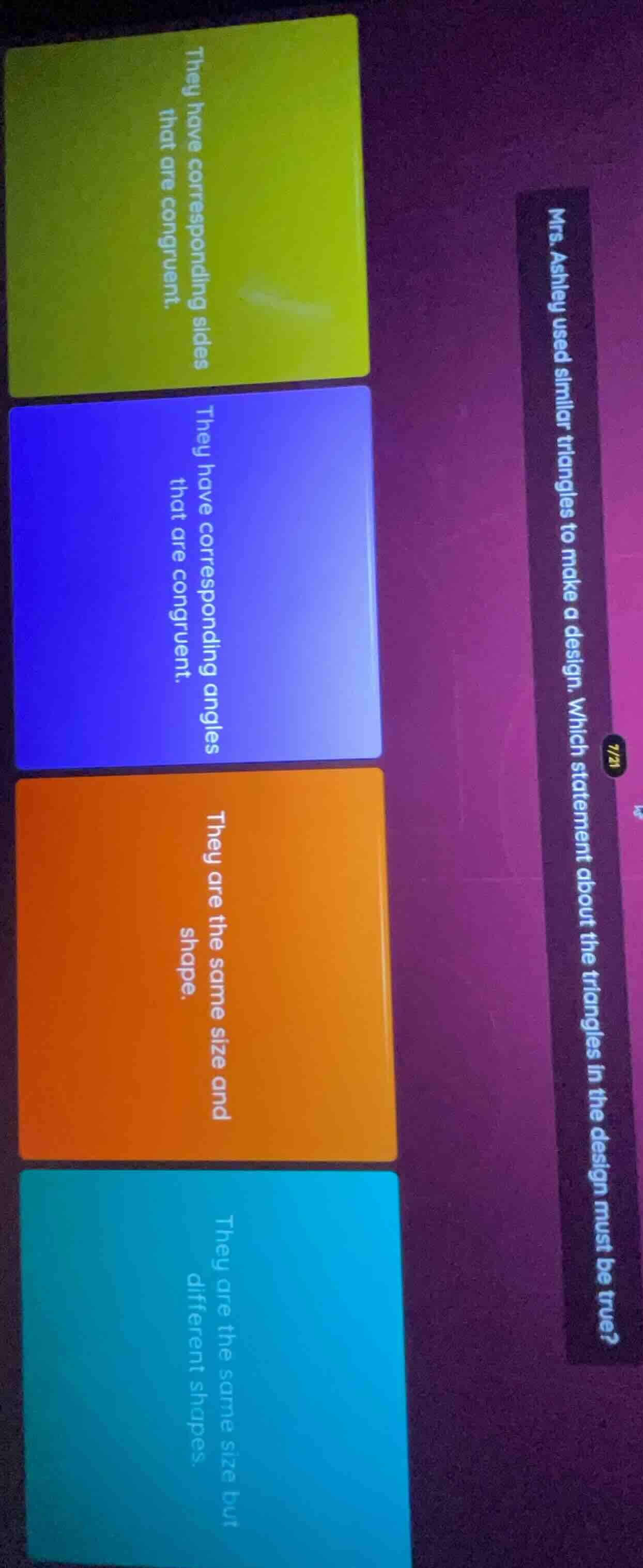
mrs. ashley used similar triangles to make a design. which statement about the triangles in the design must be true? they have corresponding sides that are congruent. they have corresponding angles that are congruent. they are the same size and shape. they are the same size but different shapes.
To determine the correct statement about similar triangles, we recall the definition of similar triangles: Similar triangles have corresponding angles that are congruent (equal) and their corresponding sides are in proportion (not necessarily congruent). Also, similar triangles have the same shape but not necessarily the same size.
- The first option (corresponding sides congruent) is incorrect because similar triangles have sides in proportion, not necessarily congruent (congruent sides would mean they are congruent triangles, a special case of similar triangles with a scale factor of 1).
- The third option (same size and shape) describes congruent triangles, not all similar triangles (similar triangles can be different sizes as long as they have the same shape).
- The fourth option (same size but different shapes) is incorrect because triangles with the same size must have the same shape (by the triangle congruence or similarity rules; same size implies congruent, hence same shape).
- The second option (corresponding angles congruent) is a key property of similar triangles.

Snap & solve any problem in the app
Get step-by-step solutions on Sovi AI
Photo-based solutions with guided steps
Explore more problems and detailed explanations
B. They have corresponding angles that are congruent. (Note: Assuming the options are labeled as follows based on the order: 1. They have corresponding sides that are congruent; 2. They have corresponding angles that are congruent; 3. They are the same size and shape; 4. They are the same size but different shapes)