QUESTION IMAGE
Question
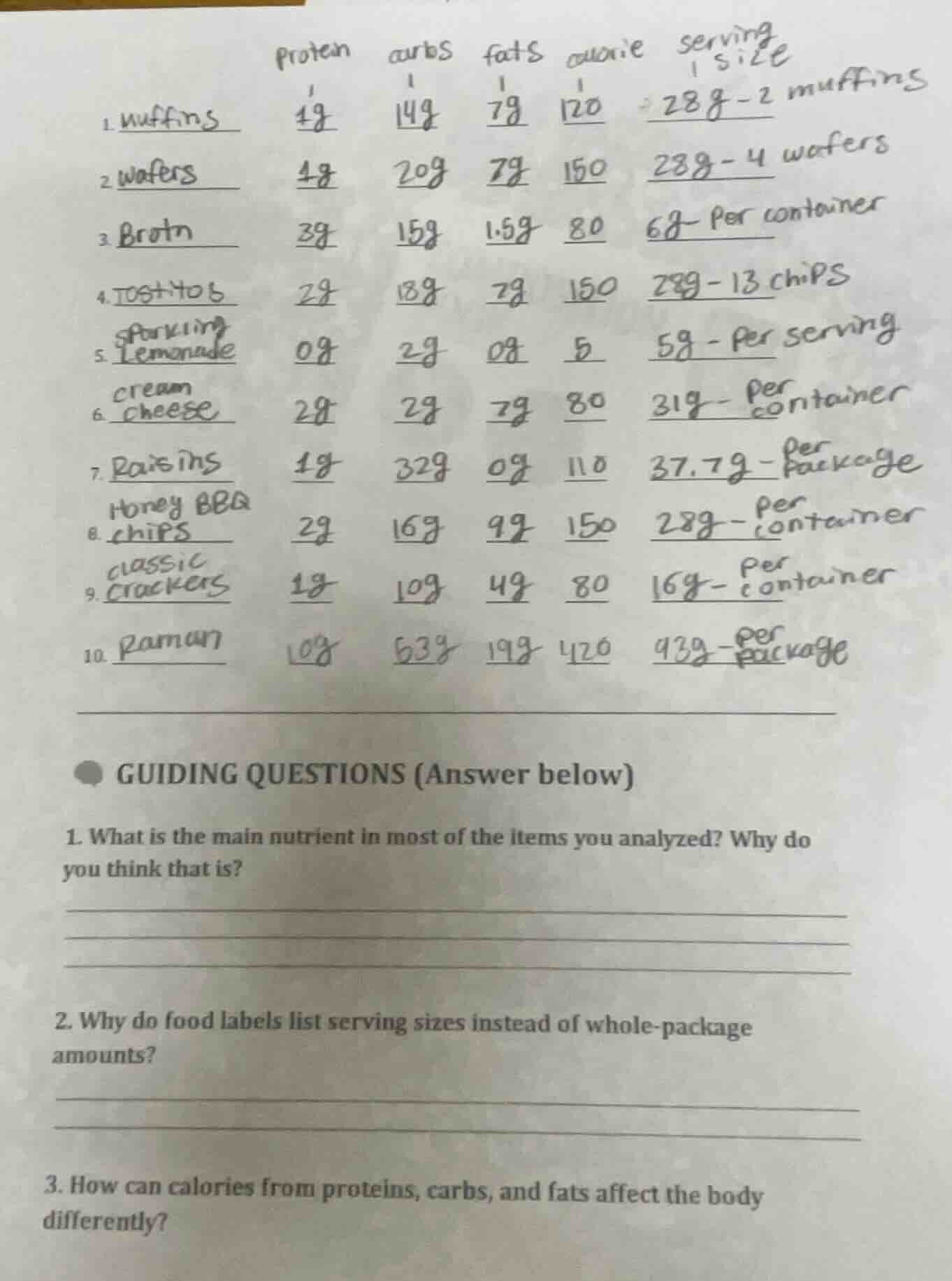
- muffins 4g 14g 7g 120 28g - 2 muffins
- wafers 4g 20g 7g 150 28g - 4 wafers
- broth 3g 15g 1.5g 80 6g - per container
- tostitos 2g 18g 7g 150 28g - 13 chips
- sparkling lemonade 0g 2g 0g 5 5g - per serving
- cream cheese 2g 2g 7g 80 31g - per container
- raisins 1g 32g 0g 110 37.7g - per package
- honey bbq chips 2g 16g 9g 150 28g - per container
- classic crackers 1g 10g 4g 80 16g - per container
- parmesan 10g 53g 19g 420 93g - per package
guiding questions (answer below)
- what is the main nutrient in most of the items you analyzed? why do you think that is?
- why do food labels list serving sizes instead of whole - package amounts?
- how can calories from proteins, carbs, and fats affect the body differently?
Question 1
To determine the main nutrient, we analyze the "carbs" (carbohydrates) column for each item:
- Muffins: 14g carbs
- Wafers: 20g carbs
- Broth: 15g carbs
- Tostitos: 18g carbs
- Sparkling Lemonade: 2g carbs (low, but others are high)
- Cream Cheese: 2g carbs (low)
- Raisins: 32g carbs (very high)
- Honey BBQ Chips: 16g carbs
- Classic Crackers: 10g carbs
- Parmesan: 63g carbs (very high)
Most items (muffins, wafers, broth, tostitos, raisins, honey BBQ chips, classic crackers, parmesan) have relatively high carbohydrate values compared to protein and fat (e.g., raisins have 32g carbs vs 1g protein and 0g fat; parmesan has 63g carbs vs 10g protein and 19g fat). Carbohydrates are a common primary energy source in many processed/snack foods, baked goods, and even some dairy/cheese products (like parmesan here, which might be a typo or mislabel, but overall trend holds). Foods like muffins, wafers, crackers, chips, and raisins are typically carbohydrate - rich (grains, sugars, starches) to provide quick energy, which is why carbs are dominant.
Food labels use serving sizes for several reasons:
- Portion Control: People don't always eat an entire package. Serving sizes help individuals understand the nutrients in a typical or recommended portion, preventing overestimation/underestimation of intake. For example, a package of chips might have 4 servings, so knowing the nutrient content per serving (not per package) helps someone who eats 1 serving (e.g., 13 chips) track their intake accurately.
- Consistency and Comparison: The FDA (or similar regulatory bodies) sets standard serving size guidelines (e.g., based on typical consumption) so consumers can compare nutrients across different brands of the same type of food (e.g., comparing the carb content of two different cracker brands by looking at their per - serving values).
- Nutritional Awareness: It makes it easier to manage diets (e.g., for weight loss, diabetes, or general health). If a person is on a low - calorie diet, knowing the calories per serving (not per package) helps them decide how much to eat.
- Carbohydrates: Calories from carbs (4 calories per gram) are the body's primary and most efficient energy source. They are quickly broken down into glucose, which is used by cells (especially the brain and muscles) for immediate energy. Excess carbs are stored as glycogen in the liver/muscles or as fat if glycogen stores are full.
- Proteins: Calories from protein (4 calories per gram) are mainly used for growth, repair, and maintenance of body tissues (muscles, organs, enzymes, etc.). While protein can be used for energy if carbs/fats are insufficient, its primary role is not energy production. Using protein for energy long - term can lead to muscle breakdown (since the body has to break down muscle tissue to get amino acids for energy), which is not ideal.
- Fats: Calories from fat (9 calories per gram) are a concentrated energy source. They are stored in adipose tissue for long - term energy reserves. Fats also insulate the body, protect organs, and help absorb fat - soluble vitamins (A, D, E, K). Unlike carbs, fat is broken down more slowly, providing sustained energy, but excess fat intake is more easily stored as body fat and can contribute to weight gain if not burned.

Snap & solve any problem in the app
Get step-by-step solutions on Sovi AI
Photo-based solutions with guided steps
Explore more problems and detailed explanations
The main nutrient in most items is carbohydrates. Most analyzed items (muffins, wafers, broth, tostitos, raisins, etc.) have relatively high carbohydrate content. This is likely because many of these foods (snacks, baked goods, etc.) are designed to provide quick energy, and carbohydrates are a primary energy - yielding nutrient, often derived from grains, sugars, or starches in such products.