QUESTION IMAGE
Question
this is a multi - part item.
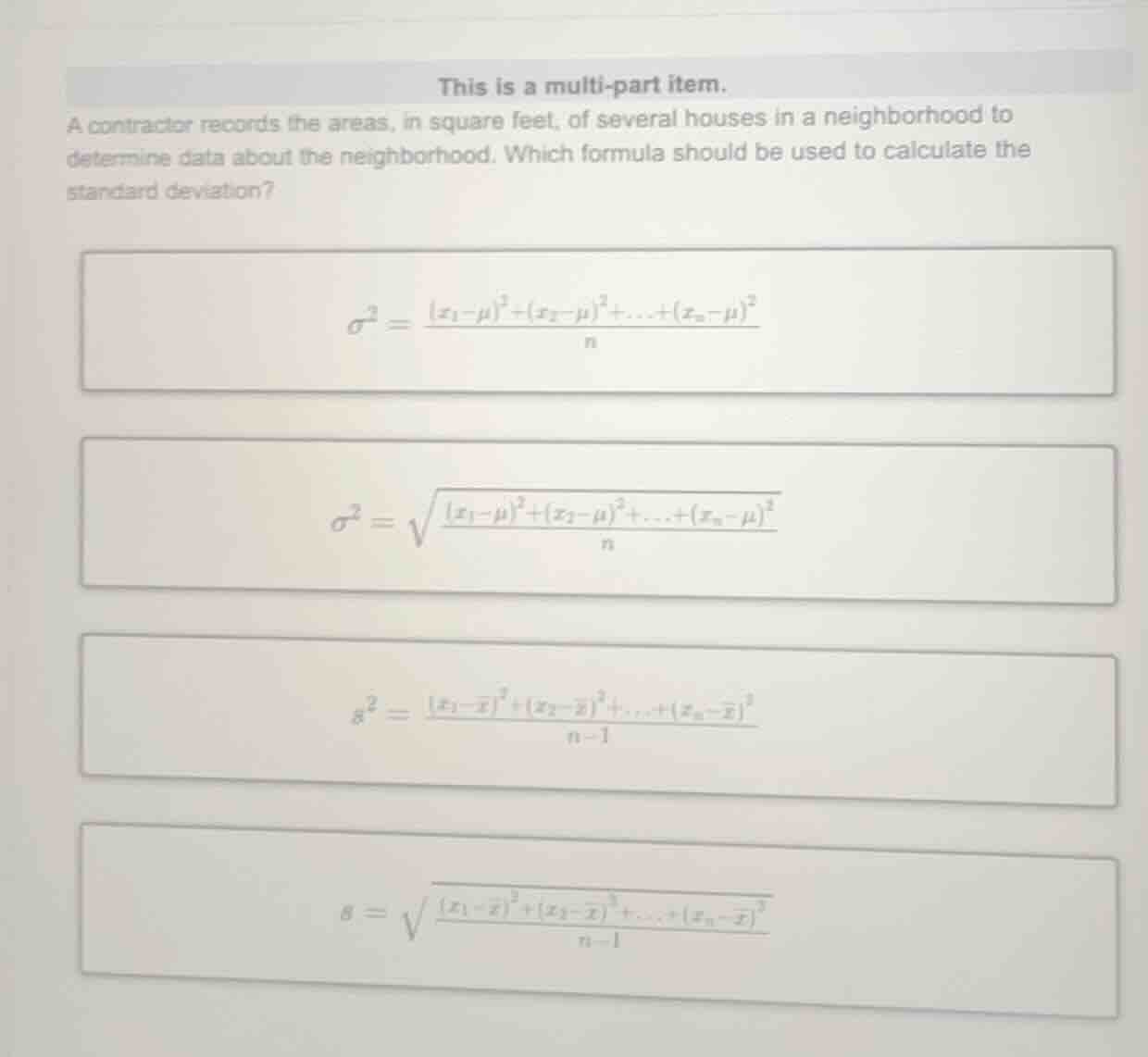
a contractor records the areas, in square feet, of several houses in a neighborhood to determine data about the neighborhood. which formula should be used to calculate the standard deviation?
$\sigma^{2}=\frac{(x_{1}-\mu)^{2}+(x_{2}-\mu)^{2}+\dots+(x_{n}-\mu)^{2}}{n}$
$\sigma^{2}=\sqrt{\frac{(x_{1}-\mu)^{2}+(x_{2}-\mu)^{2}+\dots+(x_{n}-\mu)^{2}}{n}}$
$s^{2}=\frac{(x_{1}-\bar{x})^{2}+(x_{2}-\bar{x})^{2}+\dots+(x_{n}-\bar{x})^{2}}{n - 1}$
$s = \sqrt{\frac{(x_{1}-\bar{x})^{2}+(x_{2}-\bar{x})^{2}+\dots+(x_{n}-\bar{x})^{2}}{n - 1}}$
Step1: Recall Standard Deviation Concepts
The contractor is dealing with a sample of house areas (not the entire population). For a sample, the sample standard deviation \( s \) is calculated using the formula that involves the sample mean \( \bar{x} \) and divides by \( n - 1 \) (degrees of freedom for sample). The population standard deviation \( \sigma \) uses population mean \( \mu \) and divides by \( n \), but here we have a sample (several houses, not all in the neighborhood), so we use sample standard deviation.
Step2: Analyze Each Option
- First option: \( \sigma^2=\frac{(x_1 - \mu)^2+\dots+(x_n - \mu)^2}{n} \) is population variance, not sample standard deviation.
- Second option: Incorrect formula (mixes variance and square root incorrectly, and uses population mean).
- Third option: \( s^2=\frac{(x_1 - \bar{x})^2+\dots+(x_n - \bar{x})^2}{n - 1} \) is sample variance, not standard deviation.
- Fourth option: \( s=\sqrt{\frac{(x_1 - \bar{x})^2+(x_2 - \bar{x})^2+\dots+(x_n - \bar{x})^2}{n - 1}} \) is the formula for sample standard deviation, which is appropriate here as we have a sample of house areas.

Snap & solve any problem in the app
Get step-by-step solutions on Sovi AI
Photo-based solutions with guided steps
Explore more problems and detailed explanations
\( s = \sqrt{\frac{(x_1 - \bar{x})^2+(x_2 - \bar{x})^2+\dots+(x_n - \bar{x})^2}{n - 1}} \) (the fourth formula option)