QUESTION IMAGE
Question
multiple choice
directions: the choice that best completes the statement or answers the question.
- all the members of the kingdom animalia
a. are heterotrophs.
b. are multicellular.
c. have cells without cell walls.
d. all of the above
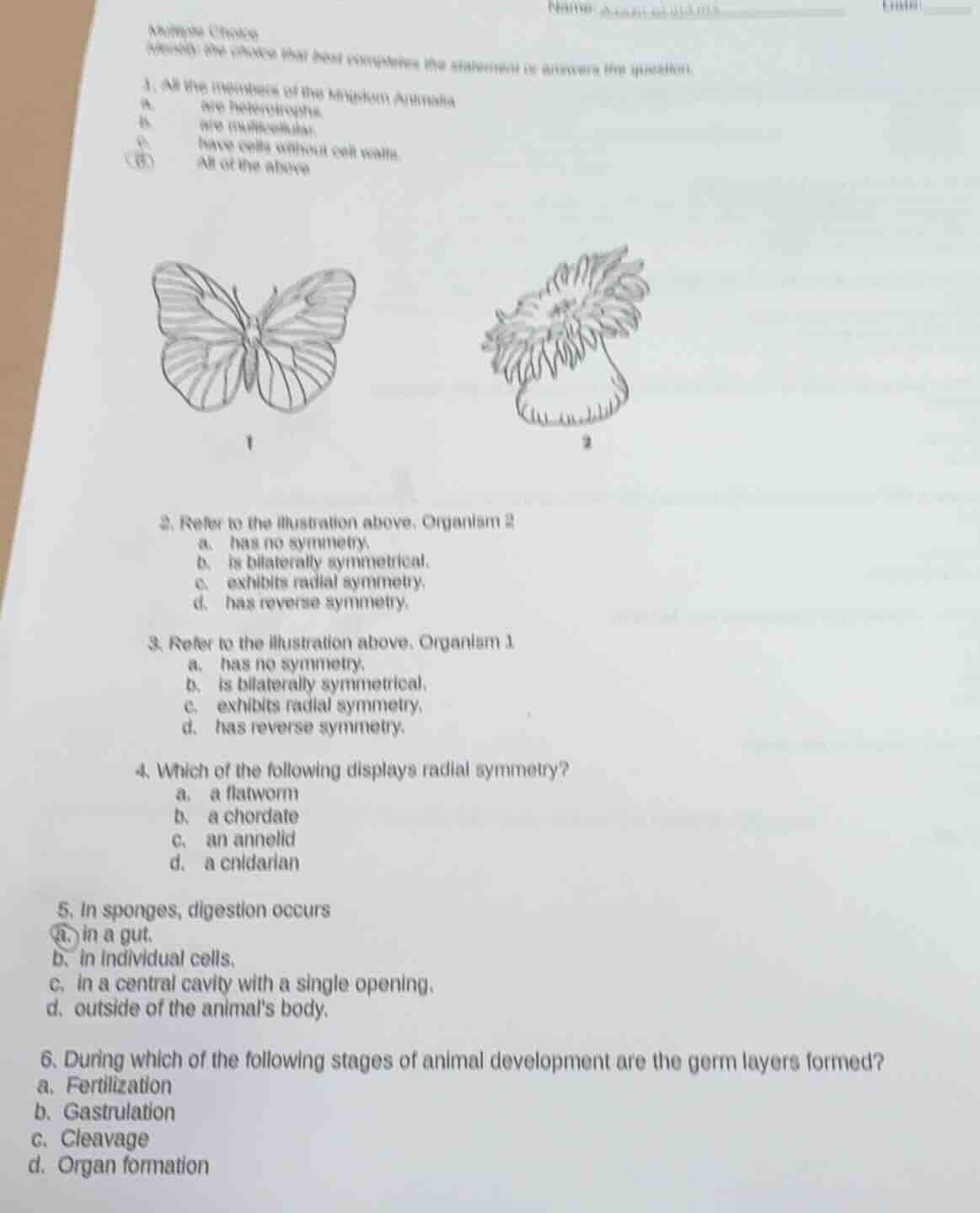
- refer to the illustration above. organism 2
a. has no symmetry.
b. is bilaterally symmetrical.
c. exhibits radial symmetry.
d. has reverse symmetry.
- refer to the illustration above. organism 1
a. has no symmetry.
b. is bilaterally symmetrical.
c. exhibits radial symmetry.
d. has reverse symmetry.
- which of the following displays radial symmetry?
a. a flatworm
b. a chordate
c. an annelid
d. a cnidarian
- in sponges, digestion occurs
a. in a gut.
b. in individual cells.
c. in a central cavity with a single opening.
d. outside of the animals body.
- during which of the following stages of animal development are the germ layers formed?
a. fertilization
b. gastrulation
c. cleavage
d. organ formation
- For question 1: All animals are heterotrophs (rely on other organisms for food), multicellular, and their cells lack cell walls (a feature that distinguishes animal cells from plant/fungal cells).
- For question 2: Organism 2 (a cnidarian-like organism) can be divided into equal parts around a central axis, which is radial symmetry.
- For question 3: Organism 1 (a butterfly) can be divided into two mirror-image halves along one plane, which is bilateral symmetry.
- For question 4: Cnidarians (e.g., jellyfish, sea anemones) are defined by having radial symmetry; flatworms, chordates, and annelids have bilateral symmetry.
- For question 5: Sponges are simple organisms with no true gut; they perform intracellular digestion, meaning digestion happens inside individual cells.
- For question 6: Gastrulation is the developmental stage where the embryo folds in on itself, forming the three primary germ layers (ectoderm, mesoderm, endoderm).

Snap & solve any problem in the app
Get step-by-step solutions on Sovi AI
Photo-based solutions with guided steps
Explore more problems and detailed explanations
- d. All of the above
- c. exhibits radial symmetry.
- b. is bilaterally symmetrical.
- d. a cnidarian
- b. in Individual cells.
- b. Gastrulation