QUESTION IMAGE
Question
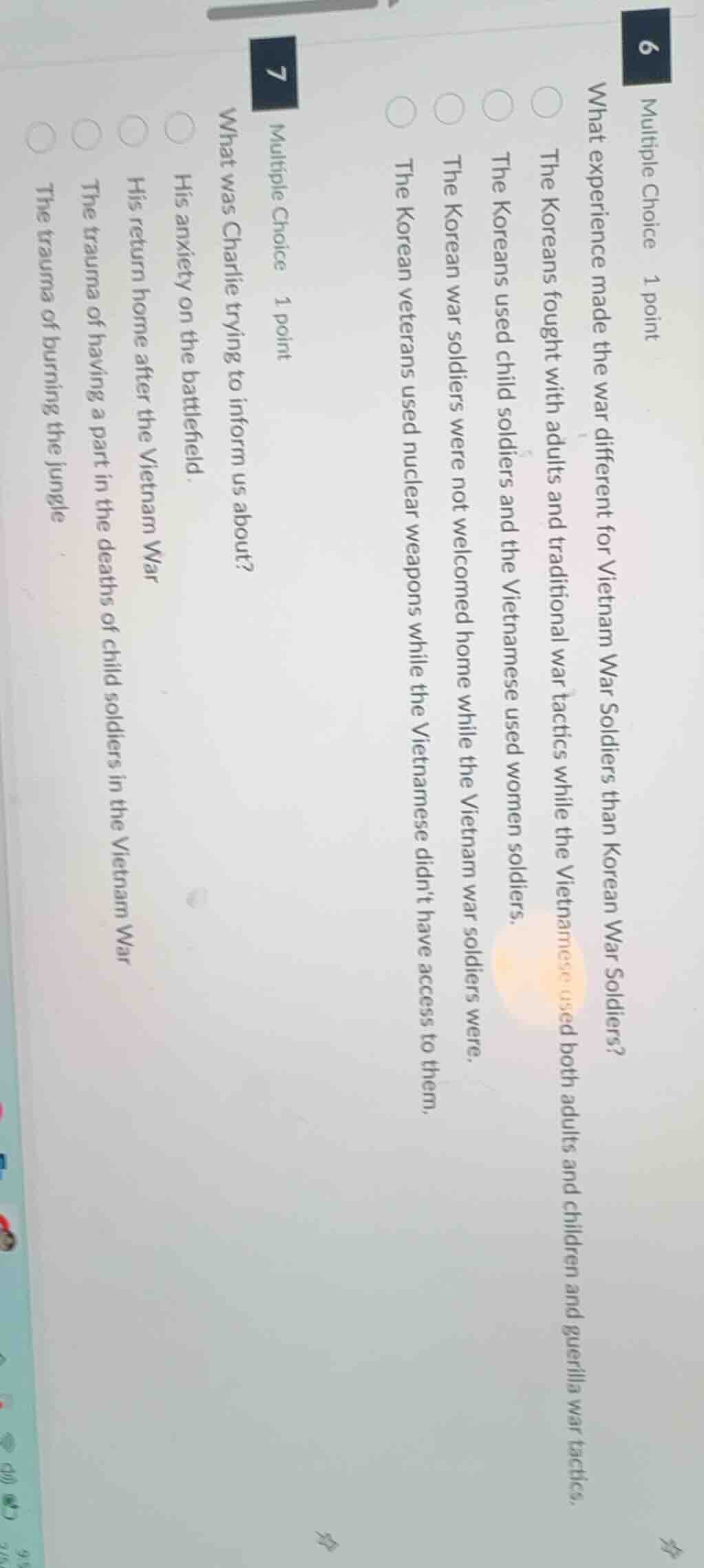
6 multiple choice 1 point what experience made the war different for vietnam war soldiers than korean war soldiers? the koreans fought with adults and traditional war tactics while the vietnamese used both adults and children and guerrilla war tactics. the koreans used child soldiers and the vietnamese used women soldiers. the korean war soldiers were not welcomed home while the vietnam war soldiers were. the korean veterans used nuclear weapons while the vietnamese didnt have access to them. 7 multiple choice 1 point what was charlie trying to inform us about? his anxiety on the battlefield. his return home after the vietnam war the trauma of having a part in the deaths of child soldiers in the vietnam war the trauma of burning the jungle
Question 6 (Multiple Choice)
To determine the correct answer, we analyze each option:
- Option 1: The Koreans fought with adults and traditional war tactics while the Vietnamese used both adults and children and guerrilla war tactics. This aligns with historical knowledge: the Korean War was more conventional with adult soldiers and traditional tactics, while the Vietnam War involved the Viet Cong using guerrilla warfare and including children in support roles (though not front - line combat in the same way as adults, but the option's description of different tactics and use of different age groups in a general sense fits the contrast between the two wars' fighting styles).
- Option 2: There is no historical basis for the claim that Koreans used child soldiers and Vietnamese used women soldiers. Both wars had soldiers of different genders, but this is not a defining difference between the two wars' soldier experiences.
- Option 3: The reception of soldiers returning home was not a defining difference in the "war experience" of the soldiers during the war (the question is about what made the war experience different for the soldiers, not their post - war reception). Also, the statement about Korean war soldiers not being welcomed and Vietnam war soldiers being welcomed is an oversimplification and not a core difference in the war experience.
- Option 4: The use of nuclear weapons in the Korean War was limited (only the threat of nuclear weapons was more prominent, and no nuclear weapons were actually used in combat in the Korean War as in the sense of this option's description). Also, this is not a core difference in the "war experience" of the soldiers in terms of how they fought.
We analyze each option:
- Option 1: "His anxiety on the battlefield" is too general. Many soldiers had anxiety, and it doesn't seem to be a specific story Charlie would be trying to inform about (assuming Charlie's story is about a more profound and specific experience related to the Vietnam War's unique aspects).
- Option 2: "His return home after the Vietnam War" is about post - war return, not about a specific experience during the war that is unique or a key story element. The question is about what Charlie was trying to inform about, likely a more impactful experience during or related to the war's events.
- Option 3: "The trauma of having a part in the deaths of child soldiers in the Vietnam War" is a very specific and impactful experience. The Vietnam War had issues related to child soldiers (either as part of the opposing forces or in some complex situations), and being involved in the deaths of child soldiers would be a traumatic and significant story to tell.
- Option 4: "The trauma of burning the jungle" is about a tactic (like napalm use to burn jungles), which is a more general war tactic - related trauma, not as specific and personal a story as being involved in the deaths of child soldiers.

Snap & solve any problem in the app
Get step-by-step solutions on Sovi AI
Photo-based solutions with guided steps
Explore more problems and detailed explanations
A. The Koreans fought with adults and traditional war tactics while the Vietnamese used both adults and children and guerrilla war tactics.