QUESTION IMAGE
Question
4 multiple choice 2 points
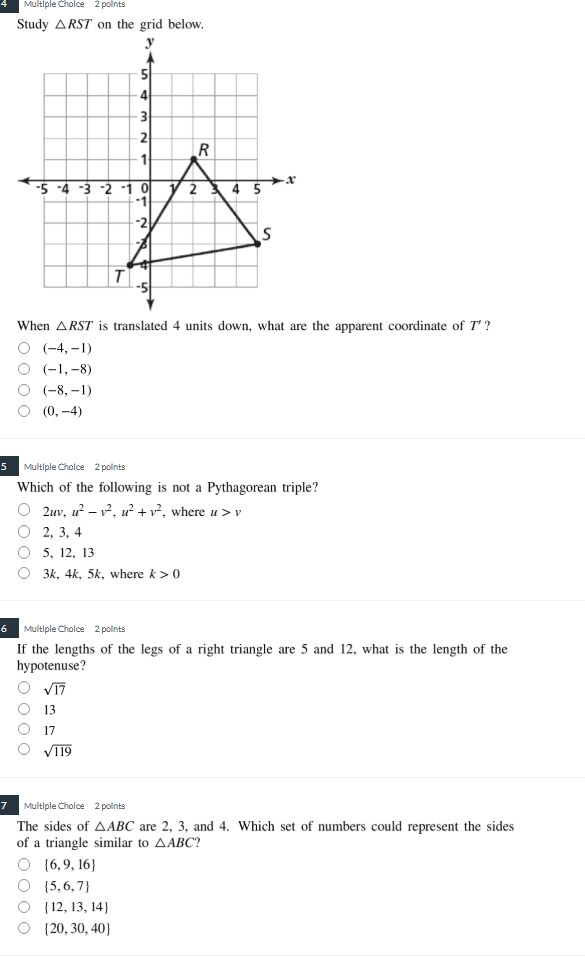
study $\triangle rst$ on the grid below.
grid image omitted
when $\triangle rst$ is translated 4 units down, what are the apparent coordinate of $t$?
$\bigcirc$ $(-4, -1)$
$\bigcirc$ $(-1, -8)$
$\bigcirc$ $(-8, -1)$
$\bigcirc$ $(0, -4)$
5 multiple choice 2 points
which of the following is not a pythagorean triple?
$\bigcirc$ $2uv, u^2 - v^2, u^2 + v^2$, where $u > v$
$\bigcirc$ $2, 3, 4$
$\bigcirc$ $5, 12, 13$
$\bigcirc$ $3k, 4k, 5k$, where $k > 0$
6 multiple choice 2 points
if the lengths of the legs of a right triangle are 5 and 12, what is the length of the hypotenuse?
$\bigcirc$ $\sqrt{17}$
$\bigcirc$ $13$
$\bigcirc$ $17$
$\bigcirc$ $\sqrt{119}$
7 multiple choice 2 points
the sides of $\triangle abc$ are 2, 3, and 4. which set of numbers could represent the sides of a triangle similar to $\triangle abc$?
$\bigcirc$ $\\{6, 9, 16\\}$
$\bigcirc$ $\\{5, 6, 7\\}$
$\bigcirc$ $\\{12, 13, 14\\}$
$\bigcirc$ $\\{20, 30, 40\\}$
---
Question 4
Step1: Identify T's coordinates
From grid: $T = (-4, -4)$
Step2: Translate 4 units down
Subtract 4 from y-coordinate: $-4 - 4 = -8$
New coordinates: $(-4, -8)$
---
Question 5
Step1: Check Pythagorean triple rule
Pythagorean triple: $a^2 + b^2 = c^2$ (c largest)
Step2: Test each option
- $2uv, u^2-v^2, u^2+v^2$: $(u^2-v^2)^2+(2uv)^2=(u^2+v^2)^2$ (valid formula)
- $2^2+3^2=4+9=13
eq 4^2=16$ (not valid)
- $5^2+12^2=25+144=169=13^2$ (valid)
- $(3k)^2+(4k)^2=9k^2+16k^2=25k^2=(5k)^2$ (valid)
---
Question 6
Step1: Apply Pythagorean theorem
Hypotenuse $c = \sqrt{a^2 + b^2}$, $a=5, b=12$
Step2: Calculate value
$$c = \sqrt{5^2 + 12^2} = \sqrt{25 + 144} = \sqrt{169} = 13$$
---
Question 7
Step1: Similar triangle side rule
Similar triangles have proportional sides (same ratio)
Step2: Test each option
Original ratio: $2:3:4$
- $\frac{6}{2}=3, \frac{9}{3}=3, \frac{16}{4}=4$ (ratios not equal)
- $\frac{5}{2}
eq\frac{6}{3}
eq\frac{7}{4}$ (no consistent ratio, but fails triangle inequality $5+6=11>7$)
- $\frac{12}{2}
eq\frac{13}{3}
eq\frac{14}{4}$ (no consistent ratio)
- $\frac{20}{2}=10, \frac{30}{3}=10, \frac{40}{4}=10$ (consistent ratio, valid)
Only $\{6,9,16\}$ does not have matching proportional sides.

Snap & solve any problem in the app
Get step-by-step solutions on Sovi AI
Photo-based solutions with guided steps
Explore more problems and detailed explanations
- $(-4,-8)$
- $2, 3, 4$
- $13$
- $\{6,9,16\}$