QUESTION IMAGE
Question
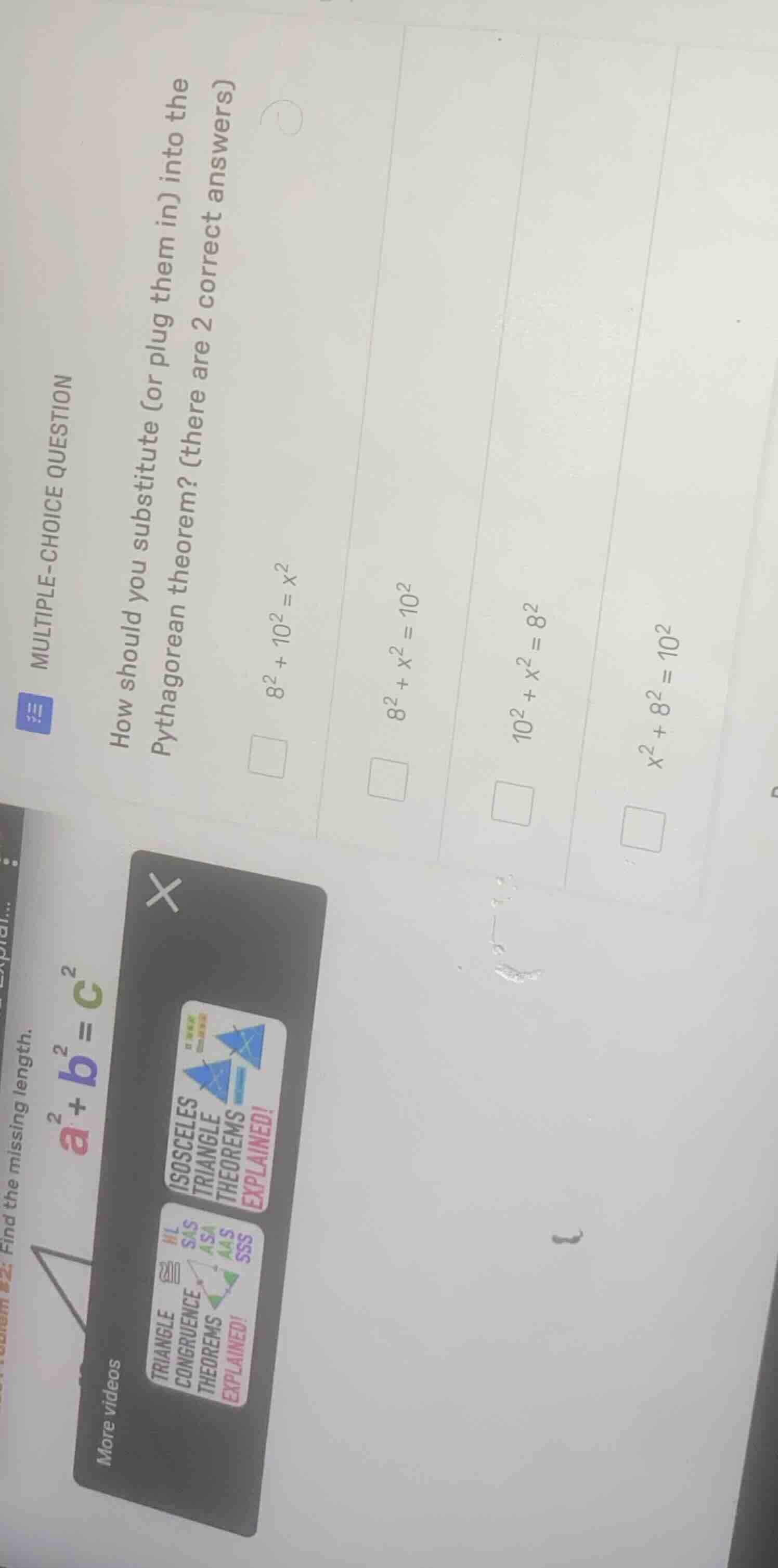
multiple-choice question how should you substitute (or plug them in) into the pythagorean theorem? (there are 2 correct answers) $8^2 + 10^2 = x^2$ $8^2 + x^2 = 10^2$ $10^2 + x^2 = 8^2$ $x^2 + 8^2 = 10^2$
The Pythagorean theorem is \(a^2 + b^2 = c^2\), where \(c\) is the hypotenuse (the longest side of a right triangle), and \(a\) and \(b\) are the legs. We need to consider two cases: when \(10\) is the hypotenuse and when \(x\) is the hypotenuse.
Step 1: Case 1 - 10 is the hypotenuse
If \(10\) is the hypotenuse (\(c = 10\)), then the legs are \(a = 8\) and \(b = x\). Substituting into the theorem:
\(8^2 + x^2 = 10^2\)
Step 2: Case 2 - \(x\) is the hypotenuse
If \(x\) is the hypotenuse (\(c = x\)), then the legs are \(a = 8\) and \(b = 10\). Substituting into the theorem:
\(8^2 + 10^2 = x^2\) (or \(x^2 + 8^2 = 10^2\) since addition is commutative, \(a^2 + b^2 = b^2 + a^2\))
Now let's check the options:
- Option 1: \(8^2 + 10^2 = x^2\) – This is valid (Case 2).
- Option 2: \(8^2 + x^2 = 10^2\) – This is valid (Case 1).
- Option 3: \(10^2 + x^2 = 8^2\) – Invalid, because \(10^2>8^2\), and the sum of squares of two positive numbers can't be less than the square of a larger number.
- Option 4: \(x^2 + 8^2 = 10^2\) – This is the same as Option 2 (due to commutativity of addition), so it's valid (Case 1). Wait, but the problem says there are 2 correct answers? Wait, no, let's re - evaluate. Wait, actually, \(10^2 + x^2 = 8^2\) is impossible because \(10^2=100\) and \(8^2 = 64\), so \(100+x^2=64\) would imply \(x^2=- 36\), which is not possible for real - valued side lengths. So the correct ones are \(8^2 + 10^2 = x^2\), \(8^2 + x^2 = 10^2\), and \(x^2 + 8^2 = 10^2\) (since \(8^2 + x^2 = x^2+8^2\)). But the problem states there are 2 correct answers? Wait, maybe a mis - statement, but from the math:
The two valid equations are \(8^2 + 10^2 = x^2\) and \(8^2 + x^2 = 10^2\) (or \(x^2 + 8^2 = 10^2\) as it's equivalent to \(8^2 + x^2 = 10^2\)).

Snap & solve any problem in the app
Get step-by-step solutions on Sovi AI
Photo-based solutions with guided steps
Explore more problems and detailed explanations
The correct options are:
- \(8^2 + 10^2 = x^2\)
- \(8^2 + x^2 = 10^2\) (and also \(x^2 + 8^2 = 10^2\) since it's the same as \(8^2 + x^2 = 10^2\))
If we consider the options given:
- \(8^2 + 10^2 = x^2\) - Correct
- \(8^2 + x^2 = 10^2\) - Correct
- \(10^2 + x^2 = 8^2\) - Incorrect
- \(x^2 + 8^2 = 10^2\) - Correct (same as option 2)
But since the problem says there are 2 correct answers, maybe a typo, but based on the Pythagorean theorem application, the two correct ones (from the first two distinct - looking options) are \(8^2 + 10^2 = x^2\) and \(8^2 + x^2 = 10^2\) (or \(x^2 + 8^2 = 10^2\)).