QUESTION IMAGE
Question
multiple choice question
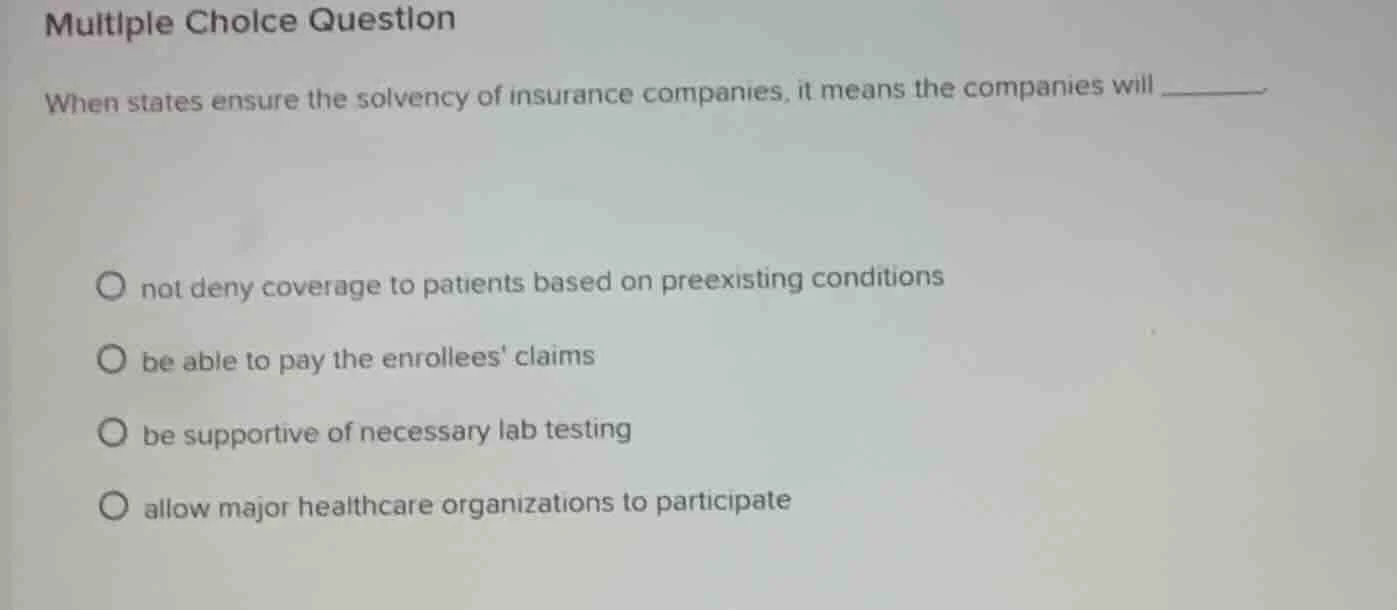
when states ensure the solvency of insurance companies, it means the companies will _______
not deny coverage to patients based on preexisting conditions
be able to pay the enrollees claims
be supportive of necessary lab testing
allow major healthcare organizations to participate
<pre_analysis>
{
"quality": "clear",
"question_count": 1,
"skills_matched": [
"direct_cot",
"multiple_choice_formatter",
"explain_then_answer",
"tutor",
"mastery_adaptive_brevity"
],
"needs_drawing": false,
"concepts_used": [
"State Insurance Regulation"
],
"new_concepts": [],
"current_concepts": [
"State Insurance Regulation",
"Insurance Solvency"
]
}
</pre_analysis>
<reasoning>
Define the concept of solvency
Using the State Insurance Regulation knowledge point
Solvency refers to the ability of an insurance company to meet its long-term financial obligations. In the context of state regulation, ensuring solvency means verifying that the company has sufficient financial reserves and capital to pay out future policyholder claims.
Analyze the given options
- Option 1: "not deny coverage to patients based on preexisting conditions" relates to consumer protection laws and underwriting regulations (such as provisions in the Affordable Care Act), not financial solvency.
- Option 2: "be able to pay the enrollees' claims" directly describes the financial capacity of the insurer to fulfill its primary obligation to policyholders, which is the definition of maintaining solvency.
- Option 3: "be supportive of necessary lab testing" relates to clinical coverage guidelines and medical necessity policies, not financial solvency.
- Option 4: "allow major healthcare organizations to participate" relates to network adequacy and provider contracting, not financial solvency.
Select the correct option
The option that correctly defines what it means when states ensure the solvency of insurance companies is that the companies will be able to pay the enrollees' claims.
</reasoning>
<answer>
<mcq-option>not deny coverage to patients based on preexisting conditions</mcq-option>
<mcq-correct>be able to pay the enrollees' claims</mcq-correct>
<mcq-option>be supportive of necessary lab testing</mcq-option>
<mcq-option>allow major healthcare organizations to participate</mcq-option>
</answer>
<post_analysis>
{
"subject": "Business",
"question_type": "Multiple Choice",
"knowledge_point": [
"Business",
"Insurance Regulation",
"State Insurance Regulation"
]
}
</post_analysis>

Snap & solve any problem in the app
Get step-by-step solutions on Sovi AI
Photo-based solutions with guided steps
Explore more problems and detailed explanations
<pre_analysis>
{
"quality": "clear",
"question_count": 1,
"skills_matched": [
"direct_cot",
"multiple_choice_formatter",
"explain_then_answer",
"tutor",
"mastery_adaptive_brevity"
],
"needs_drawing": false,
"concepts_used": [
"State Insurance Regulation"
],
"new_concepts": [],
"current_concepts": [
"State Insurance Regulation",
"Insurance Solvency"
]
}
</pre_analysis>
<reasoning>
Define the concept of solvency
Using the State Insurance Regulation knowledge point
Solvency refers to the ability of an insurance company to meet its long-term financial obligations. In the context of state regulation, ensuring solvency means verifying that the company has sufficient financial reserves and capital to pay out future policyholder claims.
Analyze the given options
- Option 1: "not deny coverage to patients based on preexisting conditions" relates to consumer protection laws and underwriting regulations (such as provisions in the Affordable Care Act), not financial solvency.
- Option 2: "be able to pay the enrollees' claims" directly describes the financial capacity of the insurer to fulfill its primary obligation to policyholders, which is the definition of maintaining solvency.
- Option 3: "be supportive of necessary lab testing" relates to clinical coverage guidelines and medical necessity policies, not financial solvency.
- Option 4: "allow major healthcare organizations to participate" relates to network adequacy and provider contracting, not financial solvency.
Select the correct option
The option that correctly defines what it means when states ensure the solvency of insurance companies is that the companies will be able to pay the enrollees' claims.
</reasoning>
<answer>
<mcq-option>not deny coverage to patients based on preexisting conditions</mcq-option>
<mcq-correct>be able to pay the enrollees' claims</mcq-correct>
<mcq-option>be supportive of necessary lab testing</mcq-option>
<mcq-option>allow major healthcare organizations to participate</mcq-option>
</answer>
<post_analysis>
{
"subject": "Business",
"question_type": "Multiple Choice",
"knowledge_point": [
"Business",
"Insurance Regulation",
"State Insurance Regulation"
]
}
</post_analysis>