QUESTION IMAGE
Question
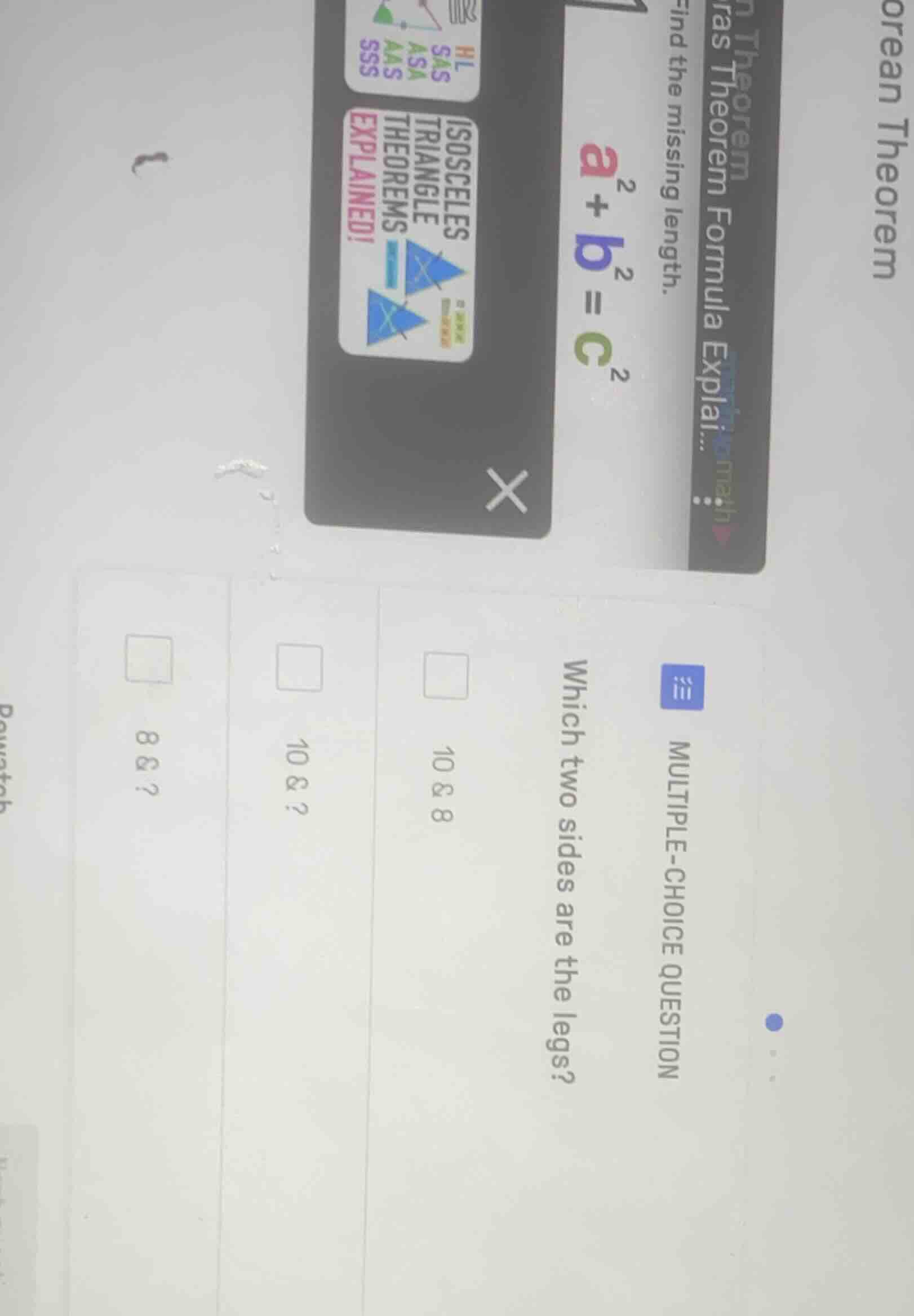
multiple-choice question which two sides are the legs? 10 & 8 10 &? 8 &?
find the missing length. $a^2 + b^2 = c^2$
Step1: Recall Pythagorean Theorem
In a right triangle, the legs are the two shorter sides (the sides forming the right angle), and the hypotenuse is the longest side (opposite the right angle). The Pythagorean theorem is \(a^2 + b^2 = c^2\), where \(c\) is the hypotenuse (longest side), and \(a, b\) are the legs.
Step2: Analyze the given side lengths
The given side lengths to consider are 10, 8, and the missing side. Since 10 is longer than 8, 10 is likely the hypotenuse (or the longest side), so the two shorter sides (legs) should be 10? No, wait—wait, 10 is longer than 8, so actually, the legs are the two sides that are not the hypotenuse. Wait, the options are "10 & 8", "10 &?", "8 &?". Wait, no—wait, in a right triangle, legs are the two sides that are perpendicular (the ones that form the right angle), and hypotenuse is the side opposite the right angle (the longest side). So if the sides are, say, 6, 8, 10 (a common Pythagorean triple), 6 and 8 are legs, 10 is hypotenuse. So here, if one of the sides is 10 (the longest), then the other two (8 and the missing one, or 8 and 10? Wait, no—wait, the question is "Which two sides are the legs?" with options: 10 & 8, 10 &?, 8 &?. Wait, maybe the triangle has sides 8, some leg, and hypotenuse 10. Wait, let's check: if hypotenuse \(c = 10\), and one leg \(a = 8\), then the other leg \(b\) would be \(\sqrt{10^2 - 8^2} = \sqrt{100 - 64} = \sqrt{36} = 6\). But the options are about which two are legs. So legs are the two sides that are not the hypotenuse. Since 10 is the longest (hypotenuse), the legs must be 8 and the other leg (the missing one), but the options have "10 & 8"—no, that can't be. Wait, maybe I misread. Wait, the options are: first option "10 & 8", second "10 &?", third "8 &?". Wait, no—wait, maybe the triangle is such that 10 is a leg? No, because 10 is longer than 8, so hypotenuse should be longer than legs. So if 10 is a leg, then hypotenuse would be longer than 10, but the other leg is 8, so hypotenuse would be \(\sqrt{10^2 + 8^2} = \sqrt{164} \approx 12.8\), but that's less likely. Wait, the common triple is 6-8-10, where 6 and 8 are legs, 10 is hypotenuse. So in that case, legs are 8 and 6 (the missing side), but the options are about which two are legs. The first option is "10 & 8"—no, that's wrong. Wait, maybe the question is phrased differently. Wait, the options are:
- 10 & 8
- 10 &?
- 8 &?
Wait, maybe the "?" is the missing leg. So if the hypotenuse is, say, 10, and one leg is 8, then the other leg is 6 (as above). So the legs are 8 and 6 (the "?"), but the options are "8 &?" (so 8 and the missing leg) or "10 & 8" (no, 10 is hypotenuse). Wait, maybe the question is simpler: in a right triangle, legs are the two sides that are not the hypotenuse. So if the sides are 8, 10, and the missing side, then if 10 is the hypotenuse, legs are 8 and the missing side (so "8 &?"). But the first option is "10 & 8"—that would mean 10 is a leg, which would make hypotenuse longer than 10, but 8 is shorter, so hypotenuse would be \(\sqrt{10^2 + 8^2} = \sqrt{164}\), but that's not a whole number. Wait, the common triple is 6-8-10, so legs 6 and 8, hypotenuse 10. So in that case, legs are 8 and 6 (the "?"), so the legs are 8 and the missing side (so "8 &?"). But the first option is "10 & 8"—no, that's incorrect. Wait, maybe the question is asking which two are legs, and the correct answer is "8 &?" (the third option), but wait, the first option is "10 & 8"—no, that can't be. Wait, maybe I made a mistake. Wait, let's re-express:
In Pythagorean theorem, \(a^2 + b^2 = c^2\), w…

Snap & solve any problem in the app
Get step-by-step solutions on Sovi AI
Photo-based solutions with guided steps
Explore more problems and detailed explanations
The correct option is the one with "8 &?", but since the options are labeled (assuming the first option is A, second B, third C), if the options are:
A. 10 & 8
B. 10 &?
C. 8 &?
Then the answer is C. 8 &?