QUESTION IMAGE
Question
multiple-choice questions
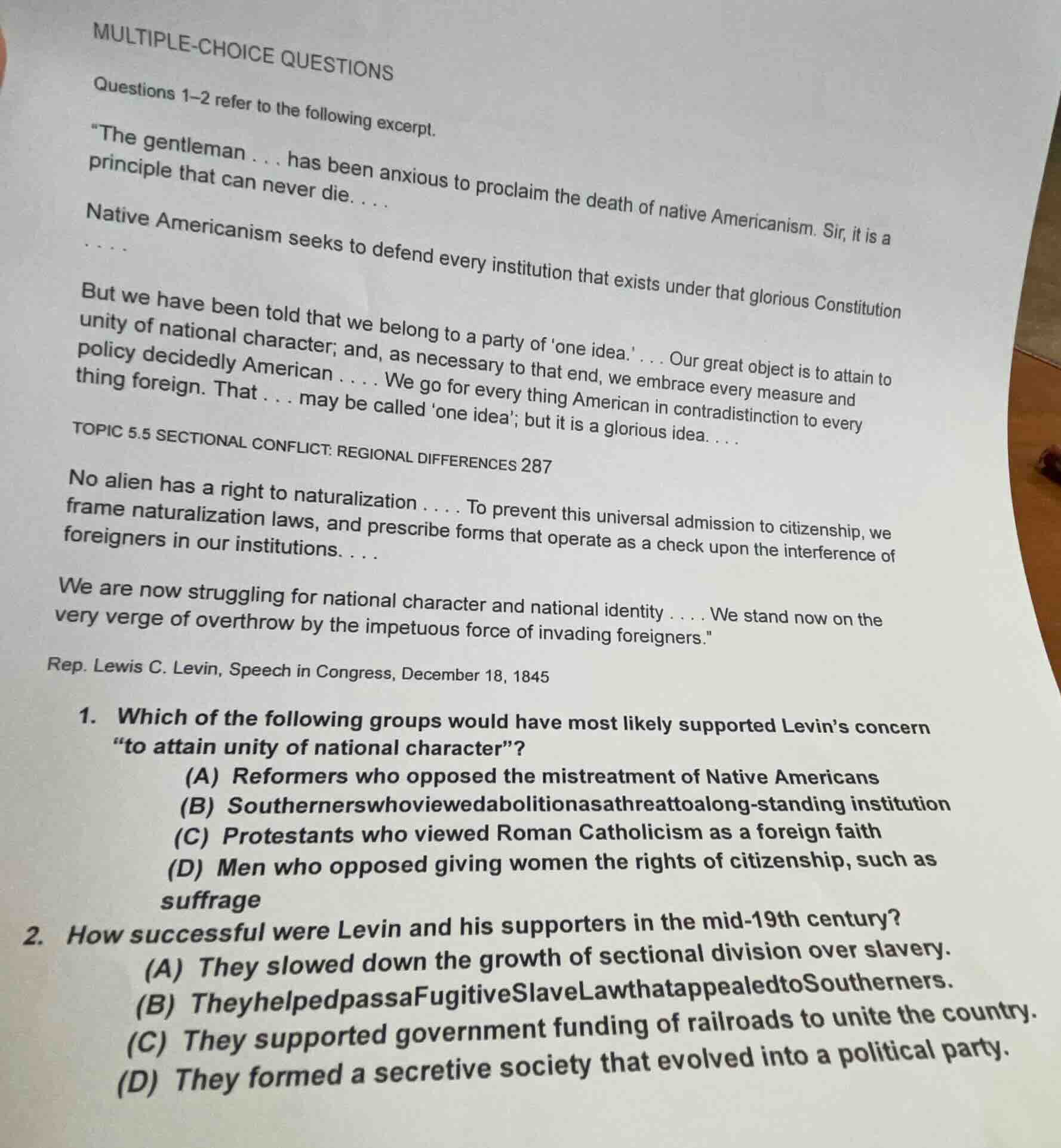
questions 1–2 refer to the following excerpt.
\the gentleman... has been anxious to proclaim the death of native americanism. sir, it is a principle that can never die....
native americanism seeks to defend every institution that exists under that glorious constitution
....
but we have been told that we belong to a party of one idea.... our great object is to attain to unity of national character; and, as necessary to that end, we embrace every measure and policy decidedly american.... we go for every thing american in contradistinction to every thing foreign. that... may be called one idea; but it is a glorious idea....
topic 5.5 sectional conflict: regional differences 287
no alien has a right to naturalization.... to prevent this universal admission to citizenship, we frame naturalization laws, and prescribe forms that operate as a check upon the interference of foreigners in our institutions....
we are now struggling for national character and national identity.... we stand now on the very verge of overthrow by the impetuous force of invading foreigners.\
rep. lewis c. levin, speech in congress, december 18, 1845
- which of the following groups would have most likely supported levin’s concern \to attain unity of national character\?
(a) reformers who opposed the mistreatment of native americans
(b) southernerswhoviewedabolitionasathreattoalong - standing institution
(c) protestants who viewed roman catholicism as a foreign faith
(d) men who opposed giving women the rights of citizenship, such as suffrage
- how successful were levin and his supporters in the mid - 19th century?
(a) they slowed down the growth of sectional division over slavery.
(b) theyhelpedpassafugitiveslavelawthatappealedtosoutherners.
(c) they supported government funding of railroads to unite the country.
(d) they formed a secretive society that evolved into a political party.
Question 1
Levin's concern about "unity of national character" and opposition to foreign influence (like limiting naturalization, fearing foreign interference) aligns with nativist sentiments. In the mid - 19th century, many Protestants viewed Roman Catholicism (often associated with immigrants, especially Irish and German) as a foreign faith. Option A: Reformers opposing Native American mistreatment are about Native rights, not nativism. Option B: Southerners fearing abolition is about slavery, not foreign influence. Option D: Opposing women's suffrage is about gender, not foreign influence. So Protestants with anti - Catholic (foreign faith) views would support Levin's nativist - leaning concern.
Levin and his supporters were part of the nativist movement. The Know - Nothing Party (American Party) evolved from secret nativist societies. Option A: Sectional division over slavery grew, they didn't slow it. Option B: Fugitive Slave Law was about slavery, not their focus. Option C: Government funding of railroads was not their main action. The nativist movement formed secret societies (like the Order of the Star - Spangled Banner) that evolved into the Know - Nothing (American) political party.

Snap & solve any problem in the app
Get step-by-step solutions on Sovi AI
Photo-based solutions with guided steps
Explore more problems and detailed explanations
C. Protestants who viewed Roman Catholicism as a foreign faith