QUESTION IMAGE
Question
multiple-choice questions
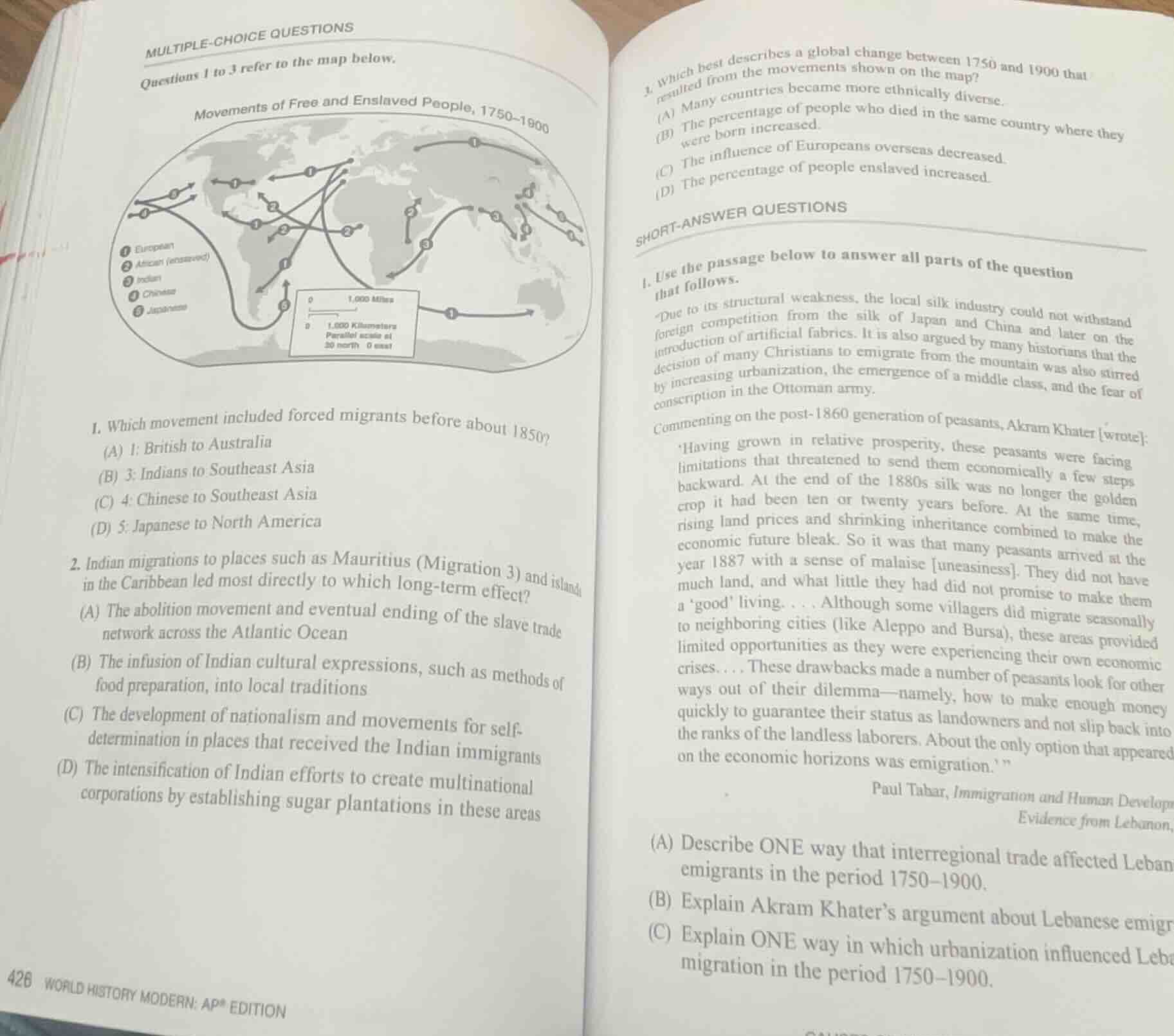
questions 1 to 3 refer to the map below.
movements of free and enslaved people, 1750–1900
- which movement included forced migrants before about 1850?
(a) 1: british to australia
(b) 3: indians to southeast asia
(c) 4: chinese to southeast asia
(d) 5: japanese to north america
- indian migrations to places such as mauritius (migration 3) and islands in the caribbean led most directly to which long - term effect?
(a) the abolition movement and eventual ending of the slave trade network across the atlantic ocean
(b) the infusion of indian cultural expressions, such as methods of food preparation, into local traditions
(c) the development of nationalism and movements for self - determination in places that received the indian immigrants
(d) the intensification of indian efforts to create multinational corporations by establishing sugar plantations in these areas
- which best describes a global change between 1750 and 1900 that resulted from the movements shown on the map?
(a) many countries became more ethnically diverse.
(b) the percentage of people who died in the same country where they were born increased.
(c) the influence of europeans overseas decreased.
(d) the percentage of people enslaved increased.
short - answer questions
- use the passage below to answer all parts of the question that follows.
\due to its structural weakness, the local silk industry could not withstand foreign competition from the silk of japan and china and later on the introduction of artificial fabrics. it is also argued by many historians that the decision of many christians to emigrate from the mountain was also stirred by increasing urbanization, the emergence of a middle class, and the fear of conscription in the ottoman army.
commenting on the post - 1860 generation of peasants, akram khater wrote:
having grown in relative prosperity, these peasants were facing limitations that threatened to send them economically a few steps backward. at the end of the 1880s silk was no longer the golden crop it had been ten or twenty years before. at the same time, rising land prices and shrinking inheritance combined to make the economic future bleak. so it was that many peasants arrived at the year 1887 with a sense of malaise uneasiness. they did not have much land, and what little they had did not promise to make them a good living.... although some villagers did migrate seasonally to neighboring cities (like aleppo and bursa), these areas provided limited opportunities as they were experiencing their own economic crises.... these drawbacks made a number of peasants look for other ways out of their dilemma—namely, how to make enough money quickly to guarantee their status as landowners and not slip back into the ranks of the landless laborers. about the only option that appeared on the economic horizons was emigration.\
paul tabar, immigration and human developm
evidence from lebanon,
(a) describe one way that interregional trade affected leban emigrants in the period 1750–1900.
(b) explain akram khater’s argument about lebanese emigr
(c) explain one way in which urbanization influenced leba migration in the period 1750–1900.
426 world history modern: ap® edition
Multiple-Choice Questions
- For question 1: Movement 2 is labeled as African (enslaved), which was forced migration (the transatlantic slave trade) that occurred before 1850. The other options are voluntary or post-1850 migrations.
- For question 2: Indian migrant communities brought their cultural practices, including food preparation, to regions like Mauritius and the Caribbean, which became integrated into local traditions. The other options are not direct long-term effects of these specific migrations.
- For question 3: The global movements of free and enslaved people between 1750-1900 (including enslaved Africans, indentured Indians, and European migrants) led to significant ethnic diversity in countries that received these populations.
(A) Interregional trade undermined Lebanon's silk industry, which pushed many peasants to emigrate as they lost their primary economic livelihood.
(B) Akram Khater argues that late 19th-century Lebanese peasants faced declining economic prospects (collapsing silk prices, rising land costs, shrinking inheritances) that made their future bleak, leading them to see emigration as one of the only viable ways to maintain their status as landowners.
(C) Urbanization in nearby cities like Aleppo and Bursa offered limited economic opportunities, as these cities were facing their own crises, so Lebanese peasants could not rely on local urban migration, making overseas emigration a more attractive option.

Snap & solve any problem in the app
Get step-by-step solutions on Sovi AI
Photo-based solutions with guided steps
Explore more problems and detailed explanations
- (B) 3: Indians to Southeast Asia
- (B) The infusion of Indian cultural expressions, such as methods of food preparation, into local traditions
- (A) Many countries became more ethnically diverse.
---