QUESTION IMAGE
Question
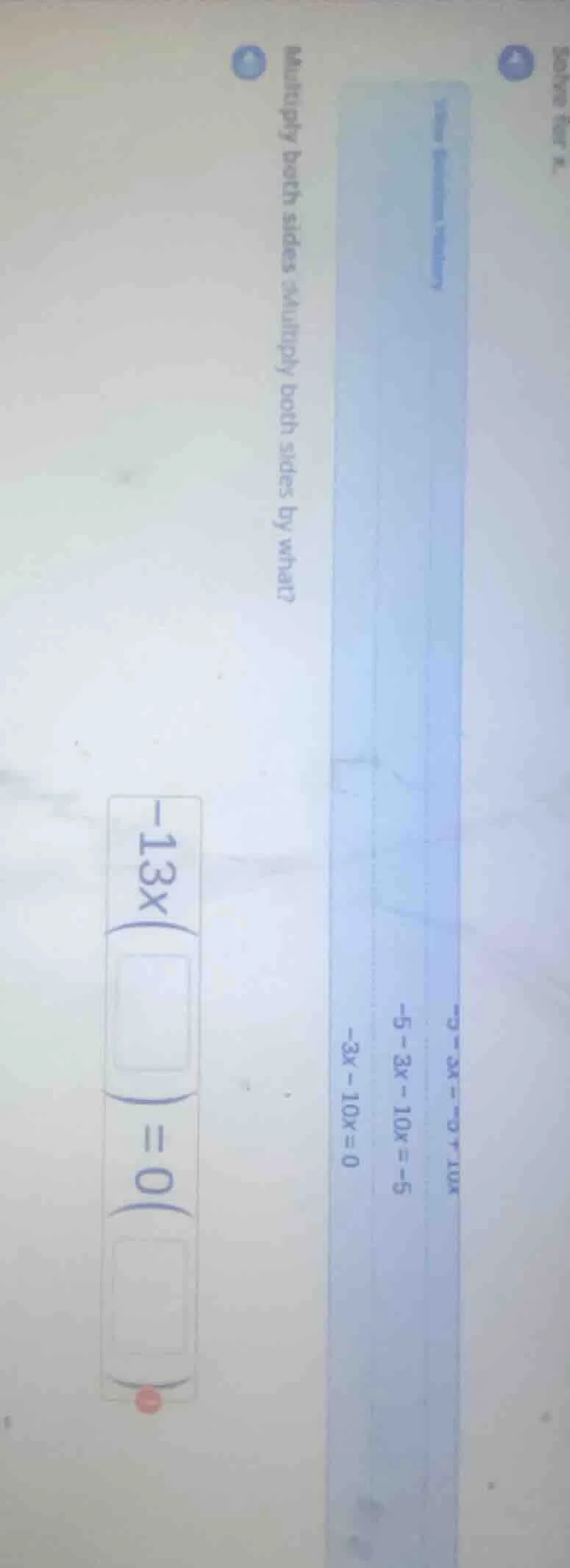
multiply both sides: multiply both sides by what?
-13x ( ) = 0 ( )
-3 - 3x = -5 + 10x
-5 - 3x - 10x = -5
-3x - 10x = 0
Step1: Analyze the equation -13x = 0
To solve for \( x \), we need to isolate \( x \). We can do this by multiplying both sides of the equation by the reciprocal of the coefficient of \( x \). The coefficient of \( x \) is -13, so its reciprocal is \( \frac{1}{-13} \) or \( -\frac{1}{13} \).
Step2: Multiply both sides by \( -\frac{1}{13} \)
\[
-\frac{1}{13} \times (-13x) = -\frac{1}{13} \times 0
\]
Simplifying the left side: \( (-\frac{1}{13} \times -13)x = 1 \times x = x \)
Simplifying the right side: \( -\frac{1}{13} \times 0 = 0 \)

Snap & solve any problem in the app
Get step-by-step solutions on Sovi AI
Photo-based solutions with guided steps
Explore more problems and detailed explanations
To solve \( -13x = 0 \), we multiply both sides by \( \boldsymbol{-\frac{1}{13}} \) (or divide both sides by -13) and we get \( x = 0 \). So the value to multiply both sides by is \( -\frac{1}{13} \) (or equivalently, dividing by -13 is the same as multiplying by \( -\frac{1}{13} \)). If we consider the operation to make the coefficient of \( x \) equal to 1, we multiply both sides by \( \boldsymbol{-\frac{1}{13}} \).