QUESTION IMAGE
Question
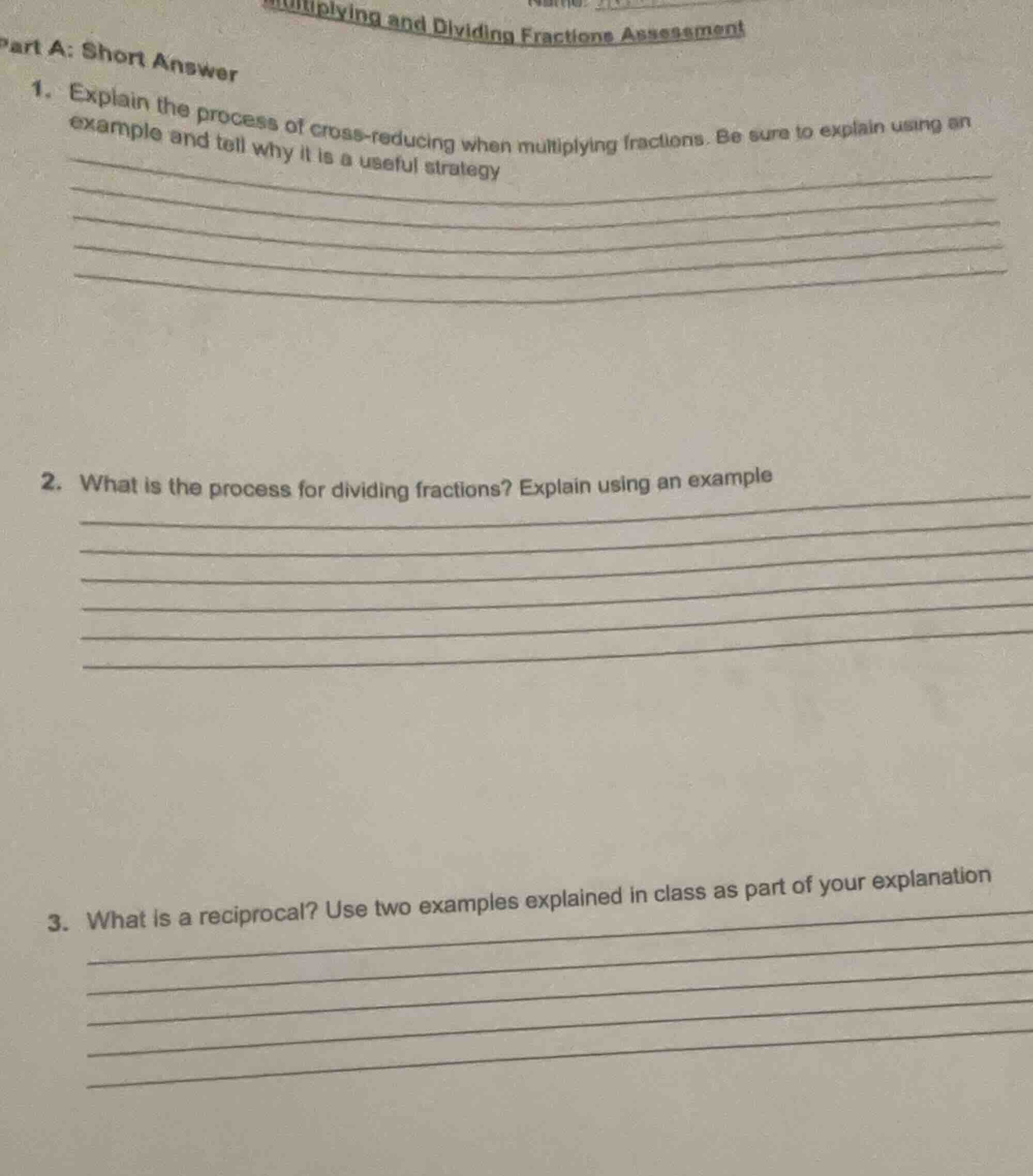
multiplying and dividing fractions assessment
part a: short answer
- explain the process of cross - reducing when multiplying fractions. be sure to explain using an example and tell why it is a useful strategy
- what is the process for dividing fractions? explain using an example
- what is a reciprocal? use two examples explained in class as part of your explanation
Question 1: Cross - reducing when multiplying fractions
- Process of Cross - reducing:
- Cross - reducing (also called cross - canceling) is a method used before multiplying two or more fractions. We look for a numerator in one fraction and a denominator in another fraction that have a common factor (other than 1). Then we divide both that numerator and that denominator by their greatest common factor (GCF).
- Example: Let's take the multiplication of two fractions $\frac{4}{6}\times\frac{3}{8}$.
- First, we identify that 4 (numerator of the first fraction) and 8 (denominator of the second fraction) have a GCF of 4, and 3 (numerator of the second fraction) and 6 (denominator of the first fraction) have a GCF of 3.
- Divide 4 by 4: $4\div4 = 1$, and divide 8 by 4: $8\div4=2$. Divide 3 by 3: $3\div3 = 1$, and divide 6 by 3: $6\div3 = 2$.
- Now our fractions become $\frac{1}{2}\times\frac{1}{2}$.
- Multiply the numerators: $1\times1 = 1$, and multiply the denominators: $2\times2=4$. So $\frac{4}{6}\times\frac{3}{8}=\frac{1}{4}$.
- Why it is useful:
- It simplifies the numbers we are working with before multiplication. If we didn't cross - reduce, we would first multiply the numerators and denominators: $\frac{4\times3}{6\times8}=\frac{12}{48}$, and then we would have to simplify $\frac{12}{48}$ by dividing numerator and denominator by their GCF (12) to get $\frac{1}{4}$. Cross - reducing makes the numbers smaller and the final simplification (if needed) easier or sometimes unnecessary.
- Process of Dividing Fractions:
- The process for dividing fractions is "keep, change, flip".
- "Keep" the first fraction as it is.
- "Change" the division sign to a multiplication sign.
- "Flip" the second fraction (find its reciprocal, which means swapping the numerator and the denominator). Then we multiply the two fractions as we would in fraction multiplication (we can also use cross - reducing here if possible).
- Example: Let's divide $\frac{2}{3}\div\frac{4}{5}$.
- "Keep" $\frac{2}{3}$, "Change" $\div$ to $\times$, "Flip" $\frac{4}{5}$ to $\frac{5}{4}$.
- Now we have $\frac{2}{3}\times\frac{5}{4}$.
- We can cross - reduce here: 2 and 4 have a GCF of 2. Divide 2 by 2: $2\div2 = 1$, divide 4 by 2: $4\div2 = 2$.
- The multiplication becomes $\frac{1}{3}\times\frac{5}{2}=\frac{1\times5}{3\times2}=\frac{5}{6}$.
- Definition of Reciprocal:
- The reciprocal of a non - zero number (or fraction) is another number (or fraction) such that when the two numbers are multiplied together, the product is 1. For a fraction $\frac{a}{b}$ (where $a
eq0$ and $b
eq0$), its reciprocal is $\frac{b}{a}$. For a whole number $n$ (which can be written as $\frac{n}{1}$), its reciprocal is $\frac{1}{n}$.
- Example 1: Take the fraction $\frac{3}{4}$. Its reciprocal is $\frac{4}{3}$ because $\frac{3}{4}\times\frac{4}{3}=\frac{3\times4}{4\times3}=1$.
- Example 2: Take the whole number 5 (which is $\frac{5}{1}$). Its reciprocal is $\frac{1}{5}$ because $5\times\frac{1}{5}=\frac{5}{1}\times\frac{1}{5}=1$.

Snap & solve any problem in the app
Get step-by-step solutions on Sovi AI
Photo-based solutions with guided steps
Explore more problems and detailed explanations
Cross - reducing involves finding common factors between numerators of one fraction and denominators of another fraction in a multiplication of fractions, dividing them by their GCF before multiplying. For example, $\frac{4}{6}\times\frac{3}{8}$ cross - reduces to $\frac{1}{2}\times\frac{1}{2}=\frac{1}{4}$. It's useful as it simplifies numbers for easier calculation and reduces the work of simplifying the final product.