QUESTION IMAGE
Question
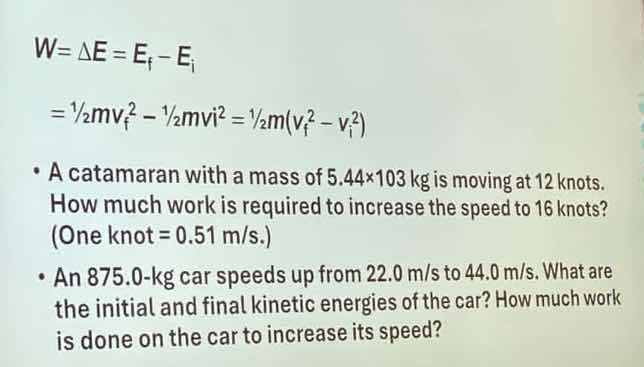
w=δe = e_f - e_i
= ½mv_f² - ½mvi² = ½m(v_f² - v_i²)
- a catamaran with a mass of 5.44×10³ kg is moving at 12 knots. how much work is required to increase the speed to 16 knots? (one knot = 0.51 m/s.)
- an 875.0-kg car speeds up from 22.0 m/s to 44.0 m/s. what are the initial and final kinetic energies of the car? how much work is done on the car to increase its speed?
Response
First Problem (Catamaran)
We use the work - kinetic energy theorem \(W=\Delta E_{k}=\frac{1}{2}m(v_{f}^{2}-v_{i}^{2})\). First, we need to convert the speed from knots to m/s. Given that 1 knot = 0.51 m/s.
Step 1: Convert speeds to m/s
- Initial speed \(v_{i}=12\) knots. So \(v_{i}=12\times0.51\ m/s = 6.12\ m/s\)
- Final speed \(v_{f}=16\) knots. So \(v_{f}=16\times0.51\ m/s=8.16\ m/s\)
- Mass of the catamaran \(m = 5.44\times10^{3}\ kg\)
Step 2: Calculate the work done
Using the formula \(W=\frac{1}{2}m(v_{f}^{2}-v_{i}^{2})\)
\[
$$\begin{align*}
W&=\frac{1}{2}\times5.44\times 10^{3}\times(8.16^{2}-6.12^{2})\\
&=\frac{1}{2}\times5.44\times 10^{3}\times(66.5856 - 37.4544)\\
&=\frac{1}{2}\times5.44\times 10^{3}\times29.1312\\
&=2.72\times 10^{3}\times29.1312\\
&=79236.864\ J\approx7.92\times 10^{4}\ J
\end{align*}$$
\]
Second Problem (Car)
Part 1: Initial Kinetic Energy (\(E_{ki}\))
The formula for kinetic energy is \(E_{k}=\frac{1}{2}mv^{2}\)
Step 1: Calculate initial kinetic energy
Given \(m = 875.0\ kg\) and \(v_{i}=22.0\ m/s\)
\[
$$\begin{align*}
E_{ki}&=\frac{1}{2}\times875.0\times(22.0)^{2}\\
&=\frac{1}{2}\times875.0\times484\\
& = 875.0\times242\\
&=211750\ J = 2.12\times 10^{5}\ J
\end{align*}$$
\]
Part 2: Final Kinetic Energy (\(E_{kf}\))
Using the kinetic energy formula \(E_{k}=\frac{1}{2}mv^{2}\)
Step 1: Calculate final kinetic energy
Given \(m = 875.0\ kg\) and \(v_{f}=44.0\ m/s\)
\[
$$\begin{align*}
E_{kf}&=\frac{1}{2}\times875.0\times(44.0)^{2}\\
&=\frac{1}{2}\times875.0\times1936\\
&=875.0\times968\\
& = 847000\ J=8.47\times 10^{5}\ J
\end{align*}$$
\]
Part 3: Work done to increase speed

Snap & solve any problem in the app
Get step-by-step solutions on Sovi AI
Photo-based solutions with guided steps
Explore more problems and detailed explanations
s:
- Work required for catamaran: \(\boldsymbol{\approx7.92\times 10^{4}\ J}\)
- Initial kinetic energy of car: \(\boldsymbol{2.12\times 10^{5}\ J}\)
- Final kinetic energy of car: \(\boldsymbol{8.47\times 10^{5}\ J}\)
- Work done on car: \(\boldsymbol{6.35\times 10^{5}\ J}\)