QUESTION IMAGE
Question
n-gen math® 8 homework
fluency
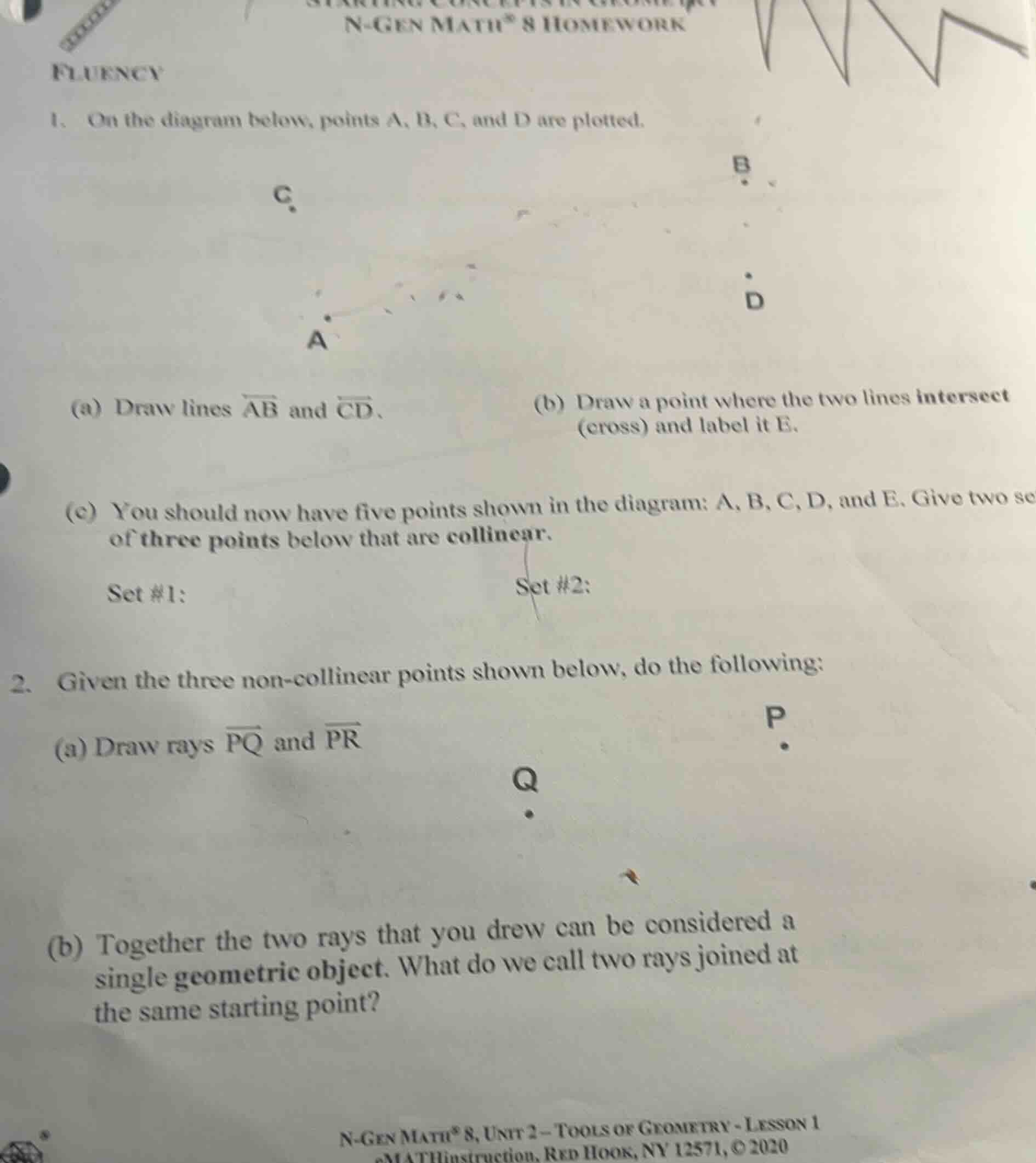
- on the diagram below, points a, b, c, and d are plotted.
(a) draw lines \\(\overline{ab}\\) and \\(\overline{cd}\\). \t (b) draw a point where the two lines intersect (cross) and label it e.
(c) you should now have five points shown in the diagram: a, b, c, d, and e. give two sets of three points below that are collinear.
set #1: \t set #2:
- given the three non - collinear points shown below, do the following:
(a) draw rays \\(\overline{pq}\\) and \\(\overline{pr}\\)
(b) together the two rays that you drew can be considered a single geometric object. what do we call two rays joined at the same starting point?
n - gen math® 8, unit 2 – tools of geometry - lesson 1
©mathinstruction, red hook, ny 12571, © 2020
Problem 1(c)
Step1: Recall collinear definition
Collinear points lie on the same line. From part (a) and (b), line $\overleftrightarrow{AB}$ contains points A, B, E (since E is the intersection of $\overleftrightarrow{AB}$ and $\overleftrightarrow{CD}$), and line $\overleftrightarrow{CD}$ contains points C, D, E.
Step2: Identify collinear sets
Set #1: A, B, E (all on $\overleftrightarrow{AB}$)
Set #2: C, D, E (all on $\overleftrightarrow{CD}$)
Problem 2(b)
Two rays with the same starting point form an angle. A ray has a fixed starting point and extends infinitely in one direction; when two such rays share the same starting point (vertex), they create an angle.

Snap & solve any problem in the app
Get step-by-step solutions on Sovi AI
Photo-based solutions with guided steps
Explore more problems and detailed explanations
Angle
Final Answers (for each sub - question):
1(c) Set #1: A, B, E; Set #2: C, D, E
2(b) Angle