QUESTION IMAGE
Question
name:
class period
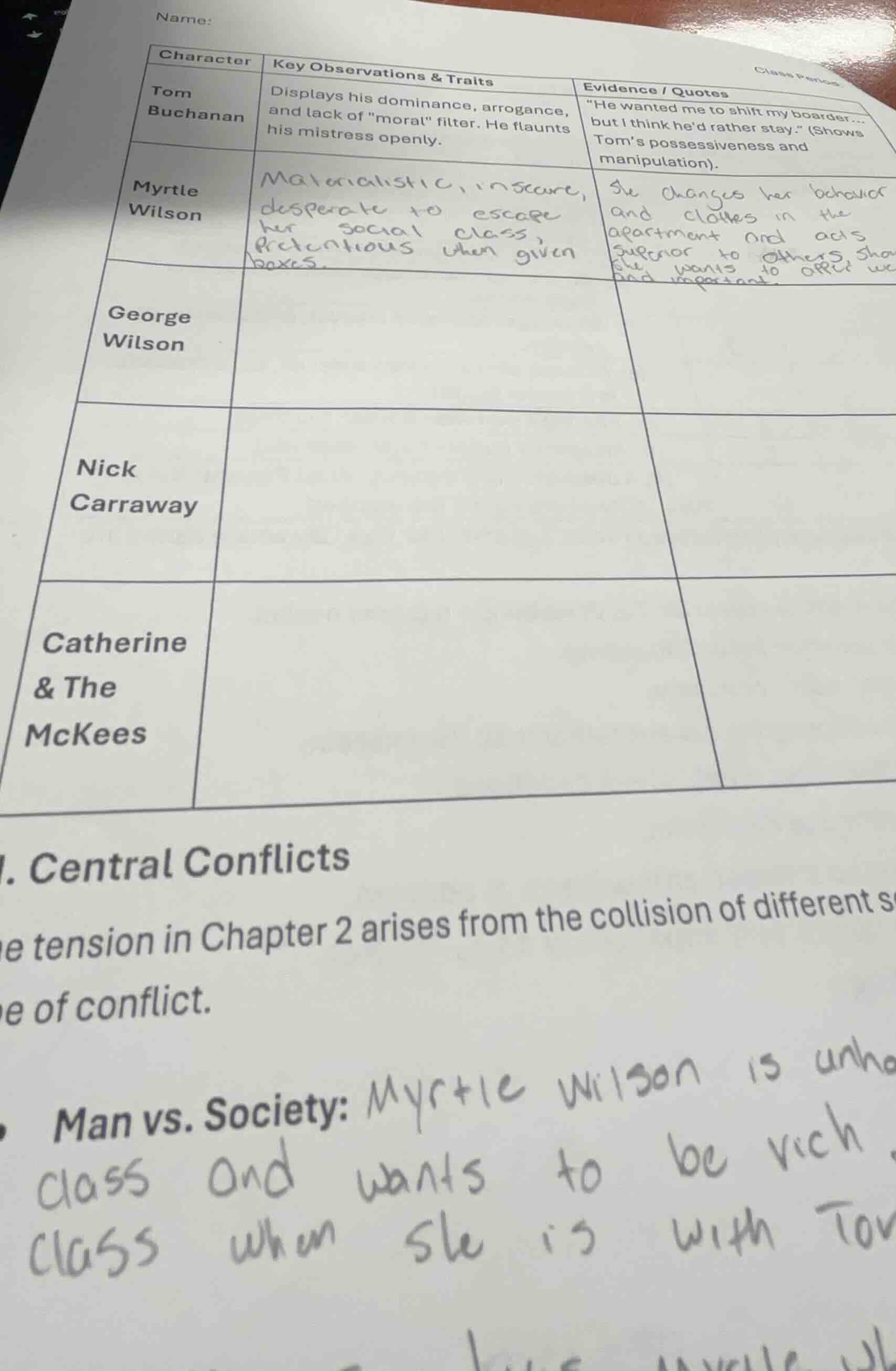
| character | key observations & traits | evidence / quotes |
|---|---|---|
| myrtle wilson | materialistic, insecure, desperate to escape her social class, pretentious when given access. | she changes her behavior and clothes in the apartment and acts superior to others showing she wants to appear wealthy and important. |
| george wilson | ||
| nick carraway | ||
| catherine & the mckees |
i. central conflicts
e tension in chapter 2 arises from the collision of different s
e of conflict.
- man vs. society: myrtle wilson is unh
class and wants to be rich
class when she is with tom
Brief Explanations
This is a character analysis worksheet for The Great Gatsby Chapter 2. Below are completed entries aligned with the text's details:
- George Wilson: He is passive, defeated, financially struggling, and emotionally dependent on Myrtle; he is unaware of her affair initially. Evidence comes from his dejected demeanor and his line: "I just got wised up to something funny the last two days."
- Nick Carraway: He is a quiet, observant, morally reserved outsider; he is uncomfortable with the excess and immorality he witnesses. Evidence: "I was within and without, simultaneously enchanted and repelled by the inexhaustible variety of life."
- Catherine & The McKees: They are shallow, gossipy, social climbers who thrive on the drama of the wealthy and upper-class affairs. Evidence: Catherine gossips about Tom and Daisy's marriage, and Mr. McKee brags about his photography work to appear important.

Snap & solve any problem in the app
Get step-by-step solutions on Sovi AI
Photo-based solutions with guided steps
Explore more problems and detailed explanations
| Character | Key Observations & Traits | Evidence / Quotes |
|---|---|---|
| Myrtle Wilson | Materialistic, insecure, desperate to escape her social class, pretentious when given luxuries. | She changes her behavior and clothes in the apartment and acts superior to others to appear wealthy and important. |
| George Wilson | Passive, financially struggling, emotionally defeated, unaware of Myrtle's affair initially. | "I just got wised up to something funny the last two days." (Shows his growing suspicion, paired with his dejected, worn-down demeanor). |
| Nick Carraway | Observant, morally reserved, quiet outsider, uncomfortable with excess and immorality. | "I was within and without, simultaneously enchanted and repelled by the inexhaustible variety of life." |
| Catherine & The McKees | Shallow, gossipy, social climbers, fixated on upper-class drama. | Catherine gossips: "It's really his wife that's keeping them apart. She's a Catholic, and they don't believe in divorce." (A lie she spreads about Daisy), and Mr. McKee brags about his professional photography to seem important. |
Central Conflicts (Completed):
- Man vs. Society: Myrtle Wilson is unhappy with her working-class status and desperately tries to adopt the lifestyle and mannerisms of the upper class when she is with Tom, clashing with the rigid social hierarchy of 1920s America.
- Man vs. Man: Tom Buchanan's arrogant, possessive treatment of Myrtle (e.g., breaking her nose for mentioning Daisy) creates direct tension between them, as he asserts his power over her to maintain control of their affair.
- Man vs. Self: Nick Carraway struggles with his role as an observer; he is drawn to the excitement of the wealthy social circle but repulsed by its moral emptiness, creating internal conflict about his own complicity.