QUESTION IMAGE
Question
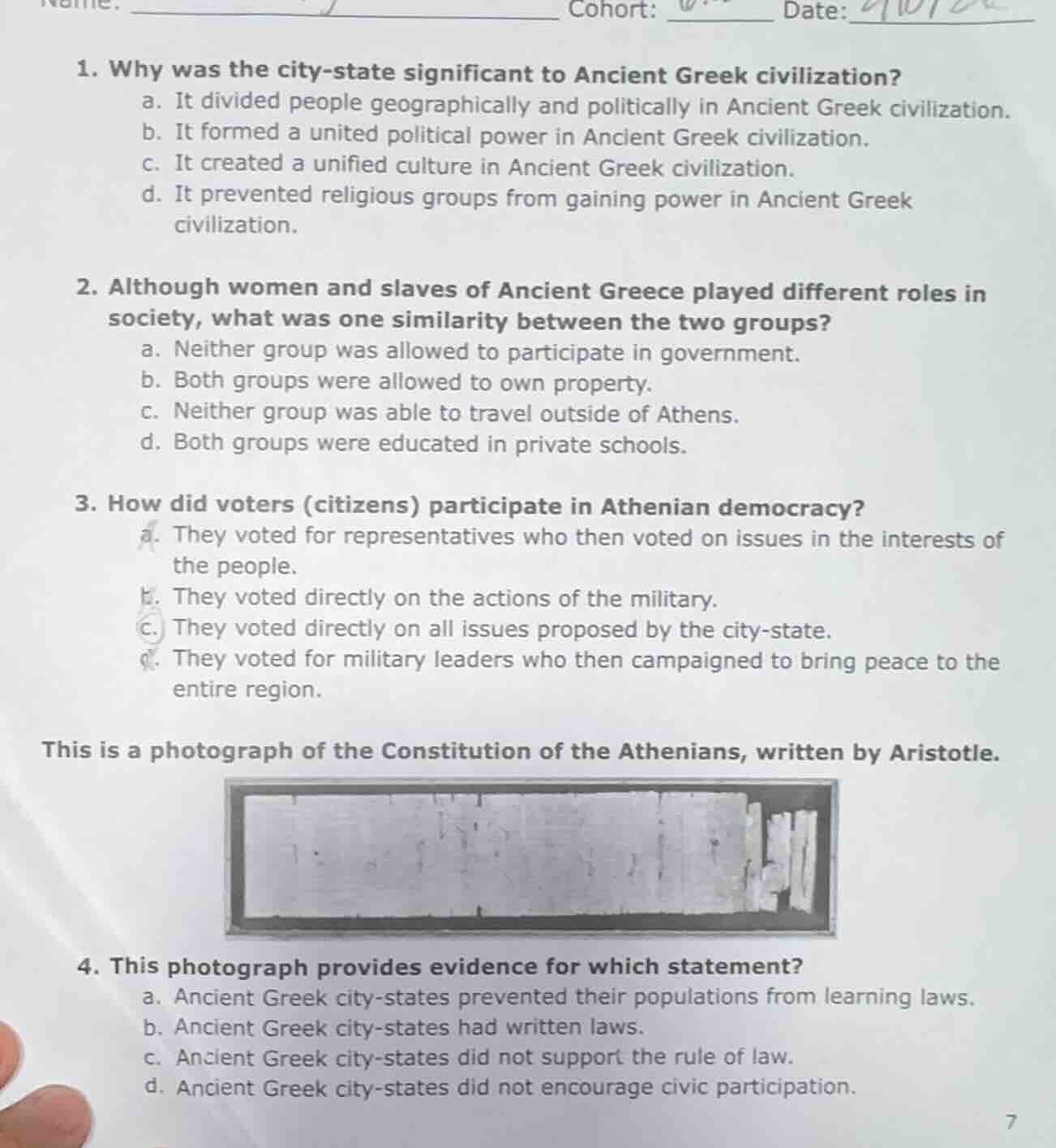
name: _____________ cohort: date: ____1. why was the city-state significant to ancient greek civilization?a. it divided people geographically and politically in ancient greek civilization.b. it formed a united political power in ancient greek civilization.c. it created a unified culture in ancient greek civilization.d. it prevented religious groups from gaining power in ancient greek civilization.2. although women and slaves of ancient greece played different roles in society, what was one similarity between the two groups?a. neither group was allowed to participate in government.b. both groups were allowed to own property.c. neither group was able to travel outside of athens.d. both groups were educated in private schools.3. how did voters (citizens) participate in athenian democracy?a. they voted for representatives who then voted on issues in the interests of the people.b. they voted directly on the actions of the military.c. they voted directly on all issues proposed by the city-state.d. they voted for military leaders who then campaigned to bring peace to the entire region.this is a photograph of the constitution of the athenians, written by aristotle.4. this photograph provides evidence for which statement?a. ancient greek city-states prevented their populations from learning laws.b. ancient greek city-states had written laws.c. ancient greek city-states did not support the rule of law.d. ancient greek city-states did not encourage civic participation.7
- Ancient Greek city-states (poleis) were geographically separated by mountains and seas, creating distinct political entities that divided the civilization politically and geographically.
- In Ancient Greece, only free male citizens could participate in government; women and slaves were excluded from political participation.
- Athenian democracy was a direct democracy, where eligible citizens voted directly on laws and issues proposed by the city-state, not through representatives.
- Aristotle's Constitution of the Athenians is a written text detailing Athenian governance, proving that Ancient Greek city-states had written legal and governmental frameworks.

Snap & solve any problem in the app
Get step-by-step solutions on Sovi AI
Photo-based solutions with guided steps
Explore more problems and detailed explanations
- a. It divided people geographically and politically in Ancient Greek civilization.
- a. Neither group was allowed to participate in government.
- c. They voted directly on all issues proposed by the city-state.
- b. Ancient Greek city-states had written laws.