QUESTION IMAGE
Question
name:
date: 12 - 4 - 26
period: 5
learning target: i can analyze primary and secondary sources about the treaty of versailles and use evidence to answer crq questions that explain the treaty’s terms and its impact on germany and the post - world war i world.
success criteria
- identify key ideas from each source related to the treaty of versailles (ex: reparations, war guilt, territorial loss, league of nations).
- explain how the treaty’s terms affected germany using evidence from the sources.
- use evidence from at least two sources to support a written response.
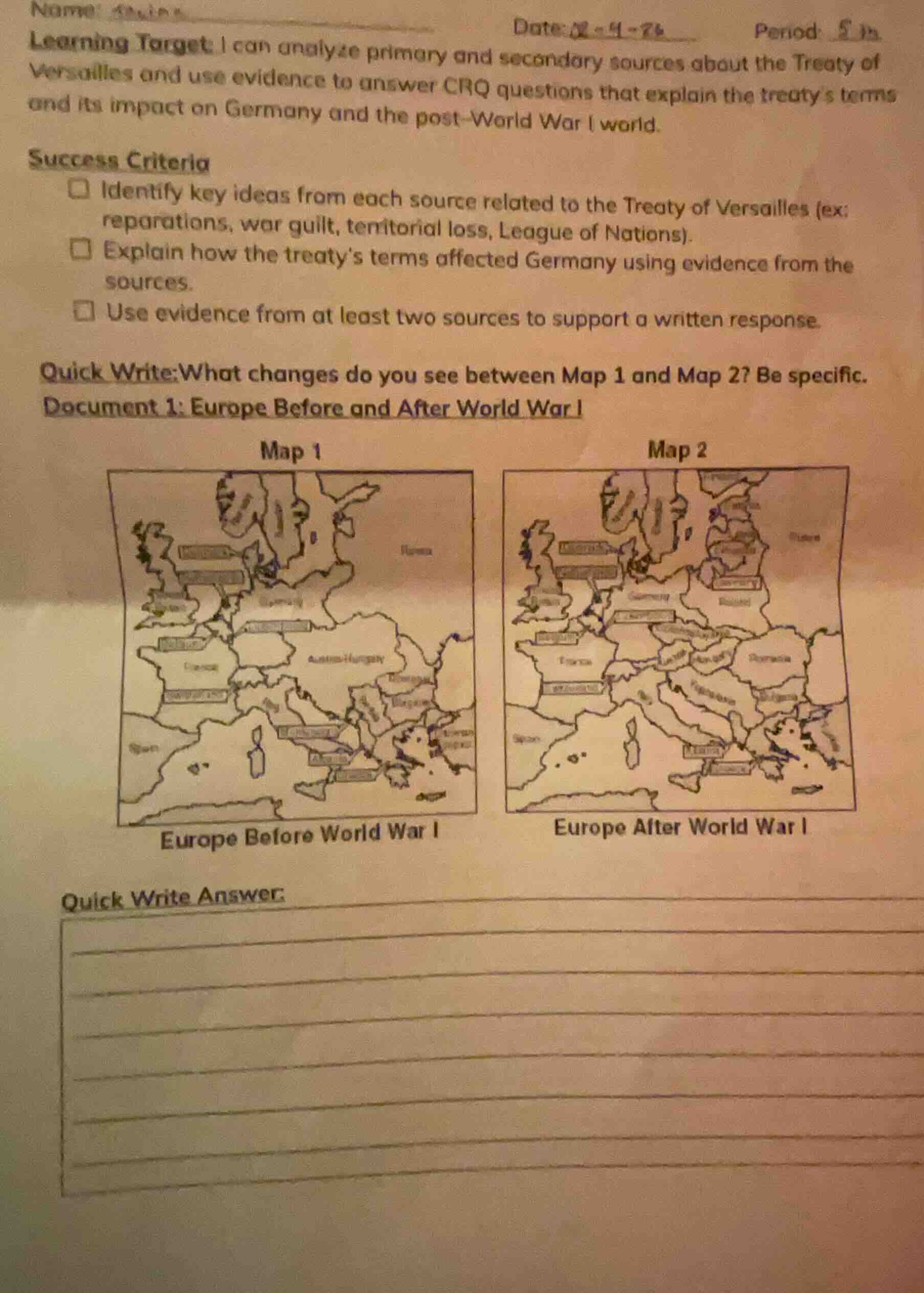
quick write: what changes do you see between map 1 and map 2? be specific.
document 1: europe before and after world war i
map 1 (europe before world war i)
map 2 (europe after world war i)
quick write answer:
To answer the question about the changes between Map 1 (Europe Before World War I) and Map 2 (Europe After World War I), we analyze the political boundaries:
- Austria - Hungary: In Map 1, the large empire of Austria - Hungary exists. In Map 2, it is dissolved into multiple new countries like Austria, Hungary, Czechoslovakia, and parts of other nations.
- Germany: Map 1 shows a larger Germany. Map 2 shows Germany with reduced territory (e.g., lost Alsace - Lorraine to France, and parts to new Eastern European states) and the creation of the Rhineland as a demilitarized zone (implied by post - war treaties).
- New States: Map 2 has new independent states such as Poland, Czechoslovakia, Yugoslavia, and Finland (more clearly defined), which were not present or were part of larger empires in Map 1.
- Russia/Soviet Union: Map 1 has the Russian Empire; Map 2 shows the Soviet Union (or a transformed Russian - led state) with different neighboring states due to the breakup of empires.

Snap & solve any problem in the app
Get step-by-step solutions on Sovi AI
Photo-based solutions with guided steps
Explore more problems and detailed explanations
- The Austro - Hungarian Empire (in Map 1) is broken into multiple countries (e.g., Austria, Hungary, Czechoslovakia) in Map 2.
- Germany’s territory is reduced (e.g., lost Alsace - Lorraine to France, and land to new Eastern European states) in Map 2 compared to Map 1.
- New independent states like Poland, Czechoslovakia, and Yugoslavia appear in Map 2 (not in Map 1’s imperial - dominated Europe).
- The Russian Empire (Map 1) is replaced by the Soviet Union (or a reorganized Russian - led state) with new neighboring states in Map 2.