QUESTION IMAGE
Question
name
date
class
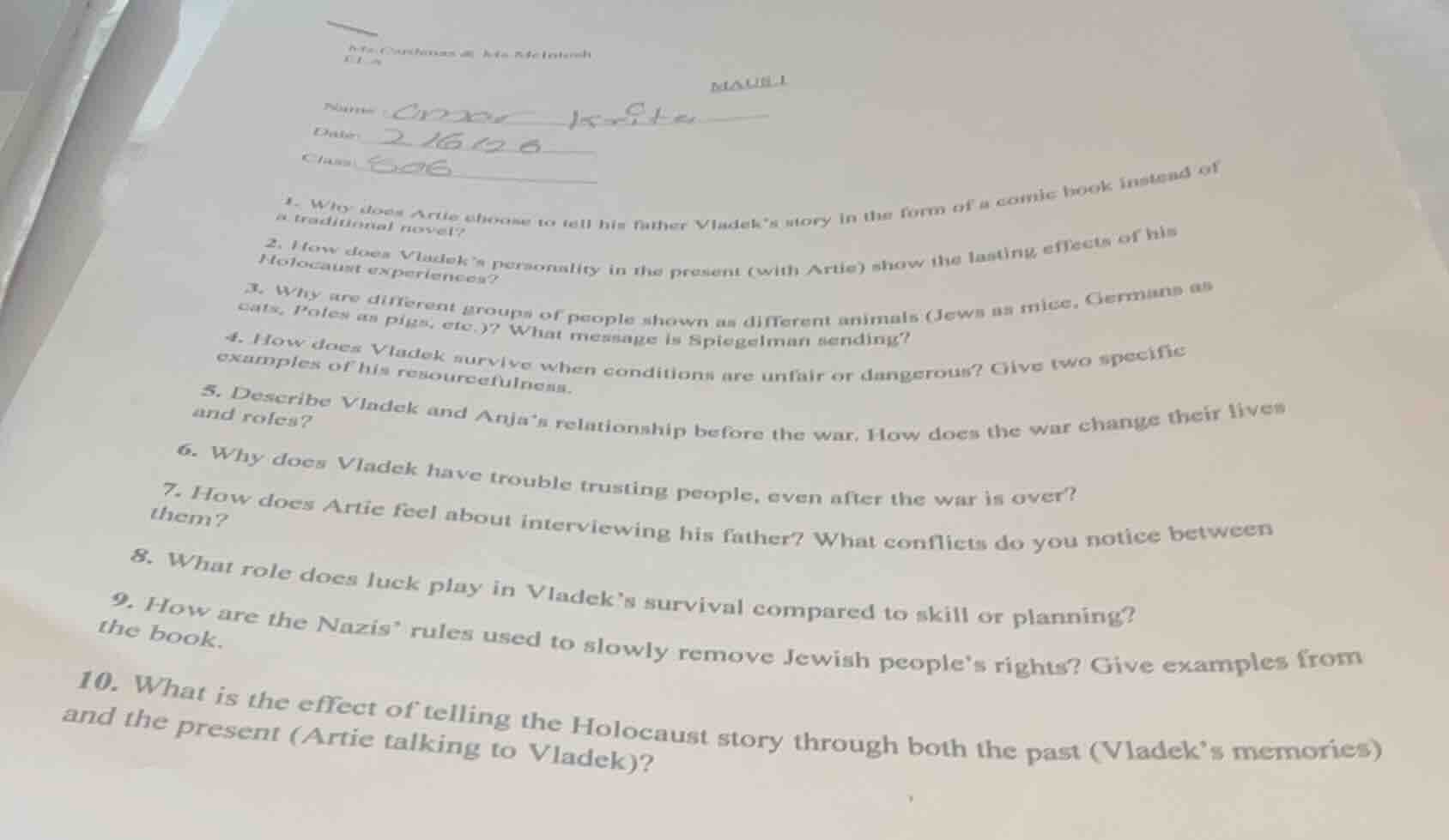
- why does artie choose to tell his father vladek’s story in the form of a comic book instead of a traditional novel?
- how does vladek’s personality in the present (with artie) show the lasting effects of his holocaust experiences?
- why are different groups of people shown as different animals (jews as mice, germans as cats, poles as pigs, etc.)? what message is spiegelman sending?
- how does vladek survive when conditions are unfair or dangerous? give two specific examples of his resourcefulness.
- describe vladek and anja’s relationship before the war. how does the war change their lives and roles?
- why does vladek have trouble trusting people, even after the war is over?
- how does artie feel about interviewing his father? what conflicts do you notice between them?
- what role does luck play in vladek’s survival compared to skill or planning?
- how are the nazis’ rules used to slowly remove jewish people’s rights? give examples from the book.
- what is the effect of telling the holocaust story through both the past (vladek’s memories) and the present (artie talking to vladek)?
Brief Explanations
- Question 1: Spiegelman uses comics to make the traumatic Holocaust story more accessible, as the visual medium softens the harshness while emphasizing the dehumanization of victims. The comic format also mirrors the "cartoonish" dehumanization of Jews by the Nazis, creating a thematic parallel.
- Question 2: Vladek's personality shows lasting trauma: he is overly frugal (hoarding food/objects from scarcity), distrustful of others (especially non-Jews), and has strained relationships due to his hyper-vigilance and emotional detachment, all rooted in his fight to survive the Holocaust.
- Question 3: The animal metaphor visualizes Nazi racial hierarchies: Jews as mice (powerless, preyed upon), Germans as cats (oppressors, predators), Poles as pigs (complicit bystanders). Spiegelman's message is that dehumanization through labeling enabled the Holocaust, making the systemic prejudice tangible.
- Question 4: Vladek survives by: 1) Smuggling food and goods into the ghetto to trade for supplies and protect his family. 2) Hiding in a bunker with other Jews and bribing a Polish guard to avoid being sent to a concentration camp, using his ability to barter and adapt.
- Question 5: Before the war, Vladek and Anja had a warm, loving relationship: Vladek doted on Anja, supported her through her depression, and they built a comfortable life with their son Richieu. The war destroyed this: they were separated, forced into hiding, and trauma made Vladek emotionally distant; Anja's mental health worsened, leading to her eventual suicide, while their relationship became defined by survival rather than affection.
- Question 6: Vladek's distrust stems from Holocaust trauma: he was betrayed by supposed allies (like Polish neighbors who turned him in), lied to by Nazis, and had to compete with others for scarce resources. This taught him that everyone is a potential threat, so he cannot trust others even in safety.
- Question 7: Artie feels a mix of duty (to preserve his father's story) and frustration: he resents Vladek's stubbornness, his inability to let go of trauma, and the way Vladek's behavior strains their relationship. Conflicts include Artie's annoyance at Vladek's frugality and Vladek's tendency to guilt Artie over his understanding of the Holocaust.
- Question 8: Luck played a small role (e.g., avoiding random roundups), but skill/planning were critical: Vladek's ability to speak multiple languages, barter, hide, and anticipate Nazi moves was far more important to his survival than chance.
- Question 9: The Nazis used incremental rules: 1) Jews were forced to wear armbands identifying them as Jewish, restricting their movement. 2) Jews were banned from owning businesses, attending public schools, and eventually confined to ghettos, stripping them of rights gradually to normalize oppression.
- Question 10: The dual timeline shows the intergenerational trauma of the Holocaust: Vladek's past trauma directly shapes his present behavior, while Artie's present struggle to understand his father humanizes the historical event. It connects the personal (Artie's relationship with Vladek) to the historical (the Holocaust), showing how trauma persists across generations.

Snap & solve any problem in the app
Get step-by-step solutions on Sovi AI
Photo-based solutions with guided steps
Explore more problems and detailed explanations
- To make the traumatic story accessible, and mirror the dehumanization of the Holocaust through the visual, cartoon medium.
- He is overly frugal, deeply distrustful of others, and emotionally detached, all rooted in his survival trauma.
- The animals visualize racial hierarchies; the message is that dehumanizing labels enabled the Holocaust.
- 1) Smuggling goods in the ghetto to trade for supplies. 2) Bribing a guard to avoid deportation.
- Before the war: warm, loving, supportive. The war made Vladek emotionally distant, worsened Anja's mental health, and turned their relationship into one focused on survival rather than affection.
- He was betrayed by allies, lied to by Nazis, and had to compete for resources, teaching him everyone is a potential threat.
- Artie feels a mix of duty and frustration; conflicts include his annoyance at Vladek's stubbornness and strained relationship dynamics.
- Luck played a minor role, but Vladek's resourcefulness, planning, and adaptability were the main factors in his survival.
- 1) Forcing Jews to wear identifying armbands. 2) Confining Jews to ghettos and stripping them of business ownership rights.
- It shows the intergenerational impact of trauma, connecting the historical Holocaust to the present-day strain between Artie and Vladek, humanizing the event and its lasting effects.