QUESTION IMAGE
Question
name
date
force, motion, and energy - teks 8.6c (r), 7.7a (s), 6.8a (s), 6.9c (s)
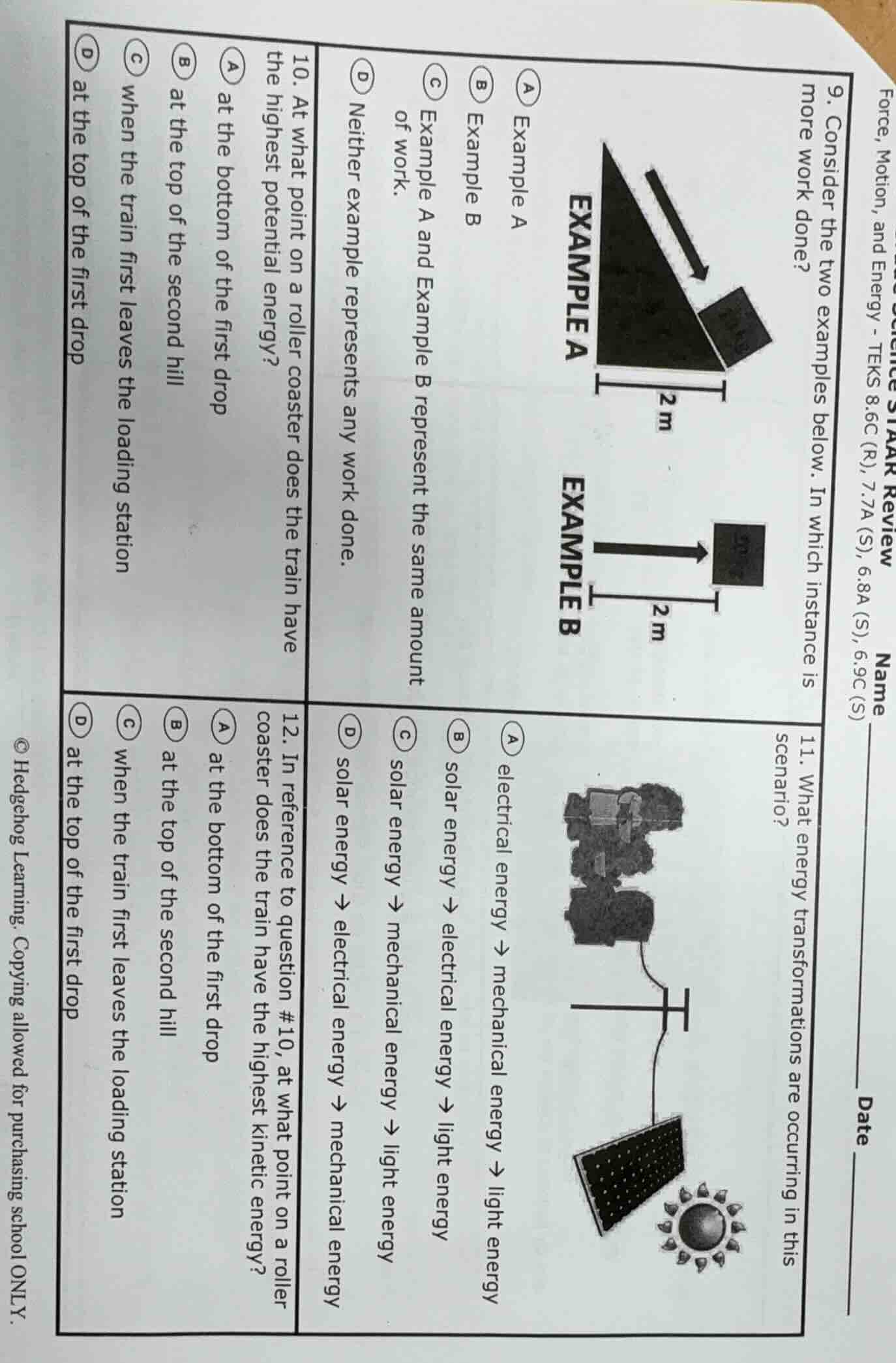
- consider the two examples below. in which instance is more work done?
example a
example b
a example a
b example b
c example a and example b represent the same amount of work.
d neither example represents any work done.
- at what point on a roller coaster does the train have the highest potential energy?
a at the bottom of the first drop
b at the top of the second hill
c when the train first leaves the loading station
d at the top of the first drop
- what energy transformations are occurring in this scenario?
a electrical energy → mechanical energy → light energy
b solar energy → electrical energy → light energy
c solar energy → mechanical energy → light energy
d solar energy → electrical energy → mechanical energy
- in reference to question #10, at what point on a roller coaster does the train have the highest kinetic energy?
a at the bottom of the first drop
b at the top of the second hill
c when the train first leaves the loading station
d at the top of the first drop
© hedgehog learning. copying allowed for purchasing school only.
Step1: Define work formula
Work is defined as $W = F \cdot d \cdot \cos\theta$, where $\theta$ is the angle between force and displacement.
Step2: Analyze Example A
In Example A, the displacement is along the ramp, and the component of gravitational force parallel to the ramp does work. The vertical height is 2m, so work done against gravity is $W_A = mgh = mg(2)$.
Step3: Analyze Example B
In Example B, the displacement is vertical, so the force (equal to weight $mg$) acts in the same direction as displacement. Work done is $W_B = mgh = mg(2)$.
Step4: Compare work values
Both examples involve moving the same mass the same vertical height, so work done is equal.
Step1: Define gravitational potential energy
Gravitational potential energy is $PE = mgh$, where $h$ is height above a reference point.
Step2: Evaluate height at each point
Potential energy depends on height; the highest point has the greatest $h$. The loading station is the starting, highest point before any drops.
Step3: Match to options
The highest height occurs when the train first leaves the loading station.
Step1: Trace energy flow start
The sun provides solar energy, which is absorbed by the solar panel.
Step2: First energy transformation
The solar panel converts solar energy into electrical energy.
Step3: Second energy transformation
The electrical energy powers the device, which produces mechanical energy (moving the toy) and light energy (the toy's lights).
Step4: Match to options
The sequence is solar energy → electrical energy → mechanical energy → light energy.
Step1: Define kinetic energy
Kinetic energy is $KE = \frac{1}{2}mv^2$, dependent on speed $v$.
Step2: Relate speed to roller coaster position
On a roller coaster, speed is highest at the lowest point (bottom of the first drop), as potential energy converts fully to kinetic energy here.
Step3: Match to options
The highest kinetic energy is at the bottom of the first drop.

Snap & solve any problem in the app
Get step-by-step solutions on Sovi AI
Photo-based solutions with guided steps
Explore more problems and detailed explanations
C. Example A and Example B represent the same amount of work done.
---