QUESTION IMAGE
Question
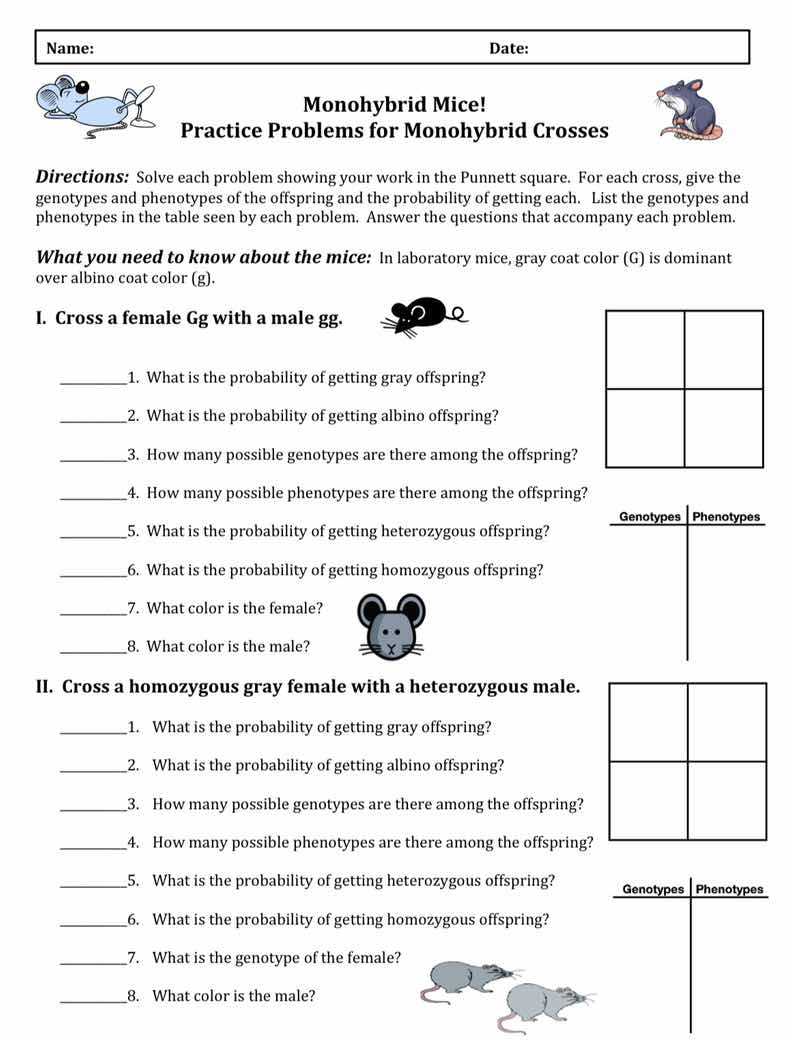
name: date: monohybrid mice! practice problems for monohybrid crosses directions: solve each problem showing your work in the punnett square. for each cross, give the genotypes and phenotypes of the offspring and the probability of getting each. list the genotypes and phenotypes in the table seen by each problem. answer the questions that accompany each problem. what you need to know about the mice: in laboratory mice, gray coat color (g) is dominant over albino coat color (g). i. cross a female gg with a male gg. 1. what is the probability of getting gray offspring? 2. what is the probability of getting albino offspring? 3. how many possible genotypes are there among the offspring? 4. how many possible phenotypes are there among the offspring? 5. what is the probability of getting heterozygous offspring? 6. what is the probability of getting homozygous offspring? 7. what color is the female? 8. what color is the male? ii. cross a homozygous gray female with a heterozygous male. 1. what is the probability of getting gray offspring? 2. what is the probability of getting albino offspring? 3. how many possible genotypes are there among the offspring? 4. how many possible phenotypes are there among the offspring? 5. what is the probability of getting heterozygous offspring? 6. what is the probability of getting homozygous offspring? 7. what is the genotype of the female? 8. what color is the male?
I. Cross a female \( Gg \) with a male \( gg \)
Step 1: Create the Punnett Square
The female can produce gametes \( G \) and \( g \), and the male can only produce gamete \( g \).
| \( G \) | \( g \) | |
|---|---|---|
| \( g \) | \( Gg \) | \( gg \) |
1. Probability of gray offspring
Gray offspring have genotype \( Gg \) (since \( G \) is dominant). From the Punnett square, there are 2 \( Gg \) out of 4 total offspring.
Probability = \(\frac{2}{4} = \frac{1}{2}\) or \( 50\% \)
2. Probability of albino offspring
Albino offspring have genotype \( gg \). From the Punnett square, there are 2 \( gg \) out of 4 total offspring.
Probability = \(\frac{2}{4} = \frac{1}{2}\) or \( 50\% \)
3. Number of possible genotypes
The genotypes are \( Gg \) and \( gg \), so there are 2 possible genotypes.
4. Number of possible phenotypes
The phenotypes are gray (for \( Gg \)) and albino (for \( gg \)), so there are 2 possible phenotypes.
5. Probability of heterozygous offspring
Heterozygous offspring have genotype \( Gg \). There are 2 \( Gg \) out of 4 offspring.
Probability = \(\frac{2}{4} = \frac{1}{2}\) or \( 50\% \)
6. Probability of homozygous offspring
Homozygous offspring have genotype \( gg \). There are 2 \( gg \) out of 4 offspring.
Probability = \(\frac{2}{4} = \frac{1}{2}\) or \( 50\% \)
7. Color of the female
The female has genotype \( Gg \), and since \( G \) (gray) is dominant, the female is gray.
8. Color of the male
The male has genotype \( gg \), so the male is albino.
II. Cross a homozygous gray female (\( GG \)) with a heterozygous male (\( Gg \))
Step 1: Create the Punnett Square
The female can only produce gamete \( G \), and the male can produce gametes \( G \) and \( g \).
| \( G \) | \( G \) | |
|---|---|---|
| \( g \) | \( Gg \) | \( Gg \) |
1. Probability of gray offspring
All offspring will have at least one \( G \) (dominant for gray). There are 4 out of 4 offspring with gray phenotype.
Probability = \(\frac{4}{4} = 1\) or \( 100\% \)
2. Probability of albino offspring
Albino offspring need \( gg \) genotype, but none of the offspring have \( gg \).
Probability = \(\frac{0}{4} = 0\) or \( 0\% \)
3. Number of possible genotypes
The genotypes are \( GG \) and \( Gg \), so there are 2 possible genotypes.
4. Number of possible phenotypes
All offspring have gray phenotype, so there is 1 possible phenotype.
5. Probability of heterozygous offspring
Heterozygous offspring have genotype \( Gg \). There are 2 \( Gg \) out of 4 offspring.
Probability = \(\frac{2}{4} = \frac{1}{2}\) or \( 50\% \)
6. Probability of homozygous offspring
Homozygous offspring have genotype \( GG \). There are 2 \( GG \) out of 4 offspring.
Probability = \(\frac{2}{4} = \frac{1}{2}\) or \( 50\% \)
7. Genotype of the female
The female is homozygous gray, so her genotype is \( GG \).
8. Color of the male
The male has genotype \( Gg \), so the male is gray.

Snap & solve any problem in the app
Get step-by-step solutions on Sovi AI
Photo-based solutions with guided steps
Explore more problems and detailed explanations
s for I:
- \(\boldsymbol{\frac{1}{2}}\) (or \( 50\% \))
- \(\boldsymbol{\frac{1}{2}}\) (or \( 50\% \))
- \(\boldsymbol{2}\)
- \(\boldsymbol{2}\)
- \(\boldsymbol{\frac{1}{2}}\) (or \( 50\% \))
- \(\boldsymbol{\frac{1}{2}}\) (or \( 50\% \))
- \(\boldsymbol{\text{Gray}}\)
- \(\boldsymbol{\text{Albino}}\)