QUESTION IMAGE
Question
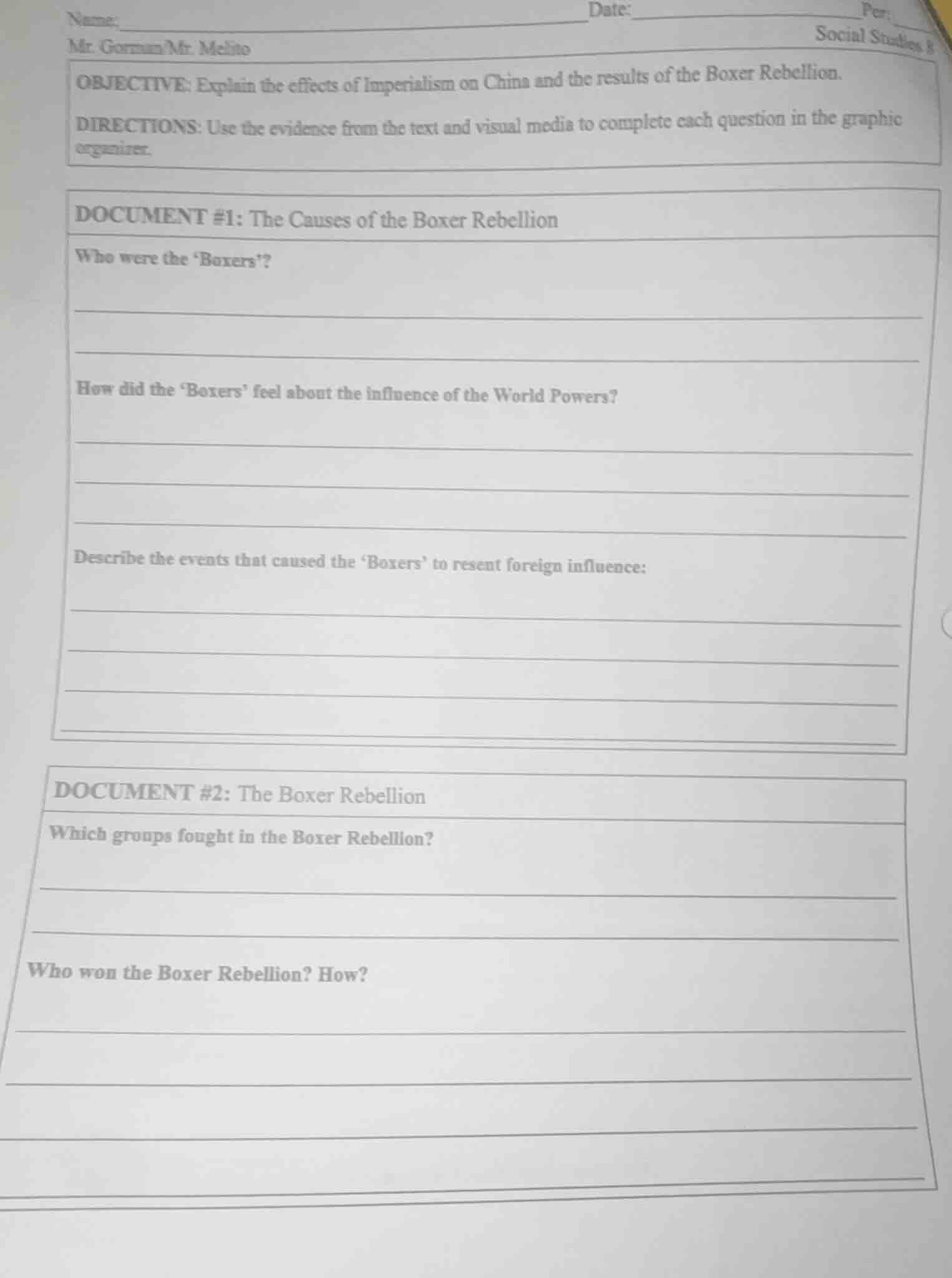
name: date: per: mr. gorman/mr. melito social studies 8 objective: explain the effects of imperialism on china and the results of the boxer rebellion. directions: use the evidence from the text and visual media to complete each question in the graphic organizer. document #1: the causes of the boxer rebellion who were the ‘boxers’? how did the ‘boxers’ feel about the influence of the world powers? describe the events that caused the ‘boxers’ to resent foreign influence: document #2: the boxer rebellion which groups fought in the boxer rebellion? who won the boxer rebellion? how?
- For "Who were the 'Boxers'?": They were a secret Chinese peasant society (officially called the Society of Righteous and Harmonious Fists) in late 19th-century China, known for martial arts practices.
- For "How did the 'Boxers' feel about the influence of the World Powers?": They were violently hostile, resenting foreign political, economic, and cultural control over China.
- For "Describe the events that caused the 'Boxers' to resent foreign influence:": Key events include unequal treaties forcing China to give foreign powers trade concessions, territorial control, and extraterritorial rights; foreign Christian missionaries challenging traditional Chinese customs and gaining special privileges; and economic exploitation that harmed Chinese peasants and artisans.
- For "Which groups fought in the Boxer Rebellion?": The Boxers, supported by some elements of the Qing Dynasty government, fought against an alliance of eight foreign powers (Britain, France, Germany, Italy, Japan, Russia, the United States, Austria-Hungary) and Chinese Christians.
- For "Who won the Boxer Rebellion? How?": The Eight-Nation Alliance won. They assembled a large military force that invaded northern China, captured Beijing, defeated Boxer and Qing forces, and forced the Qing government to surrender.

Snap & solve any problem in the app
Get step-by-step solutions on Sovi AI
Photo-based solutions with guided steps
Explore more problems and detailed explanations
- Who were the 'Boxers'?
They were the Society of Righteous and Harmonious Fists, a secret Chinese peasant society skilled in martial arts, active in late 19th-century China.
- How did the 'Boxers' feel about the influence of the World Powers?
They were fiercely hostile and deeply resentful of foreign influence in China.
- Describe the events that caused the 'Boxers' to resent foreign influence:
- Unequal treaties granted foreign powers trade concessions, territorial control, and extraterritorial rights, undermining Chinese sovereignty.
- Foreign Christian missionaries received special privileges, challenged traditional Chinese culture, and often sided with converts in local conflicts.
- Foreign economic dominance disrupted local economies, impoverishing Chinese peasants and artisans.
- Which groups fought in the Boxer Rebellion?
- The Boxers (Society of Righteous and Harmonious Fists) and elements of the Qing Dynasty military.
- The Eight-Nation Alliance (Britain, France, Germany, Italy, Japan, Russia, the U.S., Austria-Hungary) and Chinese Christian communities.
- Who won the Boxer Rebellion? How?
The Eight-Nation Alliance won. They deployed a large combined military force that marched on and captured Beijing, defeated Boxer and Qing forces, and forced the Qing government to accept a surrender in 1901.