QUESTION IMAGE
Question
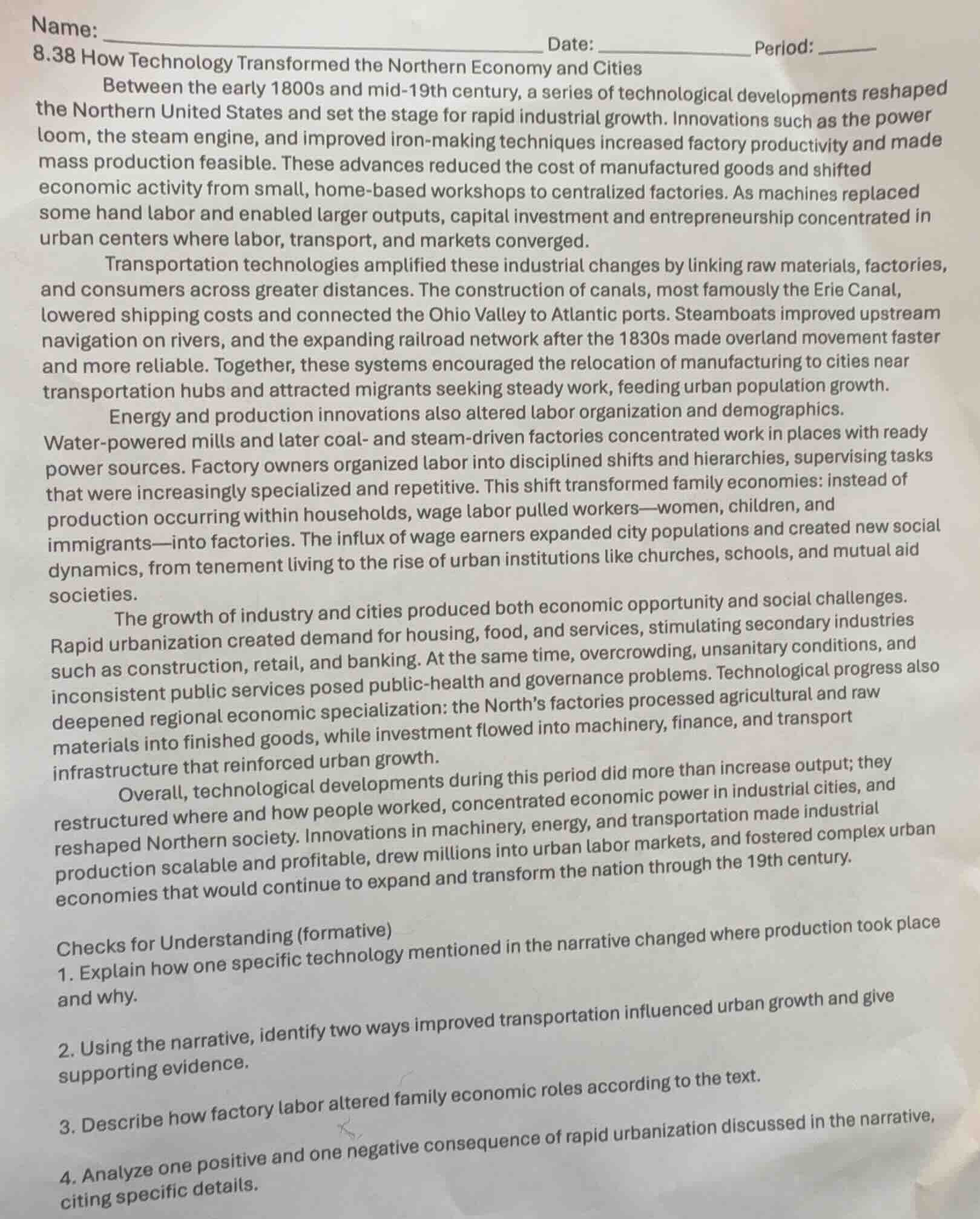
name: ______________________ date: ________ period: ____8.38 how technology transformed the northern economy and citiesbetween the early 1800s and mid-19th century, a series of technological developments reshaped the northern united states and set the stage for rapid industrial growth. innovations such as the power loom, the steam engine, and improved iron-making techniques increased factory productivity and made mass production feasible. these advances reduced the cost of manufactured goods and shifted economic activity from small, home-based workshops to centralized factories. as machines replaced some hand labor and enabled larger outputs, capital investment and entrepreneurship concentrated in urban centers where labor, transport, and markets converged.transportation technologies amplified these industrial changes by linking raw materials, factories, and consumers across greater distances. the construction of canals, most famously the erie canal, lowered shipping costs and connected the ohio valley to atlantic ports. steamboats improved upstream navigation on rivers, and the expanding railroad network after the 1830s made overland movement faster and more reliable. together, these systems encouraged the relocation of manufacturing to cities near transportation hubs and attracted migrants seeking steady work, feeding urban population growth.energy and production innovations also altered labor organization and demographics.water-powered mills and later coal- and steam-driven factories concentrated work in places with ready power sources. factory owners organized labor into disciplined shifts and hierarchies, supervising tasks that were increasingly specialized and repetitive. this shift transformed family economies: instead of production occurring within households, wage labor pulled workers—women, children, and immigrants—into factories. the influx of wage earners expanded city populations and created new social dynamics, from tenement living to the rise of urban institutions like churches, schools, and mutual aid societies.the growth of industry and cities produced both economic opportunity and social challenges. rapid urbanization created demand for housing, food, and services, stimulating secondary industries such as construction, retail, and banking. at the same time, overcrowding, unsanitary conditions, and inconsistent public services posed public-health and governance problems. technological progress also deepened regional economic specialization: the norths factories processed agricultural and raw materials into finished goods, while investment flowed into machinery, finance, and transport infrastructure that reinforced urban growth.overall, technological developments during this period did more than increase output; they restructured where and how people worked, concentrated economic power in industrial cities, and reshaped northern society. innovations in machinery, energy, and transportation made industrial production scalable and profitable, drew millions into urban labor markets, and fostered complex urban economies that would continue to expand and transform the nation through the 19th century.checks for understanding (formative)1. explain how one specific technology mentioned in the narrative changed where production took place and why.2. using the narrative, identify two ways improved transportation influenced urban growth and give supporting evidence.3. describe how factory labor altered family economic roles according to the text.4. analyze one positive and one negative consequence of rapid urbanization discussed in the narrative, citing specific details.
- For the power loom: It boosted factory productivity, enabling mass production. This shifted production from small home workshops to centralized factories, as the machine was too large/expensive for home use, and factories could concentrate labor and resources to scale output.
- First, improved transportation (like canals, railroads) linked raw materials, factories, and consumers, so manufacturing relocated to cities near transportation hubs. Second, these hubs attracted migrants seeking factory work, directly growing urban populations.
- Previously, production happened within households. Factory labor created wage labor, pulling women, children, and immigrants out of home-based production into factories, replacing household-based family economies with wage-earning roles for family members.
- Positive: Rapid urbanization created demand for housing, food, and services, stimulating secondary industries like construction, retail, and banking, which generated more economic opportunity. Negative: It led to overcrowding and unsanitary conditions, which posed public-health and governance problems for Northern cities.

Snap & solve any problem in the app
Get step-by-step solutions on Sovi AI
Photo-based solutions with guided steps
Explore more problems and detailed explanations
- The power loom shifted production from small home-based workshops to centralized factories. This was because the machine increased factory productivity and enabled mass production, which was not feasible in home settings; factories could concentrate capital, labor, and resources to scale manufacturing, while also reducing the cost of goods.
- 1. It encouraged manufacturing to relocate to cities near transportation hubs (e.g., canals, railroads linked raw materials, factories, and consumers over greater distances, making these hubs logistically ideal). 2. It attracted migrants seeking steady factory work, which fed urban population growth (e.g., the expanding railroad network and canals created job opportunities in hub cities).
- Factory labor replaced household-based production with wage labor. Instead of producing goods within family homes, women, children, and immigrants from families took on specialized, repetitive factory jobs for wages, transforming family economies from self-sustaining household production to reliance on external wage income.
- Positive consequence: It stimulated secondary industries (construction, retail, banking) by creating demand for housing, food, and services as urban populations grew. Negative consequence: It caused overcrowding and unsanitary conditions, which created public-health and governance challenges for Northern cities.