QUESTION IMAGE
Question
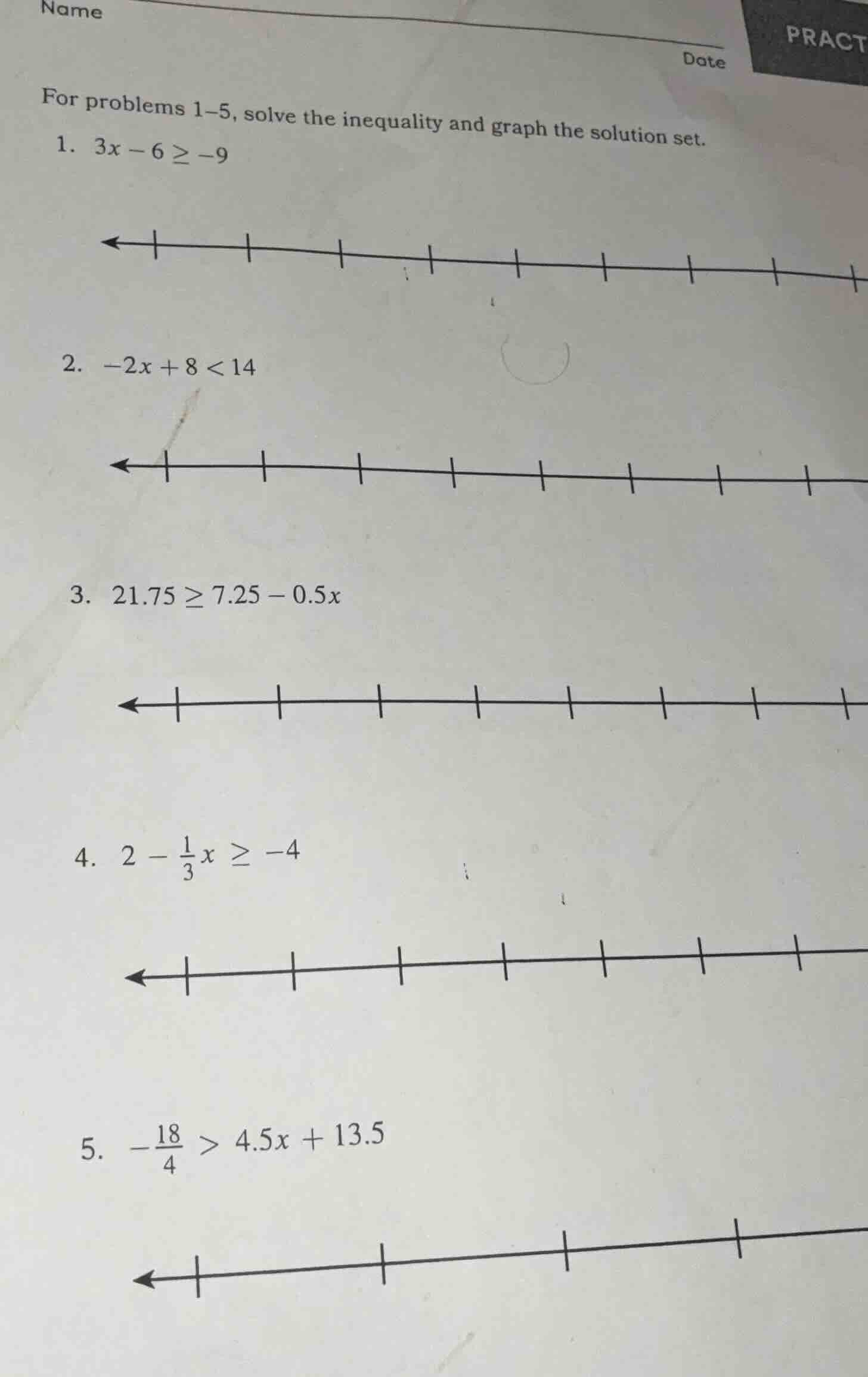
name date pract for problems 1–5, solve the inequality and graph the solution set. 1. $3x - 6 \geq -9$ 2. $-2x + 8 < 14$ 3. $21.75 \geq 7.25 - 0.5x$ 4. $2 - \frac{1}{3}x \geq -4$ 5. $-\frac{18}{4} > 4.5x + 13.5$
Problem 1
Step1: Add 6 to both sides
$3x - 6 + 6 \geq -9 + 6$
$3x \geq -3$
Step2: Divide by 3 on both sides
$\frac{3x}{3} \geq \frac{-3}{3}$
$x \geq -1$
Graph Note:
Draw a closed circle at $x=-1$ on the number line, then shade all values to the right of this point.
Problem 2
Step1: Subtract 8 from both sides
$-2x + 8 - 8 < 14 - 8$
$-2x < 6$
Step2: Divide by -2 (reverse inequality)
$\frac{-2x}{-2} > \frac{6}{-2}$
$x > -3$
Graph Note:
Draw an open circle at $x=-3$ on the number line, then shade all values to the right of this point.
Problem 3
Step1: Subtract 7.25 from both sides
$21.75 - 7.25 \geq 7.25 - 0.5x - 7.25$
$14.5 \geq -0.5x$
Step2: Divide by -0.5 (reverse inequality)
$\frac{14.5}{-0.5} \leq \frac{-0.5x}{-0.5}$
$x \geq -29$
Graph Note:
Draw a closed circle at $x=-29$ on the number line, then shade all values to the right of this point.
Problem 4
Step1: Subtract 2 from both sides
$2 - \frac{1}{3}x - 2 \geq -4 - 2$
$-\frac{1}{3}x \geq -6$
Step2: Multiply by -3 (reverse inequality)
$-\frac{1}{3}x \times (-3) \leq -6 \times (-3)$
$x \leq 18$
Graph Note:
Draw a closed circle at $x=18$ on the number line, then shade all values to the left of this point.
Problem 5
Step1: Simplify the left-hand side
$-\frac{18}{4} = -4.5$, so:
$-4.5 > 4.5x + 13.5$
Step2: Subtract 13.5 from both sides
$-4.5 - 13.5 > 4.5x + 13.5 - 13.5$
$-18 > 4.5x$
Step3: Divide by 4.5 on both sides
$\frac{-18}{4.5} > \frac{4.5x}{4.5}$
$x < -4$
Graph Note:
Draw an open circle at $x=-4$ on the number line, then shade all values to the left of this point.

Snap & solve any problem in the app
Get step-by-step solutions on Sovi AI
Photo-based solutions with guided steps
Explore more problems and detailed explanations
- $x \geq -1$
- $x > -3$
- $x \geq -29$
- $x \leq 18$
- $x < -4$
(Graphs follow the notes provided for each problem respectively)