QUESTION IMAGE
Question
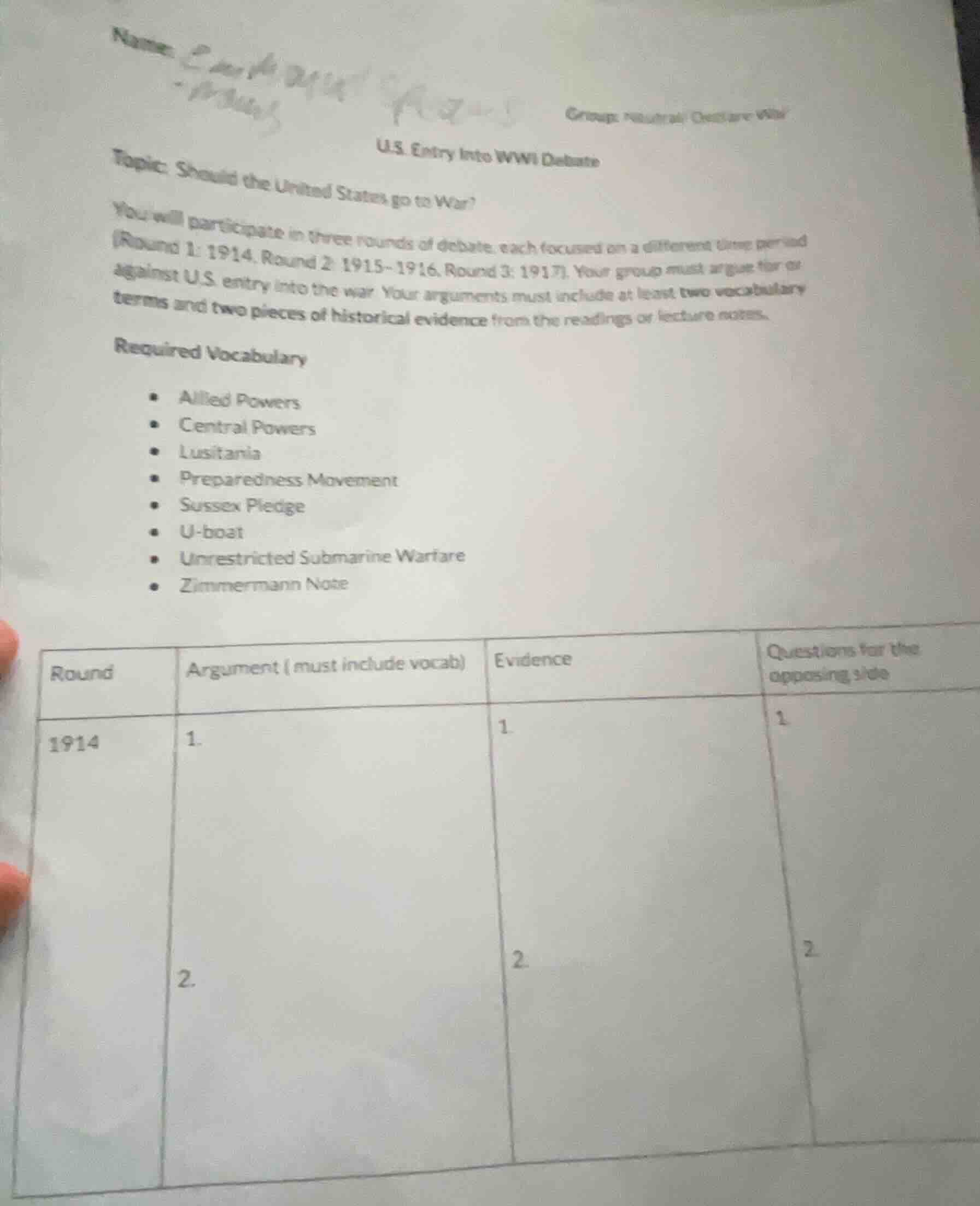
name:group: neutral/declare waru.s. entry into wwi debatetopic: should the united states go to war?you will participate in three rounds of debate, each focused on a different time period (round 1: 1914, round 2: 1915-1916, round 3: 1917). your group must argue for or against u.s. entry into the war. your arguments must include at least two vocabulary terms and two pieces of historical evidence from the readings or lecture notes.required vocabulary- allied powers- central powers- lusitania- preparedness movement- sussex pledge- u-boat- unrestricted submarine warfare- zimmermann note| round | argument ( must include vocab) | evidence | questions for the opposing side ||-------|--------------------------------|----------|---------------------------------|| 1914 | 1. <br>2. | 1. <br>2. | 1. <br>2. |
This is a debate prep sheet arguing against U.S. entry into WWI (1914). Arguments use required vocabulary, paired with historical evidence, and include targeted questions for the opposing side.
- First argument focuses on early war neutrality and the lack of direct U.S. stakes.
- Second argument highlights the U.S. military's lack of readiness for a European war.

Snap & solve any problem in the app
Get step-by-step solutions on Sovi AI
Photo-based solutions with guided steps
Explore more problems and detailed explanations
| Round | Argument (must include vocab) | Evidence | Questions for the opposing side |
|---|---|---|---|
| 1914 | 2. The U.S. military is unprepared to fight a major European war, even with early calls from the Preparedness Movement, as the force remains small and under-equipped. | 2. 1914 U.S. Army data: only ~100,000 active-duty troops, compared to the millions deployed by the Allied and Central Powers. | 2. How can you argue the U.S. is ready to send a viable fighting force to Europe in 1914, given our military's size and lack of modern equipment? |