QUESTION IMAGE
Question
name hour date
moving giants - wrap up
environmental science
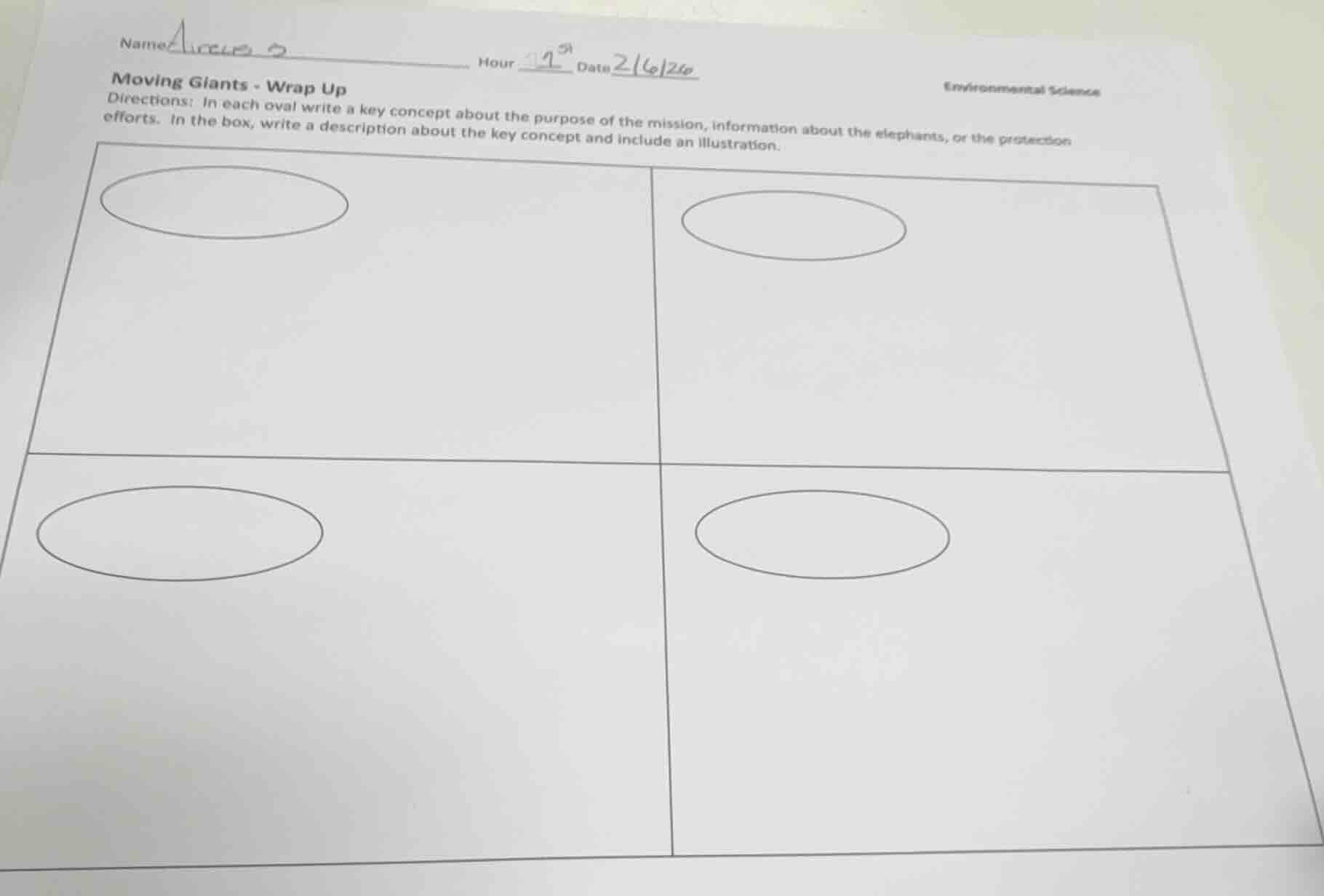
directions: in each oval write a key concept about the purpose of the mission, information about the elephants, or the protection efforts. in the box, write a description about the key concept and include an illustration.
To complete this "Moving Giants - Wrap Up" activity (related to Environmental Science, likely about elephant conservation/movement missions), here are key concepts and descriptions for each oval (and box illustration guidance):
1. Oval 1: Purpose of the Mission
- Key Concept: Habitat Restoration
- Box Description: The mission aims to relocate elephants to restore their natural habitat (e.g., from human - elephant conflict zones to protected reserves). This helps ensure elephants have enough space, food, and water, and reduces conflicts with humans. For illustration: Draw a map showing a conflict area (with farms/homes) and a new reserve (with trees, waterholes, and elephants).
2. Oval 2: Elephant Biology/Behavior
- Key Concept: Elephant Social Structure
- Box Description: Elephants live in matriarchal groups led by an older female. They have strong family bonds, and calves rely on elders for survival skills (e.g., finding food, avoiding danger). During relocation, keeping family units together is crucial. For illustration: Draw a group of elephants (calves, females, a matriarch) interacting, with labels for roles (matriarch, calf, etc.).
3. Oval 3: Protection Efforts (Human - Elephant Coexistence)
- Key Concept: Community - Based Conservation
- Box Description: Protecting elephants involves working with local communities. Programs like beehive fences (to deter elephants from farms) or eco - tourism (to fund conservation) help reduce conflicts and gain community support. For illustration: Draw a village with beehive fences around farms and tourists observing elephants in a reserve.
4. Oval 4: Conservation Science
- Key Concept: Tracking Technology
- Box Description: Scientists use GPS collars or drones to track elephant movements. This data helps study migration patterns, identify threats (e.g., poaching, habitat loss), and plan effective protection strategies. For illustration: Draw an elephant with a GPS collar and a scientist analyzing a map with movement lines.
If you need help with specific illustrations or more detailed descriptions, let me know!

Snap & solve any problem in the app
Get step-by-step solutions on Sovi AI
Photo-based solutions with guided steps
Explore more problems and detailed explanations
To complete this "Moving Giants - Wrap Up" activity (related to Environmental Science, likely about elephant conservation/movement missions), here are key concepts and descriptions for each oval (and box illustration guidance):
1. Oval 1: Purpose of the Mission
- Key Concept: Habitat Restoration
- Box Description: The mission aims to relocate elephants to restore their natural habitat (e.g., from human - elephant conflict zones to protected reserves). This helps ensure elephants have enough space, food, and water, and reduces conflicts with humans. For illustration: Draw a map showing a conflict area (with farms/homes) and a new reserve (with trees, waterholes, and elephants).
2. Oval 2: Elephant Biology/Behavior
- Key Concept: Elephant Social Structure
- Box Description: Elephants live in matriarchal groups led by an older female. They have strong family bonds, and calves rely on elders for survival skills (e.g., finding food, avoiding danger). During relocation, keeping family units together is crucial. For illustration: Draw a group of elephants (calves, females, a matriarch) interacting, with labels for roles (matriarch, calf, etc.).
3. Oval 3: Protection Efforts (Human - Elephant Coexistence)
- Key Concept: Community - Based Conservation
- Box Description: Protecting elephants involves working with local communities. Programs like beehive fences (to deter elephants from farms) or eco - tourism (to fund conservation) help reduce conflicts and gain community support. For illustration: Draw a village with beehive fences around farms and tourists observing elephants in a reserve.
4. Oval 4: Conservation Science
- Key Concept: Tracking Technology
- Box Description: Scientists use GPS collars or drones to track elephant movements. This data helps study migration patterns, identify threats (e.g., poaching, habitat loss), and plan effective protection strategies. For illustration: Draw an elephant with a GPS collar and a scientist analyzing a map with movement lines.
If you need help with specific illustrations or more detailed descriptions, let me know!