QUESTION IMAGE
Question
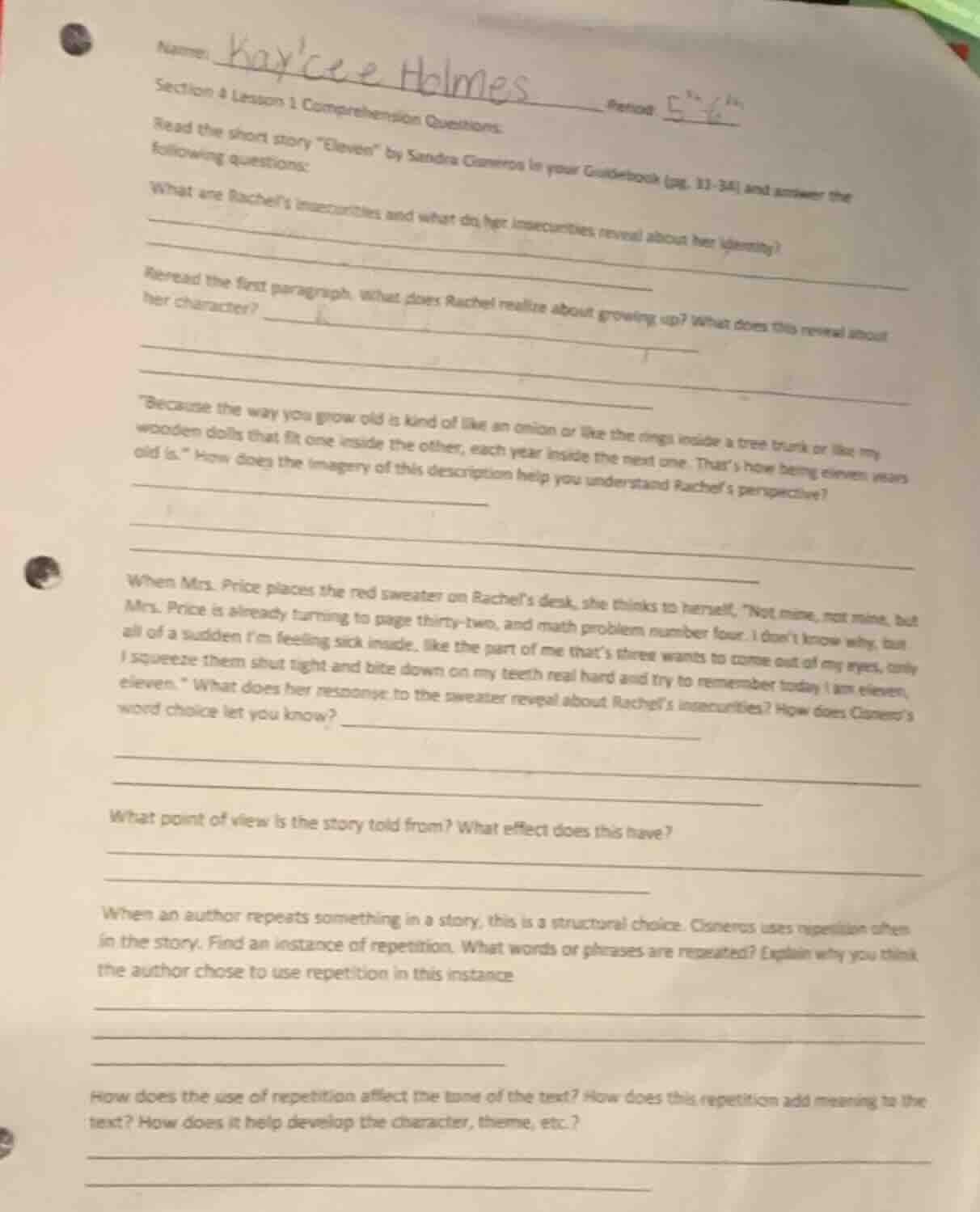
name: kaycee holmes period 5-6 section 4 lesson 1 comprehension questions: read the short story “clever” by sandra cisneros in your guidebook (pp. 11 - 34) and answer the following questions: what are rachel’s insecurities and what do her insecurities reveal about her identity? reread the first paragraph. what does rachel realize about growing up? what does this reveal about her character? “because the way you grow old is kind of like an onion or like the rings inside a tree trunk or like my wooden dolls that fit one inside the other, each year inside the next one. that’s how being eleven years old is.” how does the imagery of this description help you understand rachel’s perspective? when mrs. price places the red sweater on rachel’s desk, she thinks to herself, “not mine, not mine, but mrs. price is already turning to page thirty - two, and math problem number four. i don’t know why, but all of a sudden i’m feeling sick inside, like the part of me that’s three wants to come out of my eyes, only i squeeze them shut tight and bite down on my teeth real hard and try to remember today i am eleven, eleven.” what does her response to the sweater reveal about rachel’s insecurities? how does cisneros’s word choice let you know? what point of view is the story told from? what effect does this have? when an author repeats something in a story, this is a structural choice. cisneros uses repetition often in the story. find an instance of repetition. what words or phrases are repeated? explain why you think the author chose to use repetition in this instance. how does the use of repetition affect the tone of the text? how does this repetition add meaning to the text? how does it help develop the character, theme, etc.?
- Rachel's insecurities and identity:
Rachel feels powerless against authority (Mrs. Price), struggles to advocate for herself, and feels overwhelmed by the embarrassment of the red sweater. This reveals she is a vulnerable, young child still learning to navigate social and adult interactions, and her identity is tied to her sense of being small, unheard, and not yet "grown up" enough to stand up for herself.
- Rachel's realization about growing up:
Rachel realizes growing up does not erase younger, more vulnerable parts of herself—they stay layered inside. This reveals she is introspective, and her character is defined by the coexistence of her current age and all her past, less confident selves.
- Imagery of onion/tree rings/dolls:
The layered imagery shows Rachel sees growing up as an accumulation of past selves, not a replacement. It helps readers understand she feels her younger, more insecure parts are still present and can surface, even when she tries to feel "eleven."
- Response to the red sweater:
Her physical reaction (feeling sick, squeezing eyes shut, biting teeth) and internal panic reveal she is terrified of embarrassment and lacks the confidence to confront Mrs. Price. Cisneros uses phrases like "not mine, not mine" and the reference to her three-year-old self to show her insecurity makes her regress to a younger, more helpless state.
- Point of view and effect:
The story is told in first-person (Rachel's perspective). This effect lets readers directly experience her internal thoughts, embarrassment, and vulnerability, making her feelings relatable and emphasizing the intensity of her childhood humiliation.
- Instance of repetition:
Rachel repeatedly thinks/says "not mine, not mine" about the red sweater. Cisneros uses this repetition to highlight her desperate, panicked attempt to reject the embarrassing situation, showing her inability to cope with the unfairness and shame.
- Repetition's impact on tone and meaning:
The repetition creates a frantic, anxious tone. It reinforces Rachel's overwhelming insecurity, emphasizes the theme of childhood powerlessness, and develops her character as a child who cannot yet assert herself against adults. It also underscores the idea that embarrassment can make even an older child feel small and helpless.

Snap & solve any problem in the app
Get step-by-step solutions on Sovi AI
Photo-based solutions with guided steps
Explore more problems and detailed explanations
- Rachel's insecurities include fear of embarrassment, powerlessness against adults, and inability to advocate for herself. This reveals her identity as a vulnerable, young child still learning to navigate social pressure and authority.
- Rachel realizes growing up keeps all past, younger selves layered inside. This reveals she is introspective, and her character is shaped by the coexistence of her current and former, more insecure selves.
- The layered imagery shows Rachel views growing up as accumulating past selves, not replacing them. It helps readers understand her younger, vulnerable parts can surface even when she tries to feel "eleven."
- Her panicked physical reaction and internal retreat to her three-year-old self reveal deep insecurity. Cisneros's word choice (e.g., "not mine, not mine," reference to her young self) shows she regresses when overwhelmed by shame.
- The story uses first-person point of view. It lets readers directly experience Rachel's vulnerability and embarrassment, making her feelings relatable and amplifying the story's emotional impact.
- An instance is Rachel repeating "not mine, not mine" about the red sweater. The author uses this to emphasize her desperate, panicked rejection of the embarrassing situation, showing her inability to cope with unfairness and shame.
- Repetition creates a frantic, anxious tone. It reinforces Rachel's insecurity, develops her character as a powerless child, underscores the theme of childhood vulnerability, and adds meaning by showing how embarrassment can make older children regress to helpless, younger states.