QUESTION IMAGE
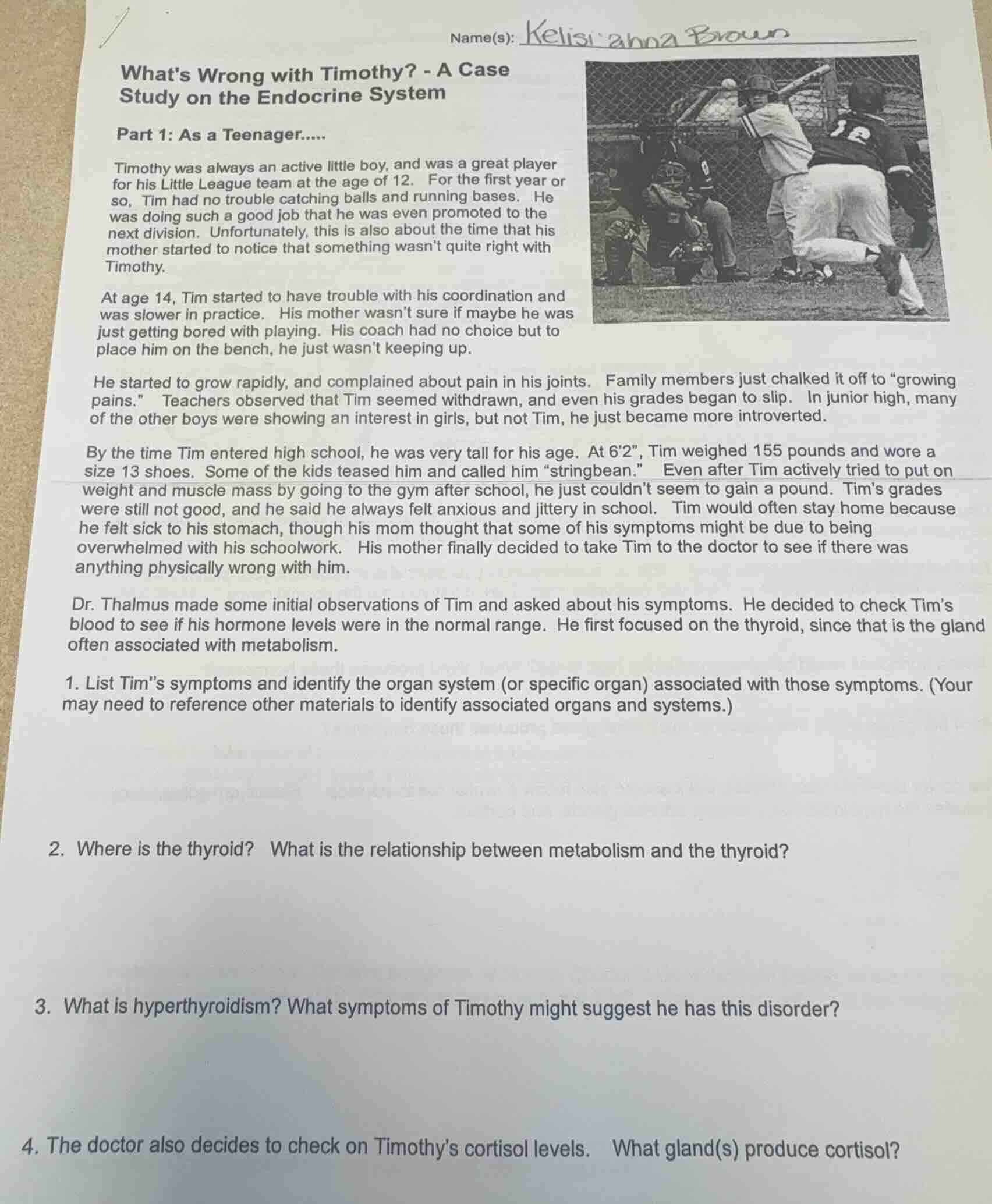
Question
name(s): kelisi anna brown
whats wrong with timothy? - a case
study on the endocrine system
part 1: as a teenager.....
timothy was always an active little boy, and was a great player
for his little league team at the age of 12. for the first year or
so, tim had no trouble catching balls and running bases. he
was doing such a good job that he was even promoted to the
next division. unfortunately, this is also about the time that his
mother started to notice that something wasnt quite right with
timothy.
at age 14, tim started to have trouble with his coordination and
was slower in practice. his mother wasnt sure if maybe he was
just getting bored with playing. his coach had no choice but to
place him on the bench, he just wasnt keeping up.
he started to grow rapidly, and complained about pain in his joints. family members just chalked it off to \growing
pains.\ teachers observed that tim seemed withdrawn, and even his grades began to slip. in junior high, many
of the other boys were showing an interest in girls, but not tim, he just became more introverted.
by the time tim entered high school, he was very tall for his age. at 62\, tim weighed 155 pounds and wore a
size 13 shoes. some of the kids teased him and called him \stringbean.\ even after tim actively tried to put on
weight and muscle mass by going to the gym after school, he just couldnt seem to gain a pound. tims grades
were still not good, and he said he always felt anxious and jittery in school. tim would often stay home because
he felt sick to his stomach, though his mom thought that some of his symptoms might be due to being
overwhelmed with his schoolwork. his mother finally decided to take tim to the doctor to see if there was
anything physically wrong with him.
dr. thalmus made some initial observations of tim and asked about his symptoms. he decided to check tims
blood to see if his hormone levels were in the normal range. he first focused on the thyroid, since that is the gland
often associated with metabolism.
- list tim\s symptoms and identify the organ system (or specific organ) associated with those symptoms. (your
may need to reference other materials to identify associated organs and systems.)
- where is the thyroid? what is the relationship between metabolism and the thyroid?
- what is hyperthyroidism? what symptoms of timothy might suggest he has this disorder?
- the doctor also decides to check on timothys cortisol levels. what gland(s) produce cortisol?
- For question 1: Compile all physical, cognitive, and behavioral symptoms from the case, then link each to the endocrine system (specifically glands/hormones tied to growth, metabolism, and mood).
- For question 2: Locate the thyroid anatomically, then explain its role in producing hormones that regulate metabolic rate.
- For question 3: Define hyperthyroidism as overactivity of the thyroid, then match Timothy's symptoms to common signs of this condition.
- For question 4: Identify the gland responsible for cortisol production, noting the regulatory pathway involved.

Snap & solve any problem in the app
Get step-by-step solutions on Sovi AI
Photo-based solutions with guided steps
Explore more problems and detailed explanations
- - Coordination issues, slowed movement: Endocrine System (thyroid, as thyroid hormones affect muscle function and coordination)
- Rapid, excessive growth (6'2" in high school, size 13 shoes): Endocrine System (pituitary gland/growth hormone, or thyroid as thyroid hormones support growth)
- Joint pain: Endocrine System (linked to rapid growth driven by hormonal changes)
- Withdrawn behavior, introversion, anxiety, jitteriness: Endocrine System (thyroid hormones and cortisol affect mood and mental state)
- Poor grades, difficulty concentrating: Endocrine System (thyroid hormones impact cognitive function)
- Inability to gain weight despite gym work: Endocrine System (thyroid, as thyroid hormones regulate metabolism)
- Stomach sickness, fatigue: Endocrine System (thyroid and adrenal glands, which regulate stress and digestion)
- - The thyroid is a butterfly-shaped gland located at the front of the neck, just below the Adam's apple.
- The thyroid produces thyroid hormones (T3 and T4) that directly regulate the body's metabolic rate: they control how quickly cells convert nutrients into energy, influence calorie burning, and affect processes like heart rate, digestion, and temperature regulation.
- - Hyperthyroidism is a condition where the thyroid gland produces an excess of thyroid hormones, causing the body's metabolism to speed up significantly.
- Timothy's symptoms that suggest hyperthyroidism include: inability to gain weight despite increased activity, anxiety and jitteriness, rapid growth, joint pain, and possibly his slowed coordination and fatigue (in some cases of hyperthyroidism, muscle weakness can occur).
- Cortisol is produced by the adrenal cortex, the outer layer of the adrenal glands (small glands located on top of each kidney). The release of cortisol is regulated by the hypothalamus and pituitary gland in the brain.