QUESTION IMAGE
Question
name:
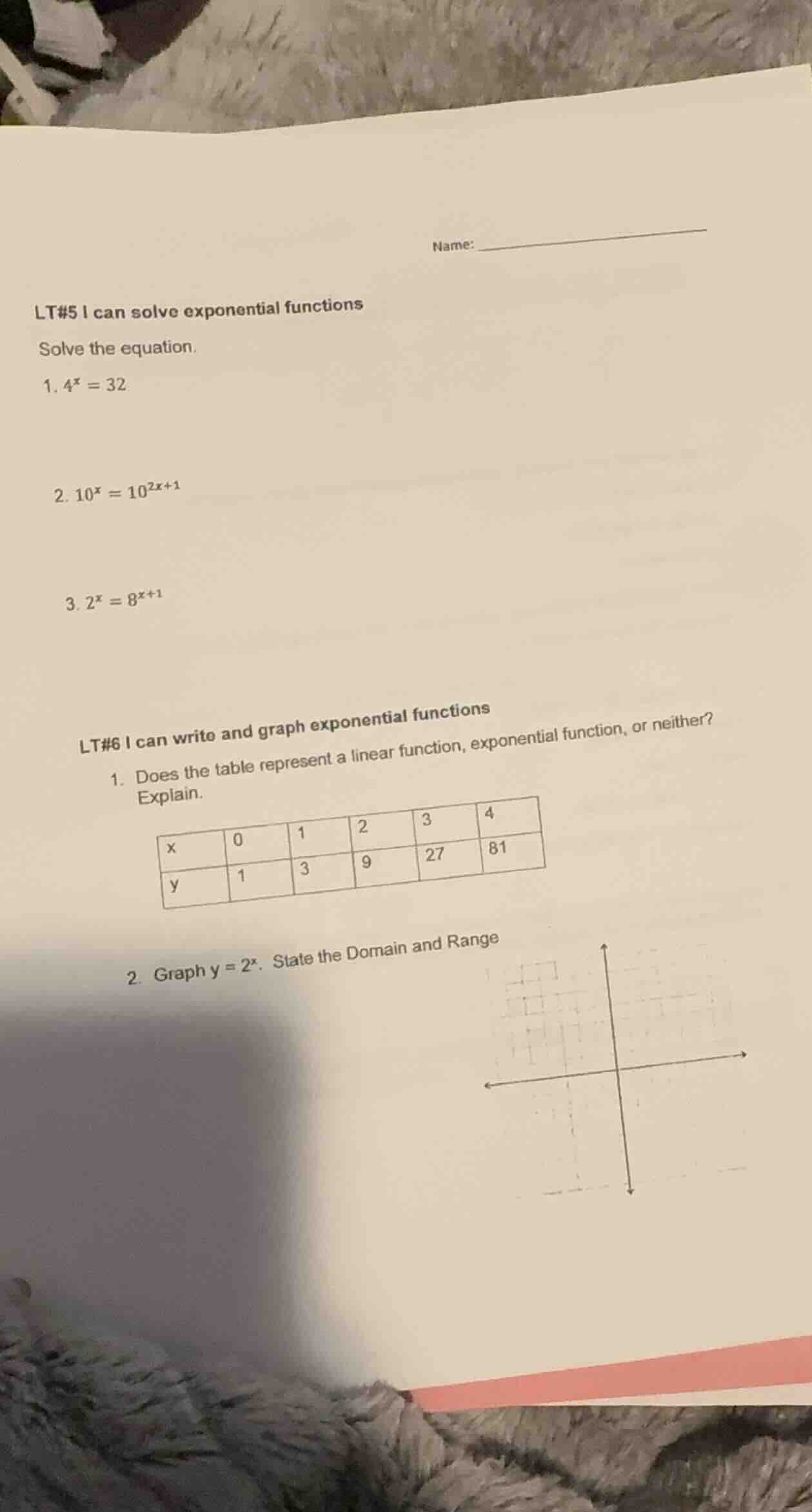
lt#5 i can solve exponential functions
solve the equation.
- $4^x = 32$
- $10^x = 10^{2x + 1}$
- $2^x = 8^{x + 1}$
lt#6 i can write and graph exponential functions
- does the table represent a linear function, exponential function, or neither?
explain.
| x | 0 | 1 | 2 | 3 | 4 |
| y | 1 | 3 | 9 | 27 | 81 |
- graph $y = 2^x$. state the domain and range
Response
---
LT#5: Solve the exponential equations
Step1: Rewrite bases as powers of 2
$4^x = 32 \implies (2^2)^x = 2^5$
Step2: Simplify exponents
$2^{2x} = 2^5 \implies 2x = 5$
Step3: Solve for x
$x = \frac{5}{2}$
Step1: Set exponents equal (same base)
$10^x = 10^{2x+1} \implies x = 2x + 1$
Step2: Isolate x
$x - 2x = 1 \implies -x = 1 \implies x = -1$
Step1: Rewrite 8 as power of 2
$2^x = 8^{x+1} \implies 2^x = (2^3)^{x+1}$
Step2: Simplify exponents
$2^x = 2^{3(x+1)} \implies x = 3x + 3$
Step3: Isolate x
$x - 3x = 3 \implies -2x = 3 \implies x = -\frac{3}{2}$
Brief Explanations
- For the table: A linear function has a constant rate of change (difference in y-values), while an exponential function has a constant ratio of y-values. Calculate the ratios: $\frac{3}{1}=3$, $\frac{9}{3}=3$, $\frac{27}{9}=3$, $\frac{81}{27}=3$. The ratio is constant, so it is exponential.
- For $y=2^x$: The domain is all real numbers (no restrictions on x). The range is all positive real numbers, since $2^x$ is always positive and approaches 0 as $x\to-\infty$, and increases to $\infty$ as $x\to\infty$. To graph, plot key points: $(-1, \frac{1}{2})$, $(0,1)$, $(1,2)$, $(2,4)$, then draw a smooth curve through them, approaching the x-axis (y=0) as x decreases.

Snap & solve any problem in the app
Get step-by-step solutions on Sovi AI
Photo-based solutions with guided steps
Explore more problems and detailed explanations
- $x = \frac{5}{2}$
- $x = -1$
- $x = -\frac{3}{2}$
---