QUESTION IMAGE
Question
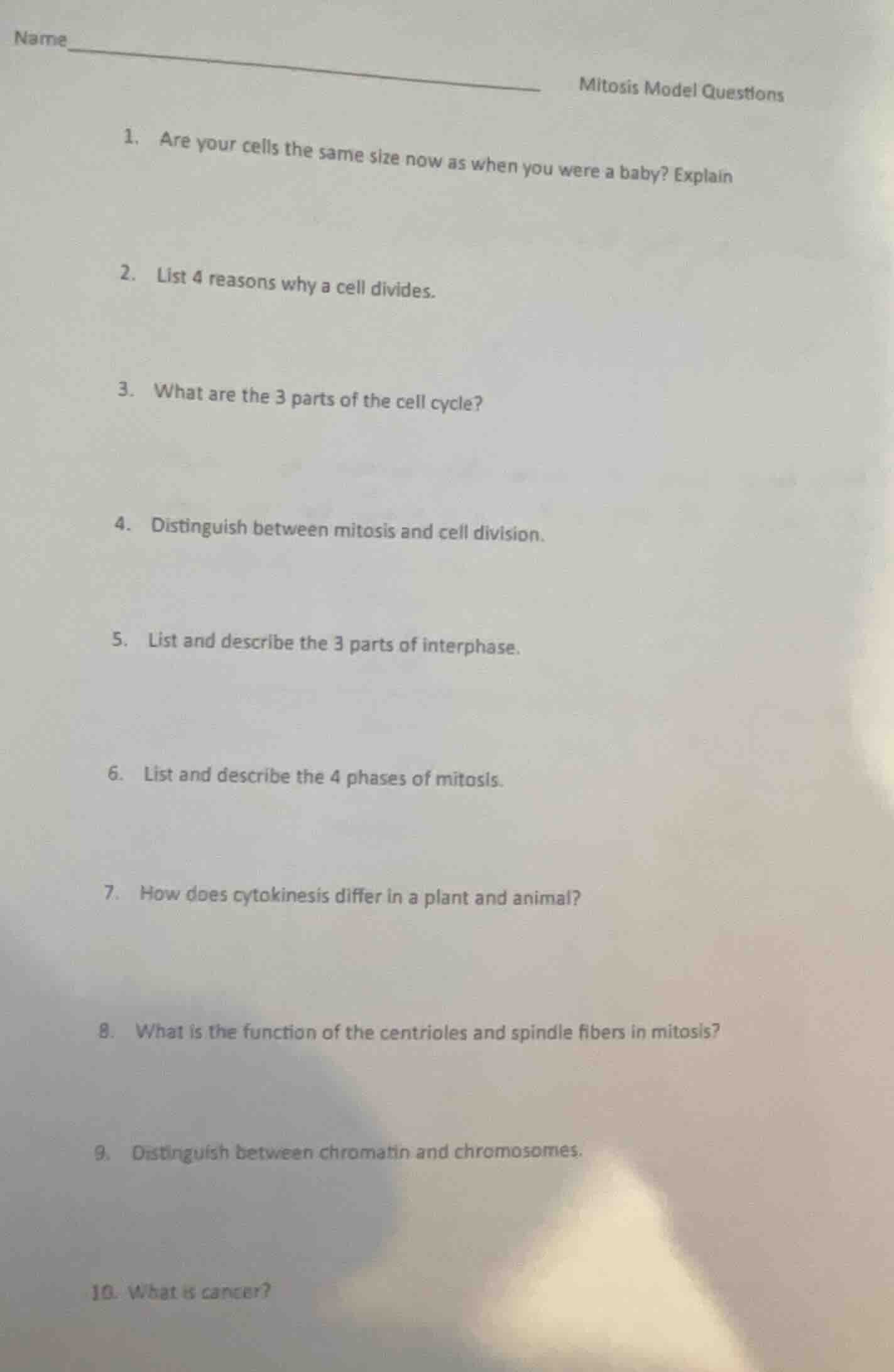
name__________mitosis model questions1. are your cells the same size now as when you were a baby? explain2. list 4 reasons why a cell divides.3. what are the 3 parts of the cell cycle?4. distinguish between mitosis and cell division.5. list and describe the 3 parts of interphase.6. list and describe the 4 phases of mitosis.7. how does cytokinesis differ in a plant and animal?8. what is the function of the centrioles and spindle fibers in mitosis?9. distinguish between chromatin and chromosomes.10. what is cancer?
Brief Explanations
- Adult cells are roughly the same size as baby cells; growth comes from more cells, not larger ones, as cells have an optimal size for nutrient exchange.
- Cells divide for growth of the organism, repair of damaged tissues, replacement of old/dead cells, and to maintain a favorable surface area to volume ratio for efficient transport.
- The cell cycle is split into interphase (growth/prep), mitosis (nuclear division), and cytokinesis (cytoplasmic division).
- Cell division is the full process of a parent cell splitting into two daughter cells, including both mitosis (nuclear division) and cytokinesis (cytoplasmic division). Mitosis is only the division of the nucleus into two identical nuclei.
- - G1 Phase: Cell grows, carries out normal functions, and prepares for DNA replication.
- S Phase: DNA is replicated, doubling the genetic material.
- G2 Phase: Cell grows more, synthesizes proteins, and prepares for mitosis.
- - Prophase: Chromatin condenses into chromosomes, nuclear envelope breaks down, spindle fibers form.
- Metaphase: Chromosomes line up at the cell's equatorial plate (metaphase plate), spindle fibers attach to centromeres.
- Anaphase: Sister chromatids separate and are pulled to opposite poles of the cell by spindle fibers.
- Telophase: Chromosomes decondense into chromatin, nuclear envelopes reform around each set of chromosomes, spindle fibers break down.
- In animal cells, cytokinesis uses a cleavage furrow (pinching of the cell membrane) to split the cytoplasm. In plant cells, a cell plate forms between the two new nuclei, which develops into a new cell wall and membrane to divide the cell.
- Centrioles (in animal cells) organize the formation of spindle fibers. Spindle fibers attach to chromosomes and pull sister chromatids apart to opposite poles during mitosis, ensuring each daughter cell gets an identical set of chromosomes.
- Chromatin is the loose, uncoiled form of DNA and proteins that fills the nucleus during interphase. Chromosomes are the condensed, tightly coiled structures of chromatin that form during mitosis for easy separation of genetic material.
- Cancer is a disease where cells undergo uncontrolled, abnormal cell division, forming tumors that can invade surrounding tissues and spread to other parts of the body, disrupting normal bodily functions.

Snap & solve any problem in the app
Get step-by-step solutions on Sovi AI
Photo-based solutions with guided steps
Explore more problems and detailed explanations
- No, cells are not larger now; growth occurs via more cells, not larger cells, since cell size is limited by surface area to volume ratio for nutrient exchange.
- 1. Growth of the multicellular organism
- Repair of damaged tissues
- Replacement of old/dead cells
- Maintain optimal surface area to volume ratio
- 1. Interphase
- Mitosis
- Cytokinesis
- Cell division is the complete process of a parent cell splitting into two daughter cells (includes mitosis + cytokinesis). Mitosis is only the division of the cell's nucleus into two identical nuclei.
- 1. G1 Phase: Cell growth and normal function
- S Phase: DNA replication (genetic material doubles)
- G2 Phase: Final growth and mitosis preparation
- 1. Prophase: Chromosomes form, nucleus breaks down
- Metaphase: Chromosomes line up at cell equator
- Anaphase: Chromatids separate to opposite poles
- Telophase: Nuclei reform, chromosomes decondense
- Animal cells use a cleavage furrow (cell membrane pinches) to split cytoplasm; plant cells form a cell plate that develops into a new cell wall/membrane.
- Centrioles organize spindle fiber formation; spindle fibers attach to chromosomes and pull chromatids apart to ensure equal genetic material in daughter cells.
- Chromatin is loose, uncoiled DNA (active form in interphase); chromosomes are condensed, tightly coiled chromatin (formed for mitosis separation).
- Cancer is uncontrolled, abnormal cell division that forms invasive tumors and disrupts normal bodily function.