QUESTION IMAGE
Question
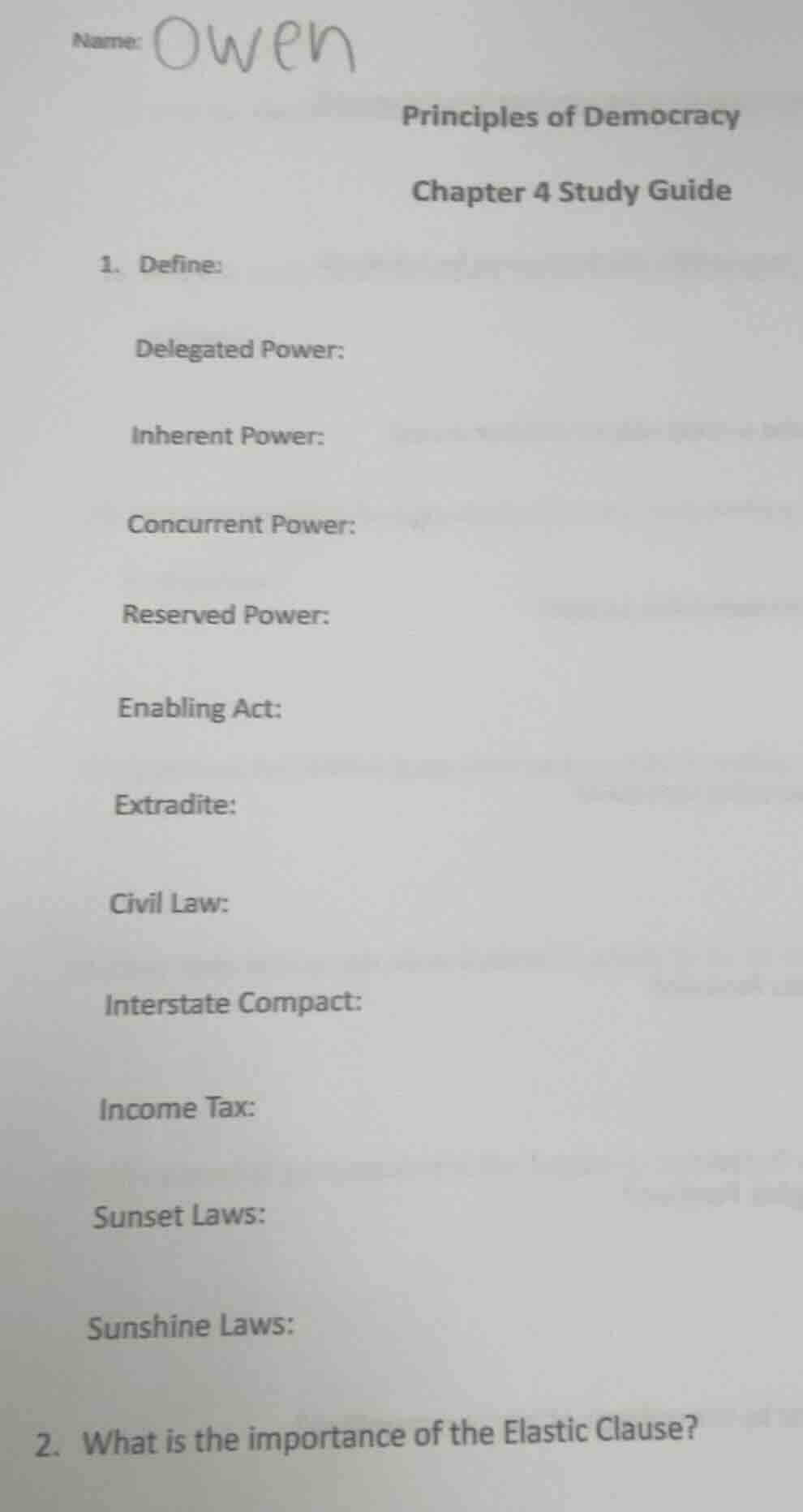
name: owen
principles of democracy
chapter 4 study guide
- define:
delegated power:
inherent power:
concurrent power:
reserved power:
enabling act:
extradite:
civil law:
interstate compact:
income tax:
sunset laws:
sunshine laws:
- what is the importance of the elastic clause?
Part 1: Definitions
Delegated Power:
Powers given to the federal government by the Constitution (e.g., coin money, declare war).
Inherent Power:
Powers the government has inherently (not in the Constitution) due to being a sovereign state (e.g., regulating immigration).
Concurrent Power:
Powers shared by federal and state governments (e.g., tax, establish courts).
Reserved Power:
Powers not delegated to the federal government, reserved for states (10th Amendment; e.g., education, local governance).
Enabling Act:
A law that empowers people to form a state (e.g., enabling territories to apply for statehood).
Extradite:
To return a person accused of a crime to the state where the crime occurred.
Civil Law:
Law dealing with private rights (e.g., contracts, property disputes), not criminal matters.
Interstate Compact:
Agreements between states (with federal approval) to solve shared issues (e.g., water rights).
Income Tax:
A tax on personal/corporate income, used to fund government operations.
Sunset Laws:
Laws that automatically expire after a set time (to review/repeal outdated regulations).
Sunshine Laws:
Laws requiring government meetings/records to be open to the public (transparency).
Part 2: Importance of the Elastic Clause
The Elastic Clause (Necessary and Proper Clause, Article I, Section 8) allows Congress to make laws “necessary and proper” to carry out its delegated powers. This flexibility lets the government adapt to new challenges (e.g., regulating new technologies, addressing economic crises) not foreseen by the Founders, ensuring the Constitution remains relevant.

Snap & solve any problem in the app
Get step-by-step solutions on Sovi AI
Photo-based solutions with guided steps
Explore more problems and detailed explanations
s (Summarized for Definitions + Elastic Clause)
- Definitions (concise):
- Delegated: Constitutional federal powers.
- Inherent: Sovereign state powers (not in Constitution).
- Concurrent: Shared federal-state powers.
- Reserved: State powers (10th Amendment).
- Enabling Act: Permits statehood.
- Extradite: Return accused to crime’s state.
- Civil Law: Private rights (non - criminal).
- Interstate Compact: State - state agreements (federal approval).
- Income Tax: Tax on earnings.
- Sunset Laws: Laws with automatic expiration.
- Sunshine Laws: Open government meetings/records.
- Elastic Clause Importance:
It gives Congress flexibility to pass laws for unforeseen issues, adapting the Constitution to modern needs.