QUESTION IMAGE
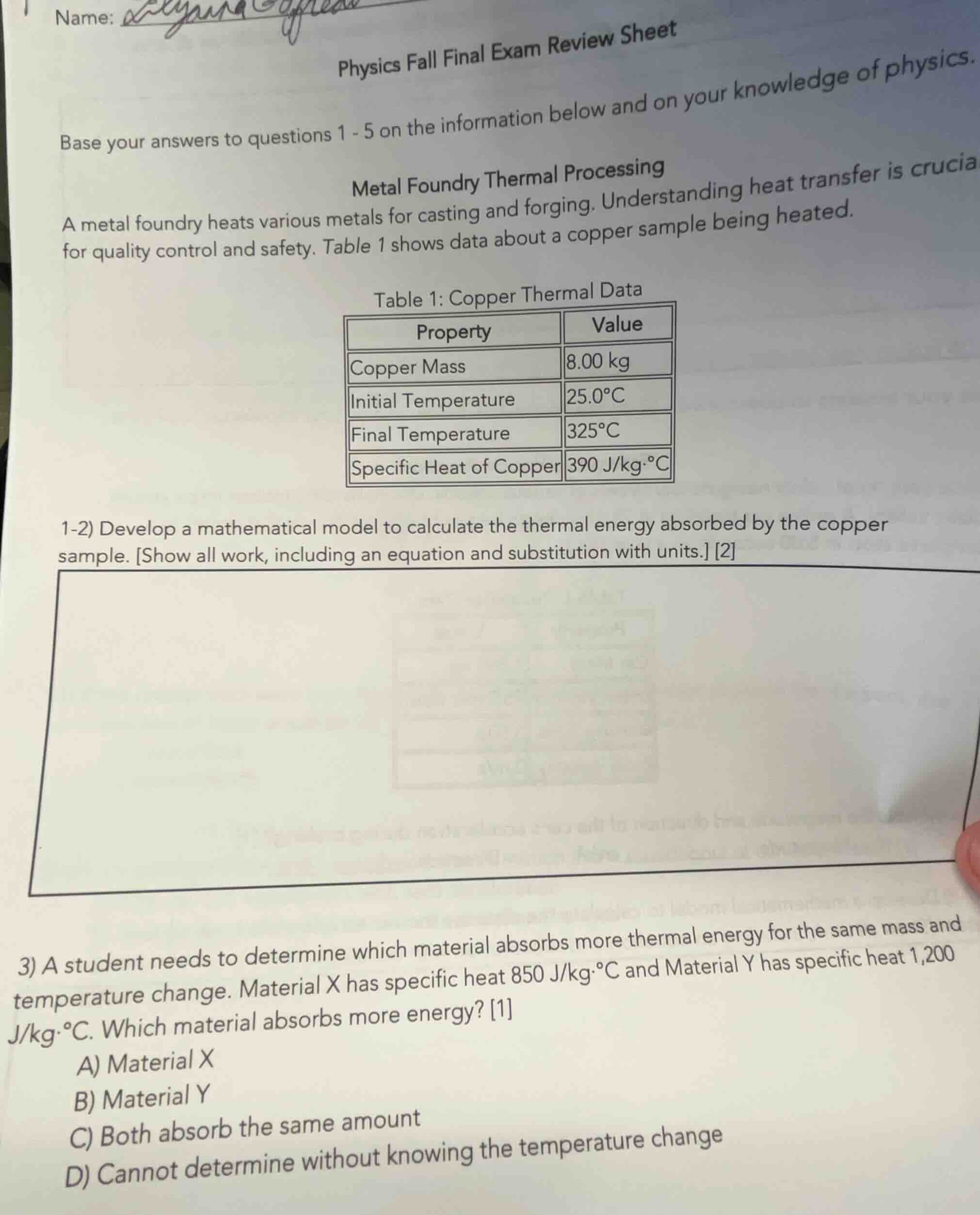
Question
name:
physics fall final exam review sheet
base your answers to questions 1 - 5 on the information below and on your knowledge of physics.
metal foundry thermal processing
a metal foundry heats various metals for casting and forging. understanding heat transfer is crucia
for quality control and safety. table 1 shows data about a copper sample being heated.
table 1: copper thermal data
| property | value |
|---|---|
| initial temperature | 25.0°c |
| final temperature | 325°c |
| specific heat of copper | 390 j/kg·°c |
1-2) develop a mathematical model to calculate the thermal energy absorbed by the copper
sample. show all work, including an equation and substitution with units. 2
- a student needs to determine which material absorbs more thermal energy for the same mass and
temperature change. material x has specific heat 850 j/kg·°c and material y has specific heat 1,200
j/kg·°c. which material absorbs more energy? 1
a) material x
b) material y
c) both absorb the same amount
d) cannot determine without knowing the temperature change
Question 1-2 Solution:
Step1: Recall the heat formula
The formula for the thermal energy \( Q \) absorbed by a substance is \( Q = mc\Delta T \), where \( m \) is mass, \( c \) is specific heat, and \( \Delta T \) is the change in temperature. \( \Delta T=T_f - T_i \), where \( T_f \) is final temperature and \( T_i \) is initial temperature.
Step2: Calculate temperature change
First, find \( \Delta T \): \( \Delta T = 325^\circ\text{C}- 25.0^\circ\text{C}= 300^\circ\text{C} \)
Step3: Substitute values into the formula
Given \( m = 8.00\space\text{kg} \), \( c = 390\space\text{J/kg}\cdot^\circ\text{C} \), and \( \Delta T = 300^\circ\text{C} \). Substitute into \( Q = mc\Delta T \):
\( Q=(8.00\space\text{kg})(390\space\text{J/kg}\cdot^\circ\text{C})(300^\circ\text{C}) \)
Step4: Calculate the result
Multiply the values: \( 8.00\times390\times300 = 8.00\times117000 = 936000\space\text{J} \) (or \( 9.36\times 10^{5}\space\text{J} \))
The formula for heat is \( Q = mc\Delta T \). For the same mass (\( m \)) and temperature change (\( \Delta T \)), \( Q \) is directly proportional to specific heat (\( c \)). Material Y has a higher specific heat (\( 1200\space\text{J/kg}\cdot^\circ\text{C} \)) than Material X (\( 850\space\text{J/kg}\cdot^\circ\text{C} \)), so Material Y absorbs more energy.

Snap & solve any problem in the app
Get step-by-step solutions on Sovi AI
Photo-based solutions with guided steps
Explore more problems and detailed explanations
(for 1 - 2):
The thermal energy absorbed is \( \boldsymbol{936000\space\text{J}} \) (or \( \boldsymbol{9.36\times 10^{5}\space\text{J}} \))