QUESTION IMAGE
Question
name
practice
for exercises 1–5, use the figure and the description to answer the questions.
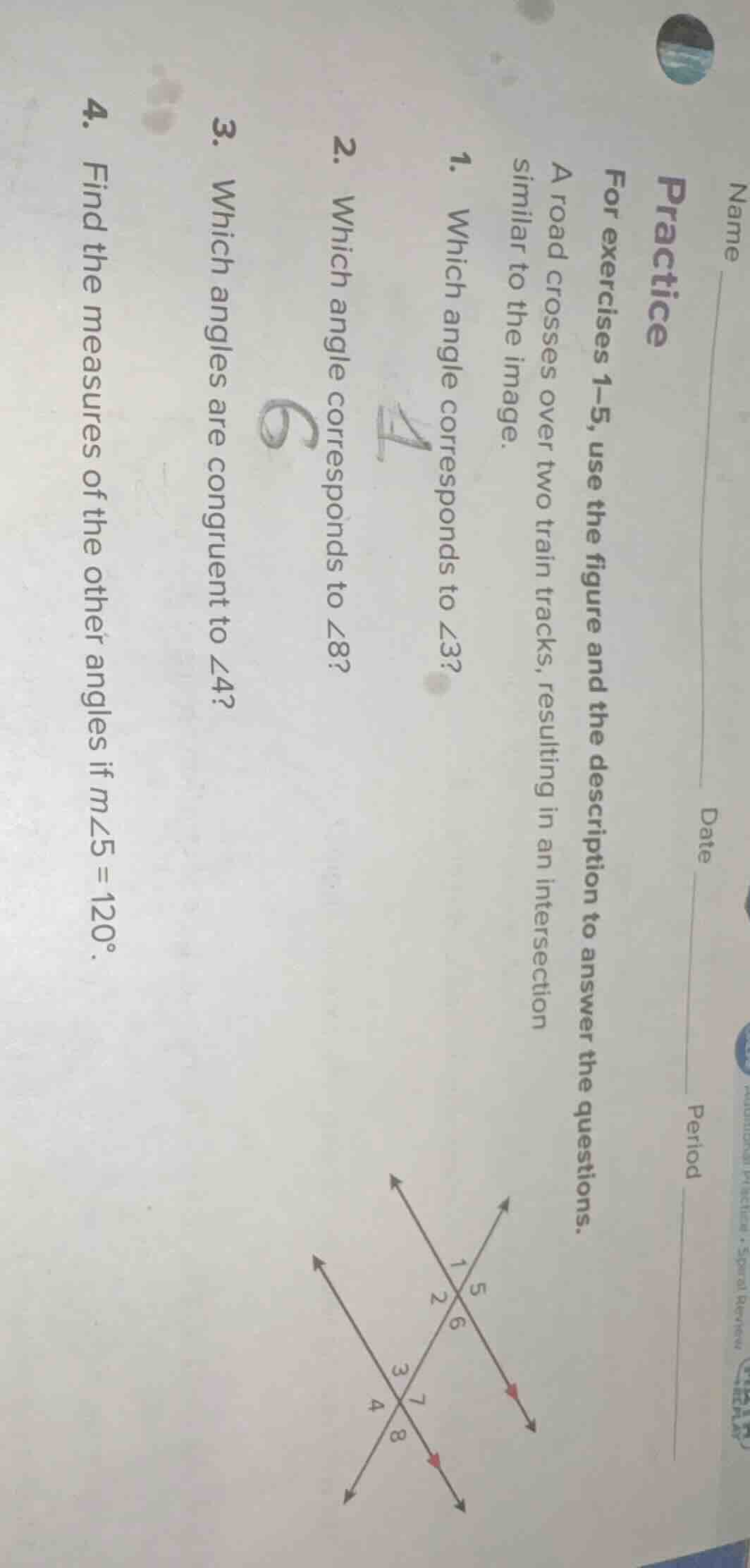
a road crosses over two train tracks, resulting in an intersection similar to the image.
- which angle corresponds to ∠3?
- which angle corresponds to ∠8?
- which angles are congruent to ∠4?
- find the measures of the other angles if m∠5 = 120°.
Question 4
Step1: Identify Vertical Angles
Vertical angles are congruent. So, \( \angle 5 \) and \( \angle 7 \) are vertical angles, so \( m\angle 7 = m\angle 5 = 120^\circ \). Also, \( \angle 1 \) and \( \angle 3 \) are vertical, \( \angle 2 \) and \( \angle 6 \), \( \angle 4 \) and \( \angle 8 \) are vertical.
Step2: Identify Linear Pairs
Linear pairs sum to \( 180^\circ \). For \( \angle 5 \) (120°), its linear pair \( \angle 1 \) and \( \angle 6 \) will be \( 180 - 120 = 60^\circ \). So \( m\angle 1 = m\angle 6 = 60^\circ \).
Similarly, \( \angle 7 \) (120°) has linear pairs \( \angle 3 \) and \( \angle 8 \), so \( m\angle 3 = m\angle 8 = 60^\circ \).
Vertical angles to \( \angle 1 \) (60°) is \( \angle 3 \) (60°), vertical to \( \angle 6 \) (60°) is \( \angle 2 \) (60°). Vertical to \( \angle 5 \) (120°) is \( \angle 7 \) (120°), vertical to \( \angle 7 \) is \( \angle 5 \), and vertical to \( \angle 4 \) (let's check \( \angle 4 \) with \( \angle 8 \)): \( \angle 4 \) and \( \angle 8 \) are vertical, and \( \angle 4 \) is linear pair with \( \angle 3 \) (60°), so \( m\angle 4 = 180 - 60 = 120^\circ \), so \( m\angle 8 = 120^\circ \) as well. Wait, let's re - organize:
- Vertical Angles:
- \( \angle 1 \cong \angle 3 \), \( \angle 2 \cong \angle 6 \), \( \angle 4 \cong \angle 8 \), \( \angle 5 \cong \angle 7 \)
- Linear Pairs (supplementary, sum to \( 180^\circ \)):
- \( \angle 1 + \angle 5 = 180^\circ \), \( \angle 1 + \angle 2 = 180^\circ \)
- Given \( m\angle 5 = 120^\circ \), then \( m\angle 1 = 180 - 120 = 60^\circ \), so \( m\angle 3 = m\angle 1 = 60^\circ \) (vertical angles)
- \( m\angle 2 = 180 - m\angle 1 = 180 - 60 = 120^\circ \)? Wait no, \( \angle 5 \) and \( \angle 2 \): are they related? Wait the two lines are parallel? Wait the problem says "a road crosses over two train tracks" so the two train tracks are parallel, and the road is a transversal. Oh! I missed that. So the two horizontal lines (train tracks) are parallel, and the road is a transversal. So we can use parallel line - transversal angle relationships (corresponding angles, alternate interior, etc.)
So let's correct: The two train tracks are parallel, so the two horizontal lines (let's say the lines with angles 1,2,5,6 and 3,4,7,8) are parallel. The road is a transversal.
So:
- Corresponding Angles: \( \angle 1 \cong \angle 3 \), \( \angle 2 \cong \angle 4 \), \( \angle 5 \cong \angle 7 \), \( \angle 6 \cong \angle 8 \)
- Alternate Interior Angles: \( \angle 2 \cong \angle 7 \), \( \angle 3 \cong \angle 6 \) (wait no, let's label the lines properly. Let line \( l_1 \) be the top line (with \( \angle 1, \angle 2, \angle 5, \angle 6 \)) and line \( l_2 \) be the bottom line (with \( \angle 3, \angle 4, \angle 7, \angle 8 \)), and transversal \( t_1 \) (the road) and transversal \( t_2 \) (the other line). Wait, actually, there are two transversals? No, the diagram has two intersecting lines (the road and another line) crossing two parallel lines (train tracks).
Wait, given \( m\angle 5 = 120^\circ \):
- \( \angle 5 \) and \( \angle 1 \): linear pair, so \( m\angle 1 = 180 - 120 = 60^\circ \)
- \( \angle 5 \) and \( \angle 2 \): vertical? No, \( \angle 5 \) and \( \angle 2 \): adjacent? Wait the intersection of the two transversals: at the top intersection, angles are 1 (top), 5 (right), 2 (bottom), 6 (left). At the bottom intersection, angles are 3 (top), 7 (right), 4 (bottom), 8 (left).
Since the train tracks are parallel, \( \angle 5 \) and \( \angle 7 \) are corresponding angles, so \( m\angle 7 = 120^\circ \)
\( \angle 1 \) and \( \angle 3…

Snap & solve any problem in the app
Get step-by-step solutions on Sovi AI
Photo-based solutions with guided steps
Explore more problems and detailed explanations
\( m\angle 1 = 60^\circ \), \( m\angle 2 = 120^\circ \), \( m\angle 3 = 60^\circ \), \( m\angle 4 = 120^\circ \), \( m\angle 6 = 60^\circ \), \( m\angle 7 = 120^\circ \), \( m\angle 8 = 60^\circ \)