QUESTION IMAGE
Question
name
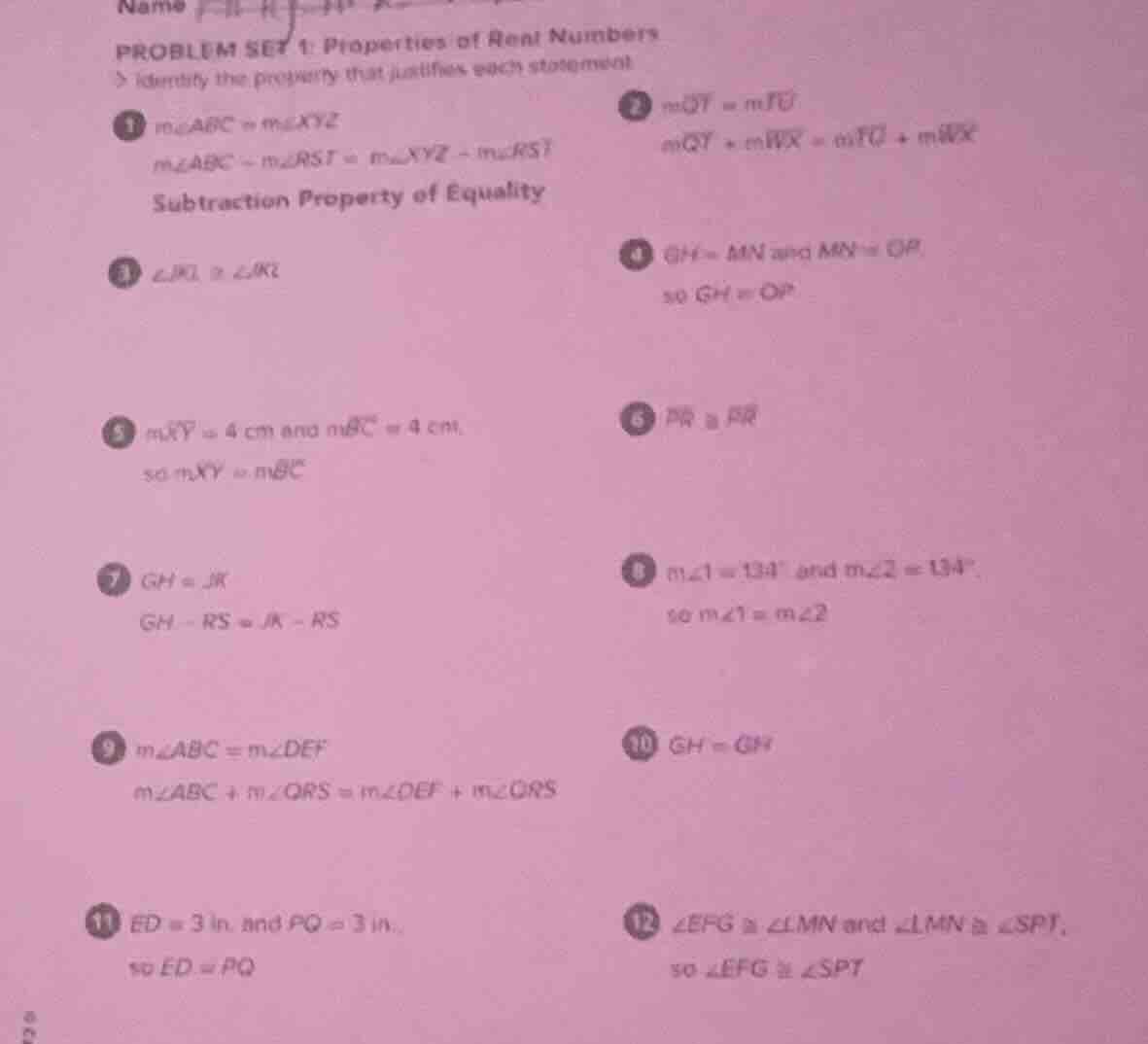
problem set 1: properties of real numbers
identify the property that justifies each statement
- ( mangle abc = mangle xyz )
( mangle abc - mangle rst = mangle xyz - mangle rst )
subtraction property of equality
- ( mqt = mfu )
( mqt + mwx = mfu + mwx )
- ( angle jkl cong angle jkl )
- ( gh = mn ) and ( mn = op )
so ( gh = op )
- ( mxy = 4 , \text{cm} ) and ( mbc = 4 , \text{cm} )
so ( mxy = mbc )
- ( pr cong pr )
- ( gh = jk )
( gh - rs = jk - rs )
- ( mangle 1 = 134^circ ) and ( mangle 2 = 134^circ )
so ( mangle 1 = mangle 2 )
- ( mangle abc = mangle def )
( mangle abc + mangle qrs = mangle def + mangle qrs )
- ( gh = gh )
- ( ed = 3 , \text{in} ) and ( pq = 3 , \text{in} )
so ( ed = pq )
- ( angle efg cong angle lmn ) and ( angle lmn cong angle spt ),
so ( angle efg cong angle spt )
Let's solve each problem by identifying the property of real numbers (or equality/congruence) that justifies each statement:
Problem 3: $\angle JKL \cong \angle JKL$
Step 1: Recall the property.
A geometric figure is congruent to itself. This is the Reflexive Property of Congruence (for angles, in this case). The Reflexive Property states that any quantity (angle, segment, etc.) is congruent (or equal) to itself.
Step 1: Recall the property.
If one quantity is congruent to a second, and the second is congruent to a third, then the first is congruent to the third. This is the Transitive Property of Congruence (for segments, in this case). The Transitive Property for congruence (or equality) states that if \( a \cong b \) and \( b \cong c \), then \( a \cong c \).
Step 1: Recall the property.
If two quantities are equal to the same quantity, then they are equal to each other. This is the Transitive Property of Equality (or we can also think of it as the Substitution Property, but more accurately, since both equal 4 cm, they equal each other). The Transitive Property of Equality states that if \( a = b \) and \( b = c \), then \( a = c \). Here, \( a = m\overline{XY} \), \( b = 4 \, \text{cm} \), \( c = m\overline{BC} \).

Snap & solve any problem in the app
Get step-by-step solutions on Sovi AI
Photo-based solutions with guided steps
Explore more problems and detailed explanations
Reflexive Property of Congruence