QUESTION IMAGE
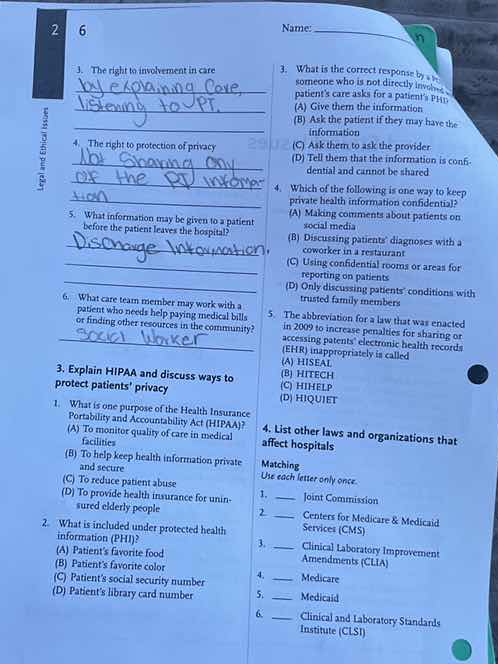
Question
2 6 name
- the right to involvement in care
______________________
- the right to protection of privacy
______________________
- what information may be given to a patient before the patient leaves the hospital?
______________________
- what care team member may work with a patient who needs help paying medical bills or finding other resources in the community?
______________________
- explain hipaa and discuss ways to protect patients’ privacy
- what is one purpose of the health insurance portability and accountability act (hipaa)?
(a) to monitor quality of care in medical
(b) to help keep health information private and secure
(c) to reduce patient abuse
(d) to provide health insurance for un- sured elderly people
- what is included under protected health information (phi)?
(a) patient’s favorite food
(b) patient’s social color
(c) patient’s library card number
(d) patient’s security card number
- what is the correct response by someone who is not involved in a patient’s care when they are asked for information?
(a) give them the information
(b) ask the patient if they may have the information
(c) tell them to ask the provider
(d) ask them if the information is confi- dential and cannot be shared
- which of the following is one way to keep private health information confidential?
(a) making comments about patients on social media
(b) discussing patients’ diagnoses with a coworker in a restaurant
(c) using confidential rooms or areas for talking with patients
(d) sharing patients’ conditions with only family members
- the abbreviation for a law that was enacted in 2009 to increase the security for sharing or accessing patients’ electronic health records (ehr) inappropriately is called
(a) hitech
(b) hitachi
(c) hietch
(d) hiqet
- list other laws and organizations that affect hospitals
matching
use each letter only once.
- ____ joint commission
- ____ centers for medicare & medicaid services (cms)
- ____ clinical laboratory improvement amendments (clia)
- ____ medicare
- ____ medicaid
- ____ clinical and laboratory standards institute (clsi)
Step1: Answer HIPAA purpose question
The Health Insurance Portability and Accountability Act (HIPAA) core goal is safeguarding patient health information. Option (B) matches this.
Step2: Answer PHI identification question
Protected Health Information (PHI) includes identifiers tied to a patient's health. A social security number (Option C) is a direct identifier linked to the patient's health records.
Step3: Answer incorrect PHI response question
A staff member not involved in the patient's care cannot access their PHI. Telling them the info is confidential (Option D) is the correct response, as unauthorized disclosure is prohibited.
Step4: Answer private health info safeguard question
Only discussing patient conditions with trusted family members (Option D) avoids unauthorized disclosure of confidential health information, unlike the other options which risk public/untrained sharing.
Step5: Answer 2009 HIPAA abbreviation question
The Health Information Technology for Economic and Clinical Health (HITECH) Act was enacted in 2009 to enforce HIPAA for electronic records, which is Option (B).
Step6: Match hospital oversight orgs
- Joint Commission: Evaluates and accredits healthcare organizations to ensure quality care.
- Centers for Medicare & Medicaid Services (CMS): Administers Medicare and Medicaid programs.
- Clinical Laboratory Improvement Amendments (CLIA): Regulates clinical lab testing to ensure accuracy.
- Medicare: Federal health insurance for people 65+ and certain disabled individuals.
- Medicaid: Joint federal-state health insurance for low-income individuals.
- Clinical and Laboratory Standards Institute (CLSI): Develops standards for clinical lab practices.
Step7: Answer open HIPAA questions
Question 3 (open):
HIPAA (Health Insurance Portability and Accountability Act) is a U.S. federal law that sets national standards to protect patients' protected health information (PHI) from unauthorized access, use, or disclosure.
Ways to protect privacy:
- Only access PHI when necessary for job duties.
- Secure electronic PHI with strong passwords and encryption.
- Discuss patient information only in private, authorized spaces.
- Obtain written patient consent for any non-required disclosure of PHI.
- Train staff regularly on HIPAA rules and privacy protocols.
Question 3 (right to involvement):
The right to involvement in care means patients have the right to participate in decisions about their treatment. This includes being informed of all treatment options, risks, and benefits, and having their preferences respected.
Question 4 (right to privacy):
The right to protection of privacy ensures patients' personal and health information is kept confidential, shared only with authorized individuals involved in their care, and not disclosed without their consent (except in specific legal cases).
Question 5 (pre-discharge info):
Before a patient leaves the hospital, they may be given:
- Instructions for post-hospital care (medications, wound care, activity limits).
- Follow-up appointment details.
- Information about warning signs to watch for and when to seek emergency care.
- Resources for at-home support (e.g., home health services).
Question 6 (social worker role):
A social worker on the care team helps patients connect with community resources (like financial aid, housing, mental health support) and navigate non-medical barriers to managing their health.

Snap & solve any problem in the app
Get step-by-step solutions on Sovi AI
Photo-based solutions with guided steps
Explore more problems and detailed explanations
Multiple Choice Section
- (B) To help keep health information private and secure
- (C) Patient's social security number
- (D) Tell them that the information is confidential and cannot be shared
- (D) Only discuss patients' conditions with trusted family members
- (B) HITECH
Matching Section
- Joint Commission: Evaluates and accredits healthcare organizations
- Centers for Medicare & Medicaid Services (CMS): Administers Medicare and Medicaid
- Clinical Laboratory Improvement Amendments (CLIA): Regulates clinical lab testing accuracy
- Medicare: Federal health insurance for 65+ and disabled
- Medicaid: Joint federal-state low-income health insurance
- Clinical and Laboratory Standards Institute (CLSI): Develops clinical lab practice standards
Open Response Section
- HIPAA is a U.S. federal law that establishes national standards to protect patients' protected health information (PHI) from unauthorized access, use, or disclosure.
Ways to protect privacy:
- Only access PHI when required for job responsibilities
- Use encryption and strong passwords for electronic PHI
- Discuss patient information only in private, authorized areas
- Obtain written patient consent for non-essential PHI disclosure
- Complete regular HIPAA privacy training for all staff
Right to involvement in care:
Patients have the right to participate in all decisions about their treatment, including being informed of all options, risks, and benefits, and having their personal preferences honored.
Right to protection of privacy:
Patients' personal and health-related information must be kept confidential, shared only with authorized care team members, and not disclosed without the patient's explicit consent (except in legally mandated situations).
Pre-discharge patient information:
- Post-care instructions (medications, wound care, activity restrictions)
- Follow-up appointment dates and locations
- Warning signs of complications and when to seek emergency care
- Information about at-home support resources (e.g., home health services)
Care team social worker role:
A social worker helps patients access community resources (financial aid, housing, mental health support) and addresses non-medical barriers to managing their health and following treatment plans.