QUESTION IMAGE
Question
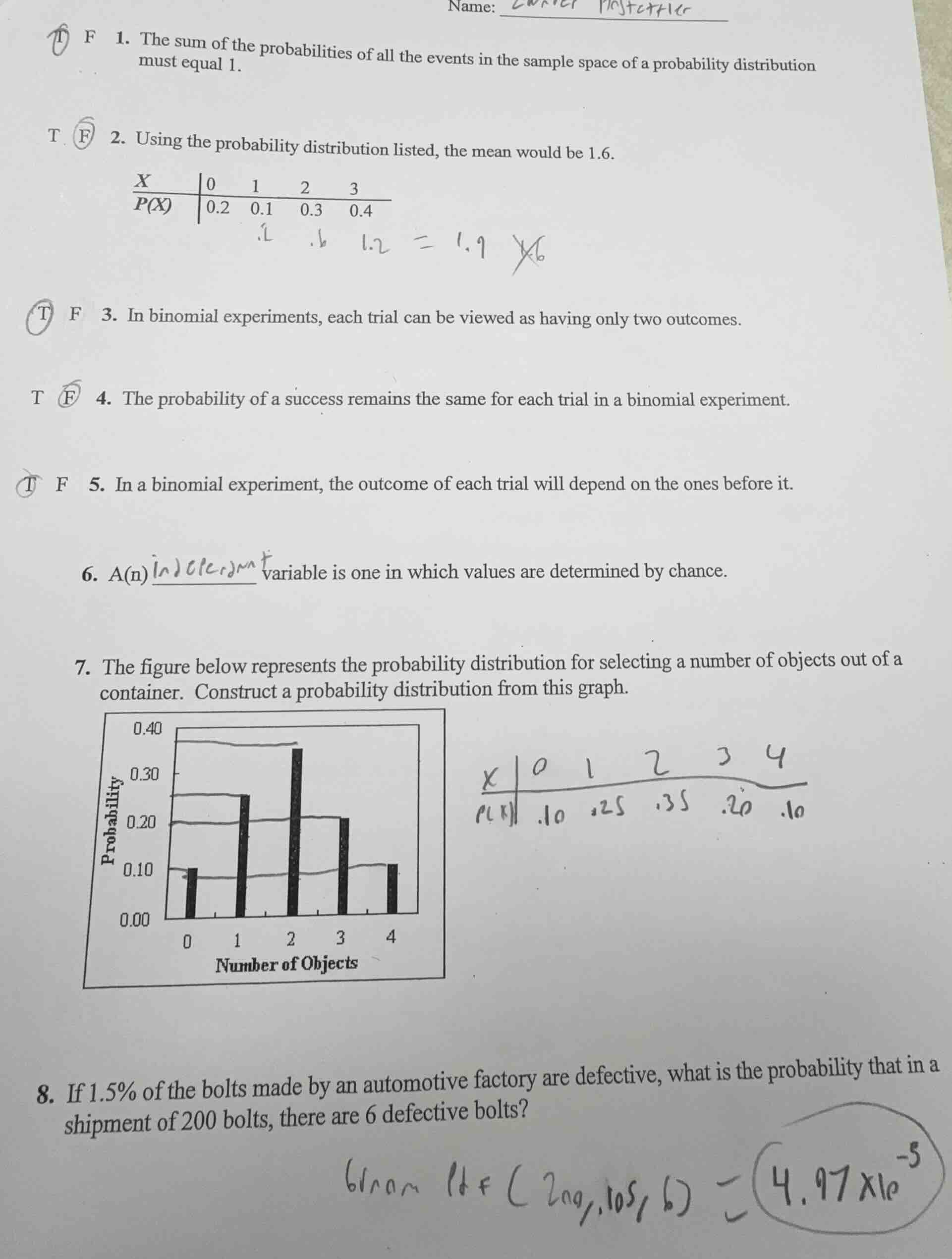
name: 1. the sum of the probabilities of all the events in the sample space of a probability distribution must equal 1.t f2. using the probability distribution listed, the mean would be 1.6.| $x$ | 0 | 1 | 2 | 3 || --- | --- | --- | --- | --- || $p(x)$ | 0.2 | 0.1 | 0.3 | 0.4 |t f3. in binomial experiments, each trial can be viewed as having only two outcomes.t f4. the probability of a success remains the same for each trial in a binomial experiment.t f5. in a binomial experiment, the outcome of each trial will depend on the ones before it.6. a(n) _______ variable is one in which values are determined by chance.7. the figure below represents the probability distribution for selecting a number of objects out of a container. construct a probability distribution from this graph.8. if 1.5% of the bolts made by an automotive factory are defective, what is the probability that in a shipment of 200 bolts, there are 6 defective bolts?
Step1: Evaluate True/False 1
This is a core rule of probability distributions: the sum of all probabilities in the sample space must equal 1. So this is True.
Step2: Calculate mean for Q2
The formula for the mean $\mu$ of a discrete probability distribution is $\mu = \sum [X \cdot P(X)]$.
$\mu = (0 \cdot 0.2) + (1 \cdot 0.1) + (2 \cdot 0.3) + (3 \cdot 0.4) = 0 + 0.1 + 0.6 + 1.2 = 1.9$. The stated mean 1.6 is wrong, so this is False.
Step3: Evaluate True/False 3
Binomial experiments have exactly two mutually exclusive outcomes (success/failure) per trial. So this is True.
Step4: Evaluate True/False 4
A key property of binomial experiments is that the probability of success $p$ is constant for every trial. So this is True (the marked F is incorrect).
Step5: Evaluate True/False 5
Binomial experiment trials are independent, meaning outcomes do not depend on prior trials. So this is False (the marked T is incorrect).
Step6: Fill in Q6 blank
A variable whose values are determined by chance is a random variable.
Step7: Verify Q7 distribution
From the histogram, match each $X$ (number of objects) to its probability:
$X=0$: $P(X)=0.10$, $X=1$: $P(X)=0.25$, $X=2$: $P(X)=0.35$, $X=3$: $P(X)=0.20$, $X=4$: $P(X)=0.10$.
Check sum: $0.10+0.25+0.35+0.20+0.10=1$, which is valid.
Step8: Calculate binomial probability for Q8
Use the binomial probability formula:
$$P(X=k) = \binom{n}{k} p^k (1-p)^{n-k}$$
Where $n=200$, $k=6$, $p=0.015$.
First, $\binom{200}{6} = \frac{200!}{6!(200-6)!} = 82406014700$
$p^k = (0.015)^6 = 1.1390625 \times 10^{-11}$
$(1-p)^{n-k} = (0.985)^{194} \approx 0.0523$
Multiply together: $82406014700 \times 1.1390625 \times 10^{-11} \times 0.0523 \approx 4.97 \times 10^{-5}$

Snap & solve any problem in the app
Get step-by-step solutions on Sovi AI
Photo-based solutions with guided steps
Explore more problems and detailed explanations
- T
- F (calculated mean is 1.9)
- T
- T
- F
- random
7.
| $X$ | 0 | 1 | 2 | 3 | 4 |
|---|
- $\boldsymbol{4.97 \times 10^{-5}}$