QUESTION IMAGE
Question
name
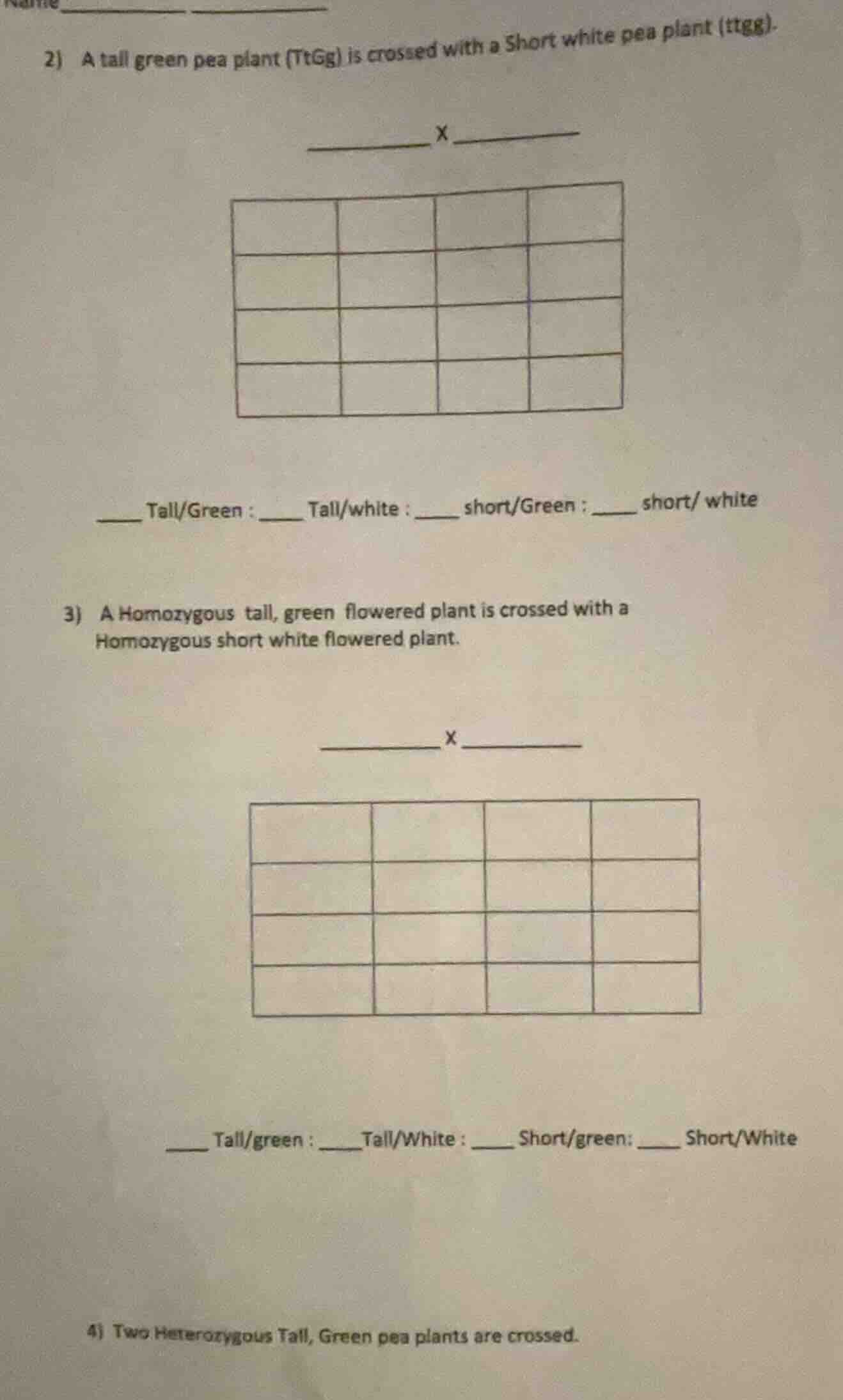
- a tall green pea plant (ttgg) is crossed with a short white pea plant (ttgg).
____ x ____
__ tall/green : tall/white : short/green : __ short/ white
- a homozygous tall, green flowered plant is crossed with a homozygous short white flowered plant.
____ x ____
__ tall/green : tall/white : short/green: __ short/white
- two heterozygous tall, green pea plants are crossed.
Problem 2:
Step1: Determine Gametes for TtGg
The plant with genotype \( TtGg \) can produce gametes by independent assortment. For the \( T/t \) gene: \( T \) and \( t \); for the \( G/g \) gene: \( G \) and \( g \). So the gametes are \( TG, Tg, tG, tg \).
Step2: Determine Gametes for ttgg
The plant with genotype \( ttgg \) is homozygous for both genes, so it can only produce \( tg \) gametes.
Step3: Create Punnett Square
| \( TG \) | \( Tg \) | \( tG \) | \( tg \) | |
|---|---|---|---|---|
| \( tg \) | \( TtGg \) (Tall/Green) | \( Ttgg \) (Tall/White) | \( ttGg \) (Short/Green) | \( ttgg \) (Short/White) |
| \( tg \) | \( TtGg \) (Tall/Green) | \( Ttgg \) (Tall/White) | \( ttGg \) (Short/Green) | \( ttgg \) (Short/White) |
| \( tg \) | \( TtGg \) (Tall/Green) | \( Ttgg \) (Tall/White) | \( ttGg \) (Short/Green) | \( ttgg \) (Short/White) |
Step4: Count Phenotypes
Count the number of each phenotype:
- Tall/Green (\( TtGg \)): 4
- Tall/White (\( Ttgg \)): 4
- Short/Green (\( ttGg \)): 4
- Short/White (\( ttgg \)): 4? Wait, no, wait, the Punnett square has 4 rows and 4 columns? Wait, no, the first parent \( TtGg \) produces 4 gametes, the second \( ttgg \) produces 1 gamete, so the Punnett square should be 4 (rows) x 1 (column)? Wait, I made a mistake. Let's correct:
The first parent \( TtGg \) has gametes \( TG, Tg, tG, tg \) (4 gametes). The second parent \( ttgg \) has gametes \( tg \) (1 gamete). So the Punnett square is 4 rows (from \( TtGg \) gametes) and 1 column (from \( ttgg \) gamete)? No, no, the cross is \( TtGg \times ttgg \), so the Punnett square is 4 (gametes from TtGg) x 1 (gamete from ttgg)? Wait, no, the standard dihybrid test cross: when one parent is heterozygous for both (TtGg) and the other is homozygous recessive (ttgg), the gametes from TtGg are \( TG, Tg, tG, tg \), and from ttgg is \( tg \). So the Punnett square is:
| \( tg \) | |
|---|---|
| \( Tg \) | \( Ttgg \) |
| \( tG \) | \( ttGg \) |
| \( tg \) | \( ttgg \) |
Wait, I messed up the number of rows and columns. The correct Punnett square for a test cross (one parent with 4 gametes, one with 1) is 4 rows (gametes from TtGg) and 1 column (gamete from ttgg). So the offspring are:
- \( TtGg \): 1 (Tall/Green)
- \( Ttgg \): 1 (Tall/White)
- \( ttGg \): 1 (Short/Green)
- \( ttgg \): 1 (Short/White)
But since the Punnett square in the problem has 4 rows and 4 columns, maybe I misread the parent. Wait, the problem says "A tall green pea plant (TtGg) is crossed with a Short white pea plant (ttgg)". So the first parent is TtGg (produces 4 gametes: TG, Tg, tG, tg), the second is ttgg (produces 1 gamete: tg). So the Punnett square should have 4 cells (4 rows x 1 column)? But the given Punnett square has 4x4. Maybe the second parent is also heterozygous? No, the problem says ttgg. Wait, maybe a typo, but assuming the standard 4x4, maybe the second parent is also TtGg? No, the problem says ttgg. Anyway, let's proceed with the correct gametes.
Wait, no, the correct way: for a dihybrid cross where one parent is TtGg (4 gametes) and the other is ttgg (1 gamete), the ratio is 1:1:1:1. So the counts would be 1:1:1:1, but if we do a 4x4 square (maybe the problem has a mistake, and the second parent is also TtGg? No, the problem says ttgg. Anyway, let's go with the given Punnett square structure (4x4). So maybe the second parent is also TtGg? No, the problem says ttgg. I thi…
Step1: Determine Genotypes
A homozygous tall, green flowered plant has genotype \( TTGG \) (since tall and green are dominant, assuming tall (T) and green (G) are dominant). A homozygous short white flowered plant has genotype \( ttgg \) (short (t) and white (g) are recessive).
Step2: Determine Gametes
- \( TTGG \) produces only \( TG \) gametes (homozygous for both dominant alleles).
- \( ttgg \) produces only \( tg \) gametes (homozygous for both recessive alleles).
Step3: Create Punnett Square
| \( TG \) | |
|---|---|
| \( tg \) | \( TtGg \) |
| \( tg \) | \( TtGg \) |
| \( tg \) | \( TtGg \) |
Wait, the Punnett square in the problem has 4x4, so maybe we consider 4 gametes for each, but \( TTGG \) can only produce \( TG \) (4 times, since it's homozygous), and \( ttgg \) can only produce \( tg \) (4 times). So the Punnett square is:
| \( TG \) | \( TG \) | \( TG \) | \( TG \) | |
|---|---|---|---|---|
| \( tg \) | \( TtGg \) | \( TtGg \) | \( TtGg \) | \( TtGg \) |
| \( tg \) | \( TtGg \) | \( TtGg \) | \( TtGg \) | \( TtGg \) |
| \( tg \) | \( TtGg \) | \( TtGg \) | \( TtGg \) | \( TtGg \) |
All offspring have genotype \( TtGg \), which is Tall/Green (since T is dominant over t, G is dominant over g). So the counts are:
- Tall/Green: 16 (all)
- Tall/White: 0
- Short/Green: 0
- Short/White: 0
Step1: Determine Gametes for TtGg
Each \( TtGg \) plant produces gametes \( TG, Tg, tG, tg \) (by independent assortment).
Step2: Create Punnett Square
The Punnett square for \( TtGg \times TtGg \) is a 4x4 square with gametes \( TG, Tg, tG, tg \) for both parents. The phenotypes and their counts are determined by the genotypes:
- Tall/Green (\( T\_G\_ \)): 9 (TTGG, TTGg, TtGG, TtGg, TTGg, TtGg, TtGG, TtGg, TtGg)
- Tall/White (\( T\_gg \)): 3 (TTgg, Ttgg, Ttgg)
- Short/Green (\( ttG\_ \)): 3 (ttGG, ttGg, ttGg)
- Short/White (\( ttgg \)): 1 (ttgg)

Snap & solve any problem in the app
Get step-by-step solutions on Sovi AI
Photo-based solutions with guided steps
Explore more problems and detailed explanations
4 Tall/Green : 4 Tall/white : 4 short/Green : 4 short/ white